
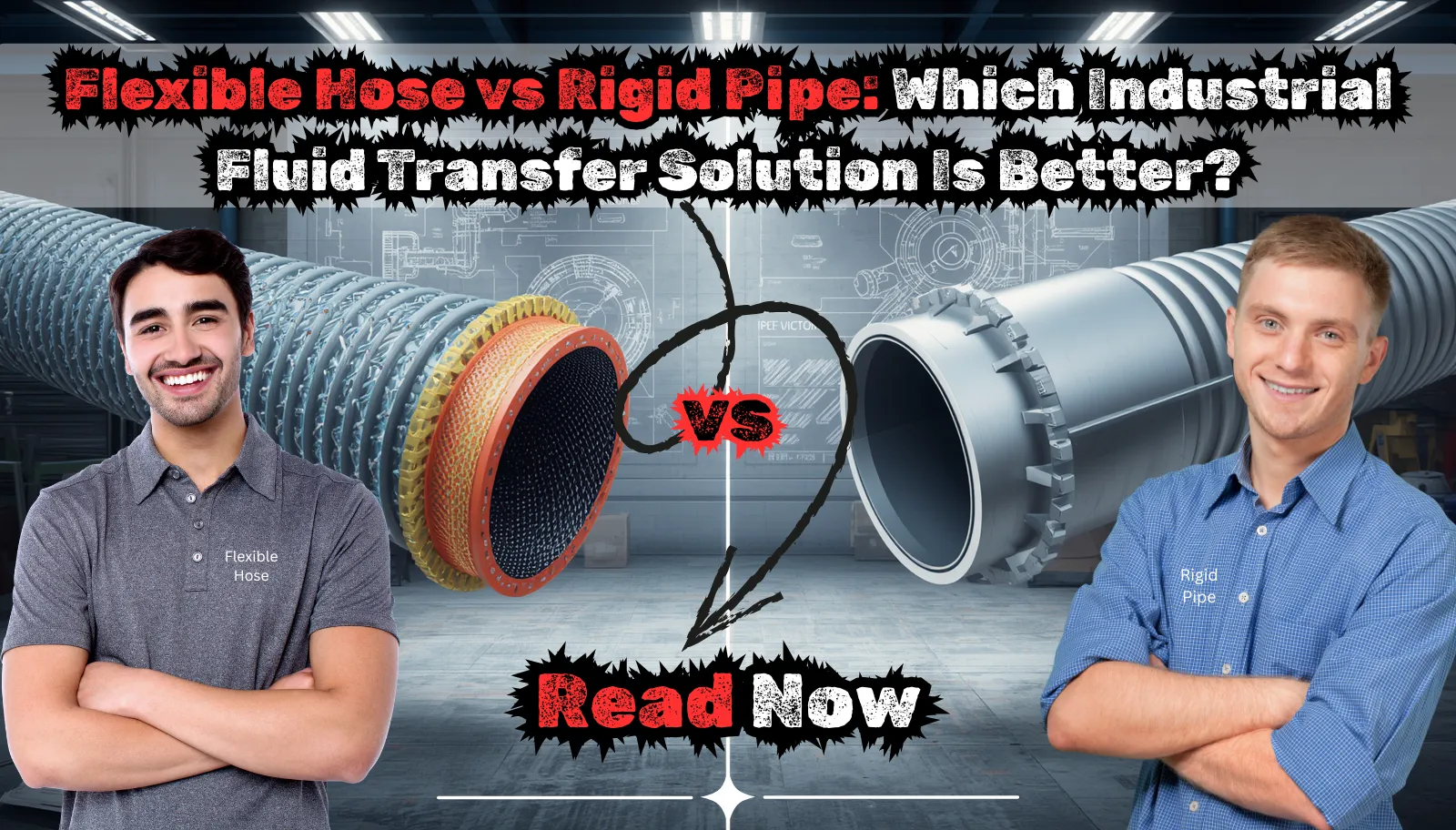
When it comes to industrial fluid transfer, one of the most debated decisions is choosing between a flexible hose vs rigid pipe. On the surface, it sounds simple. But the wrong choice can cost you money, downtime, and in worst cases — safety incidents. Plant managers, maintenance engineers, and procurement teams deal with this question constantly. Should you run a fixed metal pipe through your facility? Or install a flexible hose that can move, bend, and adapt? The answer depends on your specific application — and this guide will help you make the right call. We’ll look at how each option performs across installation, vibration handling, maintenance, pressure, temperature, and total cost of ownership. What Is a Flexible Hose? A flexible hose is a type of conduit designed to carry fluids, gases, or semi-solids while allowing movement, bending, and repositioning. Unlike rigid piping, flexible hoses can absorb vibration, accommodate misalignment, and be routed through tight or complex spaces without the need for multiple joints or elbows. Common types of flexible hoses used in industry include: Rubber Hoses — Made from natural or synthetic rubber, these Rubber Hoses are widely used for water, air, oil, and chemical transfer. They are lightweight, easy to handle, and available in a wide range of pressure ratings. Hydraulic Hoses — Reinforced with steel wire braiding or spiral layers, hydraulic hoses are built for high-pressure fluid transfer in hydraulic systems. They are a staple in construction equipment, presses, and manufacturing lines. Composite Hoses — These use multiple layers of film, fabric, and wire to handle aggressive chemicals, fuels, and solvents. They are common in petrochemical and marine applications. Thermoplastic Hoses — Made from synthetic thermoplastic materials, these hoses offer high pressure resistance combined with flexibility and light weight. They are preferred where rubber may degrade due to chemical exposure. In flexible piping systems, hoses replace rigid piping segments wherever movement, vibration, or periodic disconnection is needed. They are connected using hose fittings, couplings, clamps, or crimp ends depending on the application and pressure requirement. What Is a Rigid Pipe? A rigid pipe is a fixed conduit made from metal or hard plastic, used to carry fluids from one point to another along a permanent, unchanging route. Once installed, rigid pipes do not flex or move. They are cut to length, joined with welding, threading, or flanges, and fixed to structures using supports and brackets. Common materials for rigid industrial piping include: Carbon Steel Pipes — Standard choice for general industrial use, water, steam, and oil. Cost-effective and strong. Stainless Steel Pipes — Used where corrosion resistance is critical — food processing, chemicals, pharmaceuticals, and marine environments. Cast Iron Pipes — Found in older installations for drainage and low-pressure water lines. Copper Pipes — Used in HVAC systems and domestic water supply. PVC/CPVC Pipes — Non-metallic rigid pipes for chemical handling, water treatment, and drainage at lower pressures and temperatures. Rigid piping forms the backbone of most permanent industrial piping systems — main headers, distribution lines, plant-wide fluid networks, and long-distance runs. Flexible Hose vs Rigid Pipe: Quick Comparison Table Parameter Flexible Hose Rigid Pipe Flexibility High — bends and moves freely None — fixed and static Installation Time Fast — minimal fittings needed Slow — requires cutting, welding, threading Vibration Handling Excellent — absorbs vibration naturally Poor — vibration causes stress and cracking Space Adjustment Easy to reroute or reposition Difficult — requires cutting and re-welding Maintenance Easy — quick removal and replacement Labour-intensive — more downtime Durability Good — degrades with UV, heat, and chemicals over time Very high — lasts decades if properly installed Initial Cost Lower Higher — labour + materials Pressure Handling Very high — hydraulic hoses rated up to 700 bar Very high for thick-wall metal pipes Temperature Resistance Moderate to high — depends on material Very high for metal pipes Best Applications Moving equipment, vibration zones, quick connects Long fixed runs, high-temp steam, plant headers Flexible Hose Advantages One of the main reasons industries switch from rigid piping to flexible hoses is the sheer number of practical advantages they offer in real-world conditions. Easy and Fast Installation Hose installation benefits start from day one. Flexible hoses arrive pre-assembled or are assembled on-site with basic tools. They do not need welding, pipe threading machines, or large installation crews. A single technician can often complete a hose connection in minutes. This speed matters during initial construction and, more importantly, during shutdowns. Every hour of downtime costs money. A hose that can be replaced in 15 minutes versus a pipe section that requires hours of work is a significant operational advantage. Superior Vibration Absorption Vibration is one of the leading causes of pipe fatigue and failure in industrial plants. Pumps, compressors, engines, and motors generate constant vibration that travels through rigid pipe joints and welds, gradually weakening the system. Flexible hoses absorb and isolate this vibration naturally. This reduces stress on connected equipment, fittings, and structural supports — extending the overall life of the system. Accommodates Movement and Misalignment Machines move. Thermal expansion causes pipes to grow and contract. Pumps and tanks shift slightly over time. Rigid pipes cannot accommodate this movement without complex expansion loops, bellows, or sliding joints — all of which add cost and potential failure points. Flexible hoses handle angular misalignment, lateral offset, and axial movement without any special provisions. This makes them ideal for connecting rotating equipment, heat exchangers, and any installation where exact alignment is difficult to guarantee. Less Fittings, Elbows, and Joints In complex routing situations, rigid pipe requires multiple elbows, tees, reducers, and flanges to navigate around obstacles. Each fitting is an additional potential leak point and adds to installation time and cost. A single flexible hose can often replace a series of rigid pipe sections and fittings, reducing the total number of joints in the system — and the number of places where things can go wrong. Ideal for Compact and Confined Spaces Flexible hoses bend and route through spaces where rigid pipe
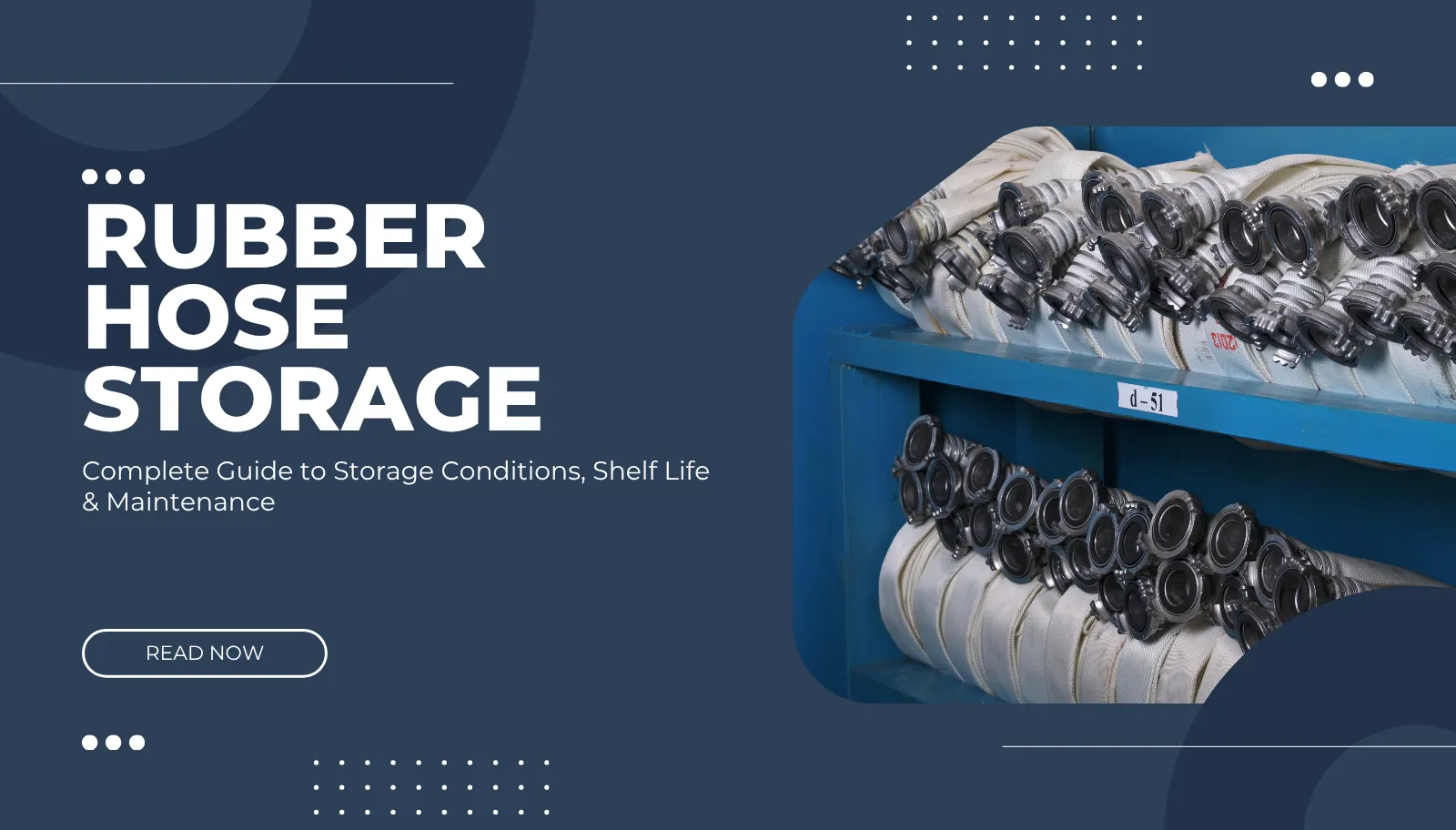
Rubber Hose Storage: Complete Guide to Storage Conditions, Shelf Life & Maintenance
Industrial rubber hoses are workhorses. They carry water, steam, chemicals, air, fuel, and hydraulic fluid across some of the most demanding environments in the world. But even the highest-quality hose will fail prematurely if it is stored incorrectly. Many industrial facilities lose thousands of rupees every year due to preventable hose failures — failures caused not by operational stress, but by poor storage. A hose that sat in direct sunlight for six months, or was stacked under heavy equipment, or stored near an ozone-generating motor, can lose structural integrity before it ever sees a single day of active use. This guide is designed for industrial buyers, warehouse managers, plant managers, maintenance engineers, procurement teams, and factory owners who want to protect their rubber hose investments. It covers everything from rubber hose storage conditions and shelf life to ageing prevention, maintenance during storage, and practical care tips. Whether you manage a small workshop or a large industrial facility, following these hose storage best practices will help you extend service life, reduce safety risks, lower replacement costs, and ensure your hoses perform exactly as expected when you need them most. What Is Rubber Hose Storage and Why Is It Important? Quick Answer Rubber hose storage refers to the controlled process of preserving unused or spare rubber hoses in conditions that prevent physical damage, chemical degradation, and premature ageing. Proper storage directly determines how long a hose lasts and how safely it performs when put into service. Rubber hoses are used across industries including oil and gas, chemicals, pharmaceuticals, agriculture, construction, mining, food processing, and manufacturing. These hoses are manufactured from natural or synthetic rubber compounds — materials that are sensitive to heat, UV radiation, ozone, moisture, and mechanical stress. When a hose is not in active use, it enters a storage phase. How it is stored during this period determines whether it arrives at the point of installation in peak condition or already damaged. Storage is not a passive activity — it is an active part of industrial hose lifecycle management. Why Proper Storage Matters for Industrial Hoses Improper rubber hose storage has real, measurable consequences: Safety Risks: A hose weakened during storage may fail under pressure, causing leaks, bursts, or workplace accidents. Productivity Loss: Unexpected hose failure causes unplanned downtime, halting production lines or critical operations. Higher Maintenance Costs: Replacing hoses that failed due to poor storage means avoidable expenditure on materials and labour. Equipment Damage: A leaking or burst hose can damage connected machinery, valves, and fittings. Regulatory Non-Compliance: In industries handling hazardous materials, a failed hose can trigger environmental incidents and regulatory penalties. Proper storage is not just a logistical detail — it is a safety and financial imperative. Industrial Hose Storage Guidelines Every Facility Should Follow The following guidelines form the foundation of effective industrial hose storage: Clean Before Storage: Remove all residual media from the hose interior. Flush with clean water or an appropriate solvent, then dry completely. Store Indoors: Always store rubber hoses in covered, indoor facilities. Outdoor storage exposes hoses to UV radiation, temperature extremes, and moisture. Protect from UV Light: Ultraviolet radiation from sunlight breaks down rubber polymer chains. Use opaque bags, covers, or packaging to block UV exposure. Ensure Good Ventilation: The storage area must be well-ventilated to prevent moisture buildup, but airflow should not carry chemical fumes or ozone-heavy air. Keep Away from Chemicals: Do not store hoses near solvents, oils, acids, alkalis, or fuels. Chemical vapours can penetrate rubber and cause swelling or degradation. Avoid Mechanical Stress: Do not fold, kink, or crush rubber hoses during storage. Keep them in natural coiled shapes without sharp bends. Handle Carefully: When moving hoses, avoid dragging them on rough surfaces. Use proper handling equipment to prevent abrasion or impact damage. Ideal Rubber Hose Storage Conditions Ideal Rubber Hose Storage Conditions Rubber hoses should be stored indoors at a temperature between 10°C and 25°C, with relative humidity below 70%, away from direct sunlight, ozone sources, and chemical fumes. The storage area should be clean, dry, dark, and well-ventilated. Here are the specific environmental conditions recommended for rubber hose storage: Temperature: Maintain between 10°C and 25°C (50°F to 77°F). Avoid areas near furnaces, boilers, or air conditioning units that blow hot or cold air directly on hoses. Humidity: Keep relative humidity below 70%. High humidity accelerates oxidation and promotes mould or corrosion on metal fittings. Light: Store in a dark environment or use opaque wrapping. Both UV and visible light can initiate photochemical degradation in rubber. Ozone: Keep hoses far from electric motors, generators, welding equipment, and fluorescent lighting — all of which generate ozone. Ozone causes surface cracking in rubber compounds. Dust & Contaminants: Seal hose ends with end caps or plugs to prevent dust, insects, or moisture from entering the bore. Ventilation: Good air circulation prevents condensation, but avoid areas with strong industrial fumes or chemical vapours. How to Store Rubber Hoses Correctly Follow these seven steps to store rubber hoses properly and extend their service life: Inspect Before Storage: Check the hose for cuts, abrasions, blisters, swelling, cracks, or damaged fittings. Do not store hoses that show signs of damage — tag them for evaluation or replacement. Clean the Hose: Flush the interior thoroughly with clean water or an appropriate cleaning agent. Wipe the exterior. Remove any residue of the media it was carrying. Dry Completely: Allow both the interior and exterior to dry completely before storage. Moisture trapped inside the hose or beneath fittings leads to corrosion and rubber degradation. Use compressed air if needed. Coil Without Sharp Bends: Coil hoses in large, natural loops. The coil radius should be at least 8–12 times the hose’s outer diameter. Avoid figure-eight bends, kinking, or folding. Store on Racks or Hangers: Place coiled hoses on purpose-built hose racks, pegs, or hangers. Do not store hoses directly on the floor, concrete surfaces, or under heavy objects. Racks allow air circulation and prevent compression. Label Properly: Attach labels showing the hose type, size, material, date
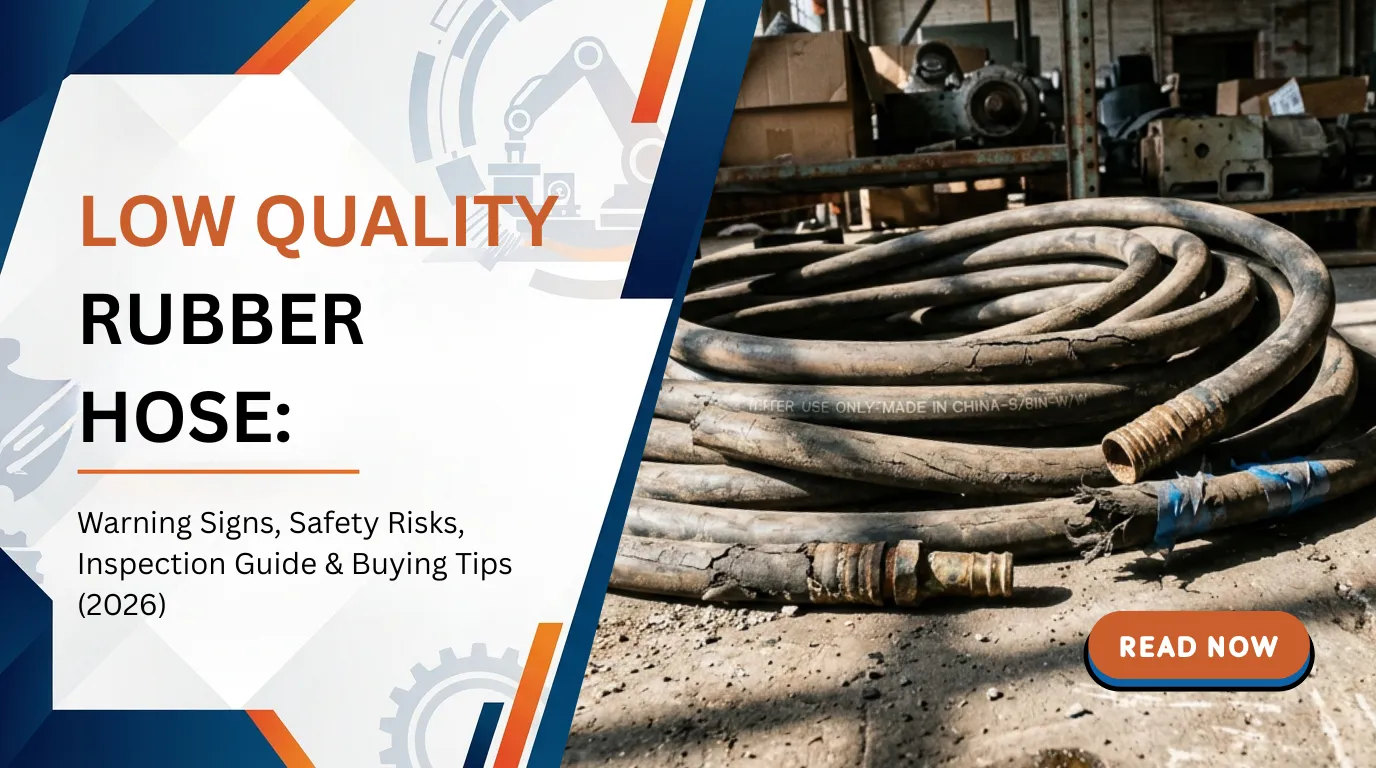
Low Quality Rubber Hose: Warning Signs, Safety Risks, Inspection Guide & Buying Tips (2026)
Industrial hoses are the circulatory system of modern manufacturing. They carry steam, chemicals, hydraulic fluid, compressed air, and countless other media through facilities where failure is simply not an option. Yet every year, plants across India and the world suffer costly downtime, equipment damage, and serious worker injuries — all traceable to a single root cause: low quality rubber hose. The problem is not just about price. A substandard hose can look perfectly acceptable on the shelf. It can carry a recognisable brand name, come wrapped in professional packaging, and sit alongside certified products in a distributor’s warehouse. The difference only becomes visible when the hose is under pressure, temperature, or chemical stress — by which point, replacement costs pale in comparison to the human and operational consequences. This guide is designed for factory owners, plant managers, maintenance engineers, and procurement teams who cannot afford to get hose selection wrong. By the end, you will know exactly how to spot poor quality rubber hose signs, conduct a professional industrial hose quality check, identify rubber hose failure signs before they become emergencies, and buy with confidence from suppliers who stand behind their products. What Is a Low Quality Rubber Hose? A low quality rubber hose is any hose that fails to meet the physical, chemical, or dimensional specifications required for its intended application — either due to inferior raw materials, poor manufacturing processes, inadequate quality control, or outright counterfeiting. Specifically, a substandard hose may suffer from one or more of the following deficiencies: Inferior rubber compound — recycled, adulterated, or incorrectly formulated rubber that degrades rapidly under heat, pressure, or chemical exposure. Weak or missing reinforcement — thin, poorly braided, or missing textile or wire reinforcement layers that cannot sustain rated working pressures. Inconsistent wall thickness — uneven extrusion that creates structural weak points along the hose body. Poor bonding between layers — inadequate vulcanisation or adhesion that causes delamination under flexing or thermal cycling. Non-compliant fittings — end connections that are not crimped to specification, leaving the joint prone to pull-out or leakage. Missing or falsified certifications — products claiming IS, ISO, or application-specific standards they were never tested against. The global industrial hose market is projected to exceed USD 5 billion by 2027, and rapid growth in demand — particularly in emerging markets — has created fertile ground for substandard and counterfeit products. Understanding what separates a genuine, high-performance hose from a dangerous substitute is no longer optional knowledge for serious industrial buyers. Why Hose Quality Matters in Industrial Applications When evaluating hose material quality, most buyers focus on upfront price. This is the wrong calculation. The true cost of a hose includes its expected lifespan, maintenance frequency, and the financial and human risk of failure. Consider these dimensions: Safety. A burst hose carrying steam at 180°C or hydraulic fluid at 350 bar can cause catastrophic injuries. Hose failure is consistently among the top causes of workplace accidents in fluid-handling industries. Productivity. Unplanned hose replacements cause line stoppages. In a continuous-process plant — cement, chemicals, petrochemicals — even one hour of unplanned downtime can cost lakhs of rupees. Equipment lifespan. A leaking hose that contaminates lubricants, hydraulic systems, or process fluids damages downstream equipment. The hose failure is frequently the smallest part of the total repair bill. Regulatory compliance. Many industries — pharmaceuticals, food processing, refineries — operate under strict statutory requirements for hose construction, materials, and testing. A non-compliant hose is not merely a quality risk; it is a legal liability. Environmental impact. Chemical or oil leaks caused by hose failure can trigger environmental compliance violations, remediation costs, and reputational damage that far outweigh any saving on hose procurement. Suppliers like Rubber Hose India LLP, one of India’s established industrial hose manufacturers, consistently emphasise that quality hoses are not a cost centre — they are an investment in operational continuity. 10 Common Poor Quality Rubber Hose Signs Knowing poor quality rubber hose signs is the first line of defence. Train your maintenance teams to recognise these indicators on every hose they handle. Surface Cracking and Crazing Fine cracks on the outer cover — especially when the hose is flexed — indicate rubber degradation from UV exposure, ozone attack, or simply inferior compound formulation. Quality hose covers resist cracking under normal bending. Weak or Sparse Reinforcement Hold the hose up to a strong light. In a well-made hose, you should see a dense, even reinforcement braid or spiral. Thin, gappy, or asymmetric reinforcement is a clear sign of cost-cutting. Uneven Wall Thickness Squeeze the hose firmly along its length. Any section that compresses significantly more easily than adjacent sections has insufficient wall thickness — a structural weak point waiting to fail. Premature Hardening Rubber compounds that harden, lose flexibility, and become brittle within months of service are using inferior or incorrectly cured compound. Quality hoses retain flexibility throughout their rated service life. Soft Spots and Blistering Localised soft areas indicate internal delamination or chemical attack. Blisters on the outer cover signal that trapped gases or fluids are migrating through failing layer bonds. Bulging Under Pressure A hose that visibly swells or distorts during normal operating pressure has inadequate reinforcement. This is a pre-burst warning sign that demands immediate replacement. Poor Fitting Attachment Wiggle the end fittings. Any movement, looseness, or visible gaps between the fitting and hose body indicates improper crimping or incorrect ferrule selection — a common rubber hose defect in low-cost assemblies. Visible Leakage Any seepage, weeping, or spray from the hose body or end connections is unacceptable and constitutes a failure condition. Even minor leaks will escalate. Delamination Peel back a section of damaged outer cover. If the inner layers separate easily or show air pockets between them, the hose has delaminated — a manufacturing defect that makes the hose structurally unreliable. Excessive Abrasion Damage A hose that shows deep abrasion cuts within its first few months of service has an inadequate outer cover compound. Premium hose covers are formulated to resist the specific abrasion
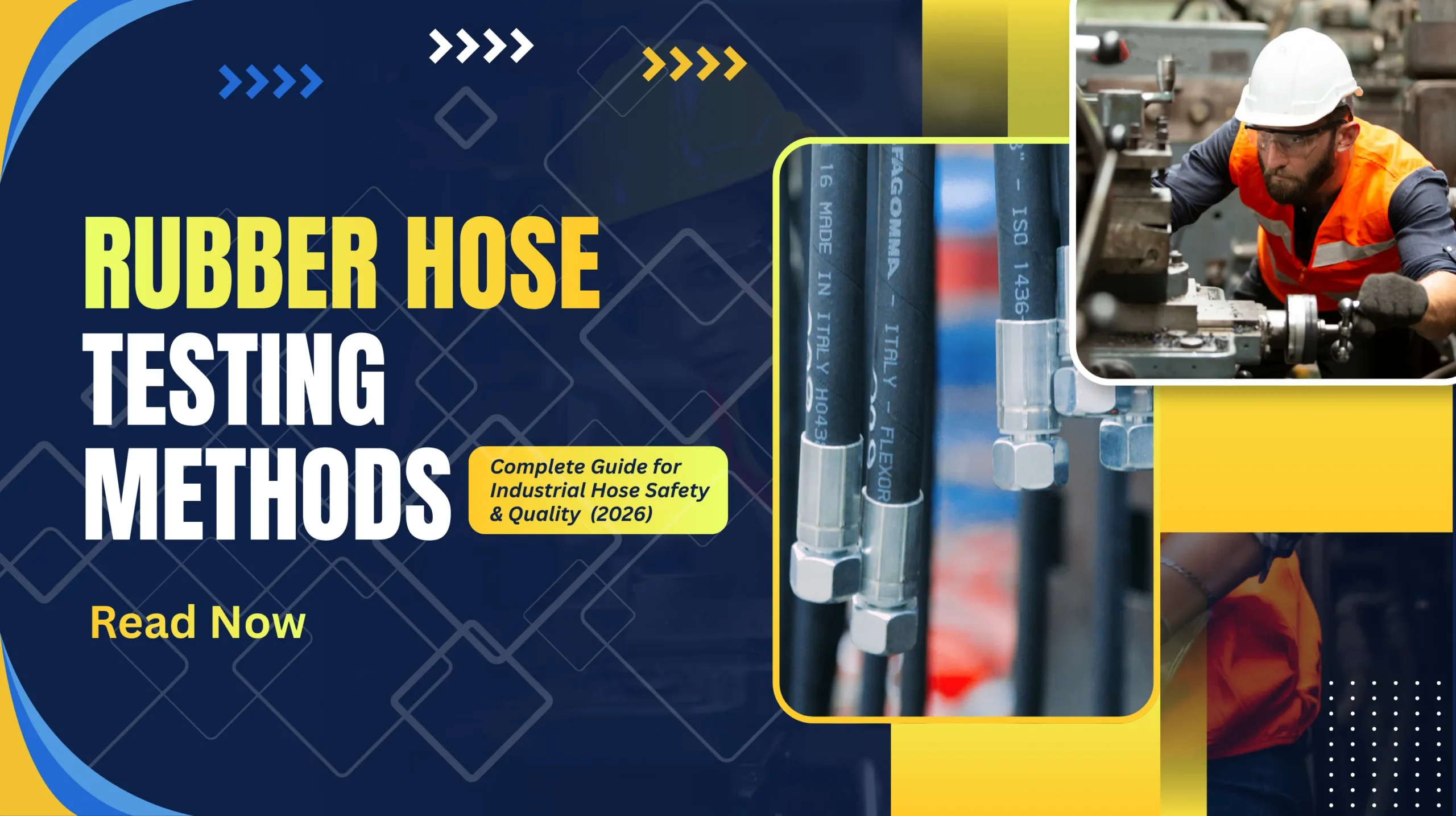
Rubber Hose Testing Methods: Complete Guide for Industrial Hose Safety & Quality (2026)
What Are Rubber Hose Testing Methods? Rubber hose testing methods are a set of standardized procedures used to evaluate the safety, quality, durability, and performance of industrial rubber hoses. These tests include pressure testing, burst pressure testing, leakage testing, dimensional checks, and durability assessments. The goal is to ensure that every hose meets industry standards before it is deployed in critical industrial applications. Whether you are a factory owner, procurement manager, or maintenance engineer, understanding rubber hose testing is not optional — it is essential for workplace safety and operational efficiency. What Is Rubber Hose Testing? Rubber hose testing is the systematic evaluation of a hose’s ability to handle pressure, resist leakage, and perform safely under real-world operating conditions. It covers both the internal material quality and external mechanical performance of the hose. Think of it this way: a rubber hose used in a chemical plant carries corrosive fluids at high pressures. If that hose fails — even once — it can cause injury, production downtime, and enormous financial losses. Rubber hose testing is the safety net that prevents such failures before they happen. Industrial hose testing is conducted at multiple stages: During manufacturing (in-process quality control) Before shipment (final quality assurance) On-site before installation (incoming inspection) During scheduled maintenance (periodic field testing) Each stage catches different types of defects and ensures that only reliable hoses reach your facility. Why Industrial Hose Testing Is Important Many industrial accidents are caused by hose failures — sudden bursts, slow leaks, or structural collapses under vacuum. These are not random events. They are preventable with proper industrial hose testing. Here is why hose testing matters: Worker Safety: A bursting hose carrying steam, chemicals, or high-pressure hydraulic fluid can cause severe injuries. Regular testing prevents catastrophic failure. Regulatory Compliance: Industries like oil & gas, pharmaceuticals, food processing, and chemicals are governed by strict safety standards. Tested hoses help you remain compliant. Reduced Downtime: An untested hose that fails mid-operation can halt an entire production line. Tested hoses are more reliable and reduce unplanned shutdowns. Cost Savings: Replacing a failed hose after an accident is far more expensive than testing it beforehand. Preventive testing is always the smarter investment. Product Quality Protection: In food, beverage, and pharmaceutical sectors, hose failures can contaminate the product — leading to recalls and liability. Simply put, rubber hose quality testing is not just a technical requirement — it is a business necessity. Common Rubber Hose Testing Methods There are several widely used rubber hose testing methods, each designed to assess a specific performance parameter. Here is a quick overview: Testing Method What It Measures Hydrostatic Pressure Test Hose ability to withstand internal pressure Burst Pressure Test Maximum pressure before hose failure Leakage Test Seal integrity and joint connections Vacuum Test Hose resistance to collapse under suction Bend Radius Test Flexibility without kinking Dimensional Check Wall thickness, bore diameter, length Adhesion Test Bond strength between hose layers Impulse Test Repeated pressure cycling endurance Heat Aging Test Performance after thermal exposure Chemical Resistance Test Compatibility with specific fluids Each of these plays a distinct role. Together, they form a comprehensive rubber hose testing procedure that covers all possible failure modes. Rubber Hose Pressure Test Process The rubber hose pressure test is the most fundamental and widely used test in industrial hose inspection. It verifies that a hose can safely handle its rated working pressure without deformation, leakage, or failure. How It Is Done Step 1 — Prepare the Hose Seal both ends of the hose using test plugs or end caps. Make sure no air is trapped inside — air is compressible and poses an explosion risk during pressure testing. Step 2 — Fill with Test Fluid Fill the hose completely with water or another non-compressible fluid. Purge all air bubbles carefully. Step 3 — Apply Pressure Gradually Using a hydraulic pump or pressure testing unit, slowly increase the internal pressure to the specified test pressure — typically 1.5× to 2× the working pressure, depending on the standard applied. Step 4 — Hold the Pressure Maintain the test pressure for a specified duration — usually 1 to 5 minutes. Watch for any drop in gauge pressure, which indicates a leak. Step 5 — Inspect the Hose After the hold period, visually inspect the hose for bulges, leaks, sweating, or deformation. Any anomaly is a failure. Step 6 — Document the Results Record the pressure applied, duration, and inspection findings. This documentation is critical for traceability and compliance. The rubber hose pressure test is non-destructive when done correctly, allowing the tested hose to be placed into service afterward. Hose Burst Pressure Test Explanation The hose burst pressure test is a destructive test — meaning the hose is intentionally pressurized until it fails. This test determines the maximum pressure a hose can withstand before catastrophic rupture. Why It Matters The burst pressure rating is typically 4× the maximum working pressure. This “safety factor” provides a large margin for pressure spikes, aging, and unexpected conditions. If a hose fails at a burst pressure lower than expected, it indicates a manufacturing defect or material degradation. How the Burst Test Works The hose is fitted with sealed end caps and filled with water. Pressure is increased slowly and continuously. The exact pressure at which the hose ruptures is recorded. This value is compared against the manufacturer’s rated burst pressure. A hose that bursts below its rated burst pressure fails the test and cannot be used. The burst pressure data is also used to set safe working pressure limits for an entire production batch. Hose Leakage Test and Safety Checks The hose leakage test focuses on detecting any loss of fluid or gas through the hose body, fittings, or connections. Even a small leak can cause safety hazards, environmental contamination, or system pressure loss. Types of Leakage Tests Hydrostatic Leakage Test: The hose is pressurized with water and inspected for external seepage. This is the most common approach. Pneumatic Leakage Test: The hose is pressurized with
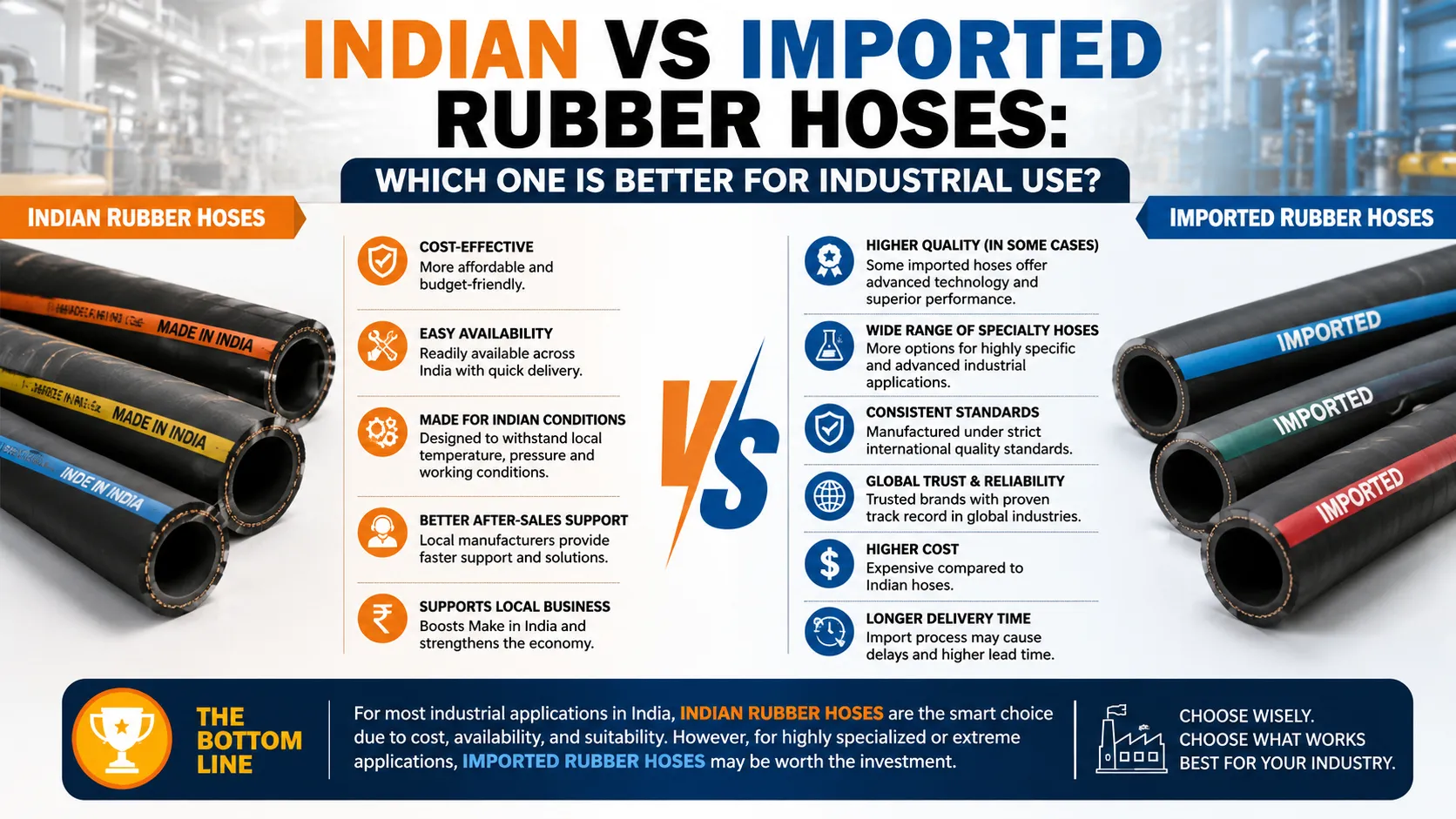
Indian vs Imported Rubber Hoses: Which One Is Better for Industrial Use?
When procurement teams, factory managers, and maintenance engineers sit down to choose rubber hoses for their operations, one question comes up almost every time: should we go with Indian rubber hoses or imported ones? It is not a simple answer. The decision involves cost, quality, lead time, standards compliance, after-sales support, and how well the hose holds up in real working conditions. Whether you are running a hydraulic system, managing a chemical plant, or maintaining heavy construction machinery, choosing the wrong rubber hose can lead to failures, downtime, and serious safety risks. This guide provides a detailed, practical comparison of Indian vs imported rubber hoses to help you make an informed decision for your specific industrial application. What Are Rubber Hoses Used For in Industries? Rubber hoses are a critical component across nearly every major industry. Their flexibility, pressure-handling capacity, and compatibility with different fluids make them irreplaceable in: Hydraulic systems in machinery, presses, and heavy equipment Oil and gas transfer including fuel lines, suction hoses, and discharge lines Chemical handling where specific inner tube materials resist corrosive fluids Water and slurry transfer in construction, mining, and agriculture Compressed air lines in factories, workshops, and pneumatic tools Steam and hot fluid transfer in refineries and food processing units Agricultural irrigation and pesticide spraying systems OEM assemblies in automotive, defence, and industrial manufacturing Given such wide application, the quality and specifications of a rubber hose directly affect system efficiency, safety, and operational life. Indian vs Imported Rubber Hoses: Quick Overview Indian rubber hoses are manufactured domestically by companies based across major industrial hubs like Mumbai, Pune, Ahmedabad, Chennai, and Hyderabad. These manufacturers use locally sourced and imported raw materials and produce hoses to both Indian Standards (IS) and international standards (ISO, SAE, EN). Imported industrial hoses typically originate from countries like China, Germany, the United States, South Korea, Italy, and Japan. They are procured either directly from the manufacturer or through Indian importers and distributors. The core difference is not just geography — it is about production standards, pricing structures, supply chain flexibility, customization capabilities, and suitability for Indian operating environments. Rubber Hose Quality Comparison: Indian vs Imported This is where buyers often have the most questions. Let us break down the rubber hose quality comparison across key performance parameters: Material Quality Top-tier Indian rubber hose manufacturers now use premium-grade synthetic rubbers including EPDM, NBR, SBR, Neoprene, and Hypalon — the same base materials used in high-end imported hoses. Material quality depends on the manufacturer, not just the country of origin. Reinforcement Both Indian and imported hoses use textile braiding, wire braiding, and spiral wire reinforcement. European and American brands often have tighter reinforcement tolerances, which can matter in ultra-high-pressure applications. However, leading Indian manufacturers have closed this gap significantly. Pressure Rating Imported hoses from premium brands may offer more consistent pressure ratings across batches. Indian manufacturers producing to SAE or EN standards are highly competitive in the standard working pressure range (up to 400 bar), which covers the vast majority of industrial needs. Flexibility and Bend Radius Both origins can produce flexible hoses with appropriate minimum bend radii. Flexibility is more a function of hose design and compound selection than country of manufacture. Abrasion and Temperature Resistance Imported hoses from specialized manufacturers sometimes offer superior abrasion-resistant outer covers or extreme-temperature formulations. Indian manufacturers offer competitive options for standard temperature ranges (-40°C to +150°C) common in Indian industrial environments. Chemical Compatibility Specialized chemical hoses for aggressive media — concentrated acids, chlorinated solvents, specialty gases — are an area where certain imported brands have long-established formulations. Indian manufacturers offer excellent chemical hoses for common industrial applications, with options for specialized requirements growing rapidly. Service Life Service life depends on proper hose selection, installation, and Hose Maintenance — not just the brand or origin. An incorrectly selected imported hose will fail faster than a correctly specified Indian hose. Imported Rubber Hose vs Indian Rubber Hose: Major Differences Here is a structured breakdown of the major differences between imported rubber hose vs Indian options: Parameter Indian Rubber Hoses Imported Rubber Hoses Manufacturing Standards IS, ISO, SAE, EN compliant ISO, SAE, EN, DIN compliant Customization High — made to order Limited or high MOQ Price Significantly lower Higher due to duties and shipping Delivery Time 2–7 days typically 4–12 weeks or more After-Sales Support Strong local support Limited in India Spare Availability Readily available Dependent on stock and imports MOQ Requirements Flexible, low MOQ Often high MOQ Suitability for Indian Conditions Designed/tested locally Not always optimized Manufacturing Standards Both Indian and imported hoses can meet the same international standards. What matters is whether the specific manufacturer you are buying from actually tests and certifies to those standards — not just claims to. Customization Options Indian rubber hose manufacturers offer a strong advantage in customization: special lengths, specific end fittings, non-standard inner diameters, and application-specific compounds can be produced quickly without large minimum order quantities. Imported hoses typically come in fixed catalogue sizes, and custom orders involve long lead times and high MOQs. Price Difference This is significant. Indian-made hoses are generally 30–60% less expensive than imported equivalents before accounting for shipping, import duties (which can add 15–25% to CIF value), port handling, and inland freight. For large-volume procurement, this difference is substantial. Delivery Time A local Indian supplier can deliver within days. Imported hoses involve ocean freight (4–8 weeks), customs clearance, and last-mile logistics. For maintenance situations or urgent replacements, imported hoses create operational risk. After-Sales Support When something goes wrong — wrong size, batch issue, fitting problem — local support is invaluable. Indian suppliers can respond quickly with replacements, technical advice, and on-site support where needed. Imported brands typically have limited or no direct support infrastructure in India. Why Indian Rubber Hose Manufacturers Are Becoming a Strong Choice Rubber hose manufacturing in India has matured significantly over the past decade. Here is what is driving the change: Technology upgrades: Indian manufacturers have invested in modern extrusion lines, wire braiding machines, and vulcanization systems

Industrial Hose Safety Guidelines: Complete Guide for Safe Hose Handling, Installation & Inspection
Industrial hoses are critical components in almost every manufacturing, processing, and heavy-duty industrial environment. They are used daily for transferring air, water, steam, chemicals, oil, fuel, slurry, food-grade materials, hydraulic fluids, and many other media — often under high pressure and in demanding conditions. Following proper industrial hose safety guidelines is not optional. It is a practical necessity that protects workers, equipment, and the business itself. Factory hose safety begins with selecting the right hose and continues through correct installation, routine inspection, safe handling, and timely replacement. When hose safety is ignored, the consequences can be serious. Poor hose selection, wrong installation, overpressure, improper handling, lack of inspection, or using a damaged hose can lead to leakage, hose burst, chemical exposure, fire hazards, equipment damage, production downtime, and worker injuries. This complete guide covers industrial hose safety tips, pressure safety, installation best practices, inspection checklists, maintenance guidance, and factory safety compliance requirements for all types of industrial rubber hose applications. What Are Industrial Hose Safety Guidelines? Industrial hose safety guidelines are practical rules and best practices for selecting, installing, handling, inspecting, storing, and maintaining hoses used in industrial applications. These guidelines help prevent hose leakage, burst, pressure accidents, chemical exposure, equipment failure, and workplace injuries. In simple terms, these guidelines define how an industrial hose should be chosen for the right job, how it should be connected and routed, how it should be used safely under pressure, and when it should be replaced before it becomes a hazard. Industrial safety guidelines for hoses cover the entire hose life cycle — from the moment you select a hose for a specific application to the moment you retire it from service. Industrial hose best practices are built on years of practical experience and are designed to maximise hose performance while minimising the risk of accidents. Rubber hose safety standards may vary based on hose type, application, pressure rating, temperature range, and local safety regulations. Always refer to the hose manufacturer’s technical data and relevant industry standards for your specific use case. Why Factory Hose Safety Is Important Factory environments involve constant movement of pressurised fluids, hot steam, corrosive chemicals, flammable fuels, abrasive slurries, and compressed air. Industrial hoses carry these media between machines, tanks, pumps, and systems — and a single point of failure can trigger a chain of consequences. Factory hose safety matters for these key reasons: Industrial hoses carry pressurised fluids, chemicals, steam, oil, fuel, slurry, and abrasive material that can cause serious harm if released unexpectedly. A small mistake — a loose fitting, an unsupported bend, or an expired hose — can escalate into a major safety incident. Hose failure can halt production immediately, causing costly downtime. Leakage can damage machines, floors, surrounding equipment, and finished products. A burst hose under pressure can injure or kill workers nearby. Chemical leakage creates burn risks, inhalation hazards, and environmental compliance issues. Proper hose safety extends service life and reduces replacement and maintenance costs. Safe hose practices are fundamental to factory safety compliance and passing regulatory audits. Following industrial hose safety guidelines consistently across a facility is not just about avoiding accidents. It reflects the overall standard of professionalism, care, and operational discipline in a factory. Common Risks of Unsafe Industrial Hoses Hose Burst Due to Overpressure Every hose is designed to operate within a specific pressure range. When a hose is subjected to pressures beyond its rated working pressure — or when pressure surges occur — the hose can fail suddenly and violently. Hose burst causes immediate fluid release under pressure, which can injure workers, damage equipment, and stop operations. Hose pressure safety is therefore one of the most important aspects of hose management. Leakage from Poor Couplings or Fittings Incorrectly fitted or incompatible couplings are a leading cause of hose leakage. Loose clamps, wrong fitting sizes, or improper sealing materials allow fluids to escape at connection points. Over time, this leakage can damage surrounding structures, create slip hazards, and cause chemical contamination. Chemical Exposure Using a hose with an inner tube material that is not compatible with the chemical being transferred can cause the hose to deteriorate internally. The hose may swell, crack, or delaminate — and the chemical may leach through or cause a sudden failure. Workers can be exposed to toxic, corrosive, or flammable substances. Fire and Heat Hazards In oil, fuel, and steam applications, an unsafe hose can cause fluid leakage near ignition sources or hot surfaces, increasing fire risk. Hose handling safety in these environments requires extra care and the use of hoses with flame-resistant outer covers and appropriate temperature ratings. Abrasion, Kinking, and Twisting Hoses that rub against sharp edges, vibrate against metal surfaces, or are bent beyond their minimum bend radius wear out faster. Twisting a hose during installation stresses the reinforcement layers. Over time, these physical stresses reduce hose strength and can cause premature failure. Worker Injury and Downtime A whipping hose under pressure, a chemical spill, or a steam burn can injure workers seriously. Beyond the human cost, hose-related incidents cause production stoppages, investigation time, equipment repair, and increased insurance costs. Preventing these incidents through industrial hose safety tips is always more cost-effective than dealing with the consequences. Industrial Hose Selection Safety Guidelines Safety begins before the hose is installed. Choosing the right hose for the right application is the foundation of all industrial hose safety guidelines. Here is what to check when selecting an industrial hose: Match the hose to the application. A hose designed for water delivery should not be used for chemical transfer. Check media compatibility. Confirm the inner tube material is compatible with the fluid being transferred — including concentration, temperature, and flow rate. Check working pressure and burst pressure. The hose’s working pressure must be higher than the maximum system pressure. Check temperature rating. The hose must be able to handle both the minimum and maximum temperatures of the media and the environment. Choose the right inner tube material. For chemicals, use PTFE or chemically resistant
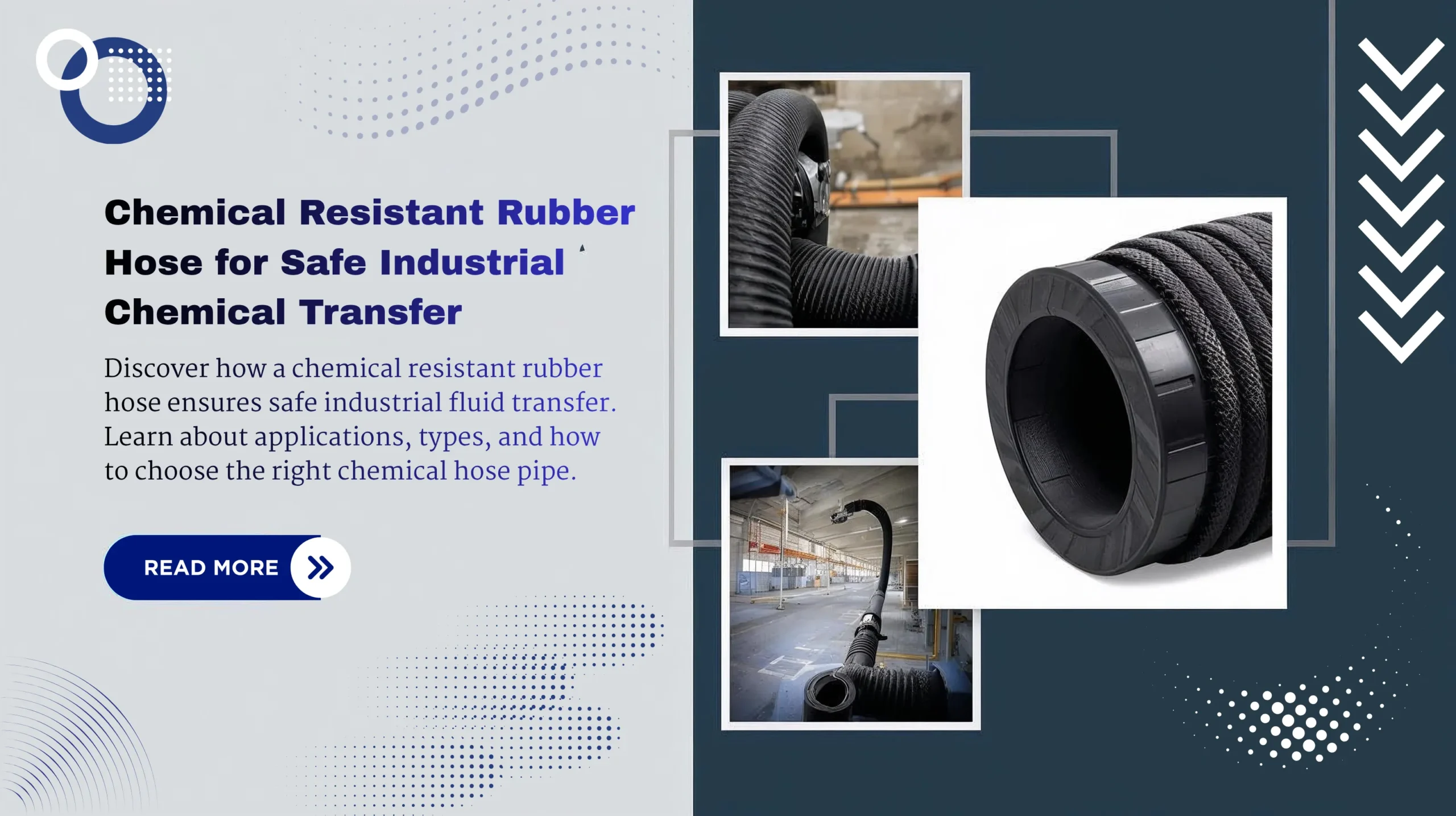
Chemical Resistant Rubber Hose for Safe Industrial Chemical Transfer
Handling industrial fluids requires precision, safety, and the right equipment. A chemical resistant rubber hose is essential for industries managing acids, alkalis, solvents, corrosive liquids, and other harsh industrial chemicals. Using the correct hose prevents dangerous leaks, rapid corrosion, costly downtime, and severe safety risks to your workforce. When you select the appropriate chemical hose pipe, you ensure a smooth, secure, and highly efficient fluid transfer process that protects both your personnel and your bottom line. What Is a Chemical Resistant Rubber Hose? A chemical resistant rubber hose is a specialized industrial tube designed specifically for the safe transfer of aggressive chemicals in demanding environments. Unlike standard water or air hoses, these hoses feature robust construction engineered to withstand chemical attacks from acids, alkalis, solvents, and corrosive fluids. The primary difference between a normal rubber hose and a chemical hose pipe lies in the inner tube lining and overall structural reinforcement. Standard rubber degrades quickly when exposed to harsh industrial fluids, leading to swelling, cracking, or complete structural failure. In contrast, a rubber hose for chemicals uses advanced synthetic materials that resist chemical degradation. The inner lining acts as an impermeable barrier, while the strong reinforcement layers ensure the hose can handle high-pressure applications. This specialized design plays a vital role in safe and efficient chemical handling across various industrial sectors. Why Chemical Resistance Is Important Using normal hoses for chemical transfer is a dangerous and costly mistake. Chemical attack can rapidly destroy ordinary hoses, dissolving the rubber and compromising the structural integrity of the tube. When you use a non-specialized hose for aggressive fluids, you face several severe risks: Risk of Leakage and Spills: Degraded hoses easily rupture, spilling hazardous chemicals onto the facility floor or into the environment. Corrosion and Hose Failure: Harsh acids and solvents eat away at standard rubber, leading to sudden and catastrophic hose failure. Safety Risks for Workers: Chemical bursts can cause severe burns, respiratory issues, and other dangerous injuries to your employees. Damage to Machines and Production Lines: Spilled chemicals can corrode nearby machinery, ruining expensive equipment and halting production. To mitigate these risks, industrial operations require a reliable corrosion resistant hose. Investing in specialized industrial chemical hoses ensures your operations remain safe, compliant, and continuously productive. Key Features of Chemical Hose Pipe A high-quality chemical hose pipe comes with specific features designed to handle extreme industrial conditions. When evaluating a chemical resistant rubber hose, look for these essential characteristics: High Resistance to Acids and Alkalis: Built to endure both low and high pH levels without degrading. Corrosion-Resistant Inner Lining: Features a smooth, specialized inner tube that prevents chemical penetration. Flexible Rubber Body: Allows for easy maneuvering and installation in tight or complex industrial spaces. Strong Reinforcement: Utilizes synthetic fabrics or wire helixes to handle high-pressure environments. Abrasion-Resistant Outer Cover: Protects the hose from external wear, dragging, and environmental damage. Weather and Ozone Resistance: Ensures the hose does not crack or degrade when exposed to outdoor elements. Leak-Proof Performance: Engineered for secure connections with industrial fittings to prevent hazardous drips. Temperature Resistance: Capable of maintaining structural integrity in extreme hot or cold chemical transfers. Suitable for Suction and Discharge: Reinforced with wire to prevent collapse under vacuum pressure. Long Service Life: Durable construction reduces the frequency of replacements and lowers long-term operational costs. Materials Used in Chemical Resistant Rubber Hose The effectiveness of an industrial chemical hose depends entirely on its construction materials. Manufacturers use specific synthetic rubbers and polymers to ensure broad chemical compatibility. Common inner lining materials include: EPDM (Ethylene Propylene Diene Monomer): Highly effective for handling acids, alkalis, and many water-based chemicals. It also offers excellent weather and ozone resistance. UHMWPE / UPE (Ultra-High Molecular Weight Polyethylene): Used for aggressive chemical transfer. This lining can handle nearly 98% of all common industrial chemicals, making it highly versatile. XLPE (Cross-Linked Polyethylene): A strong choice for a wide range of acids, alkalis, and solvents, providing excellent structural stability. Synthetic Rubber Options: Tailored based on specific chemical compatibility requirements for targeted industrial processes. To handle pressure and maintain shape, these hoses use robust reinforcement layers. Depending on the pressure requirements, a hose might feature textile braid, wire braid, or a steel wire helix. A steel helix is particularly important if the hose is used for suction applications, as it prevents the hose from collapsing inward. Material selection depends entirely on your specific application. You must base your choice on the type of chemical, chemical concentration, fluid temperature, working pressure, and whether you require suction or discharge capabilities. Always verify chemical compatibility before finalizing your selection. Types of Chemical Resistant Rubber Hoses Different chemicals require different hose formulations. Understanding the specific types of hoses available helps you make a safer, more effective choice. Acid Resistant Rubber Hose An acid resistant rubber hose is engineered specifically for transferring acidic liquids, diluted acids, and corrosive chemical solutions. You will commonly find these hoses in chemical processing plants, metal finishing facilities, and fertilizer manufacturing units. Acid compatibility matters greatly because acidic media can rapidly eat through standard rubber. The specialized inner lining ensures the acid flows safely without breaking down the hose wall, providing significant safety benefits for facility operators. Alkali Resistant Hose An alkali resistant hose is designed to handle caustic and alkaline solutions, such as sodium hydroxide or potassium hydroxide. These hoses see frequent use in processing plants, chemical cleaning operations, and industrial liquid handling. Maintaining long-term resistance to alkaline media is critical, as bases can cause normal rubber to harden, crack, and eventually burst. Chemical Transfer Hose A chemical transfer hose serves as a versatile conduit for the safe movement of acids, alkalis, solvents, and other industrial chemicals. Operations use these hoses for tanker loading and unloading, plant-to-plant fluid movement, and production line chemical supply. They are built for rigorous daily use, ensuring fluids move securely from storage tanks to processing units. Industrial Chemical Hose An industrial chemical hose is a heavy-duty option used in large-scale environments like chemical plants, refineries, petrochemical units,
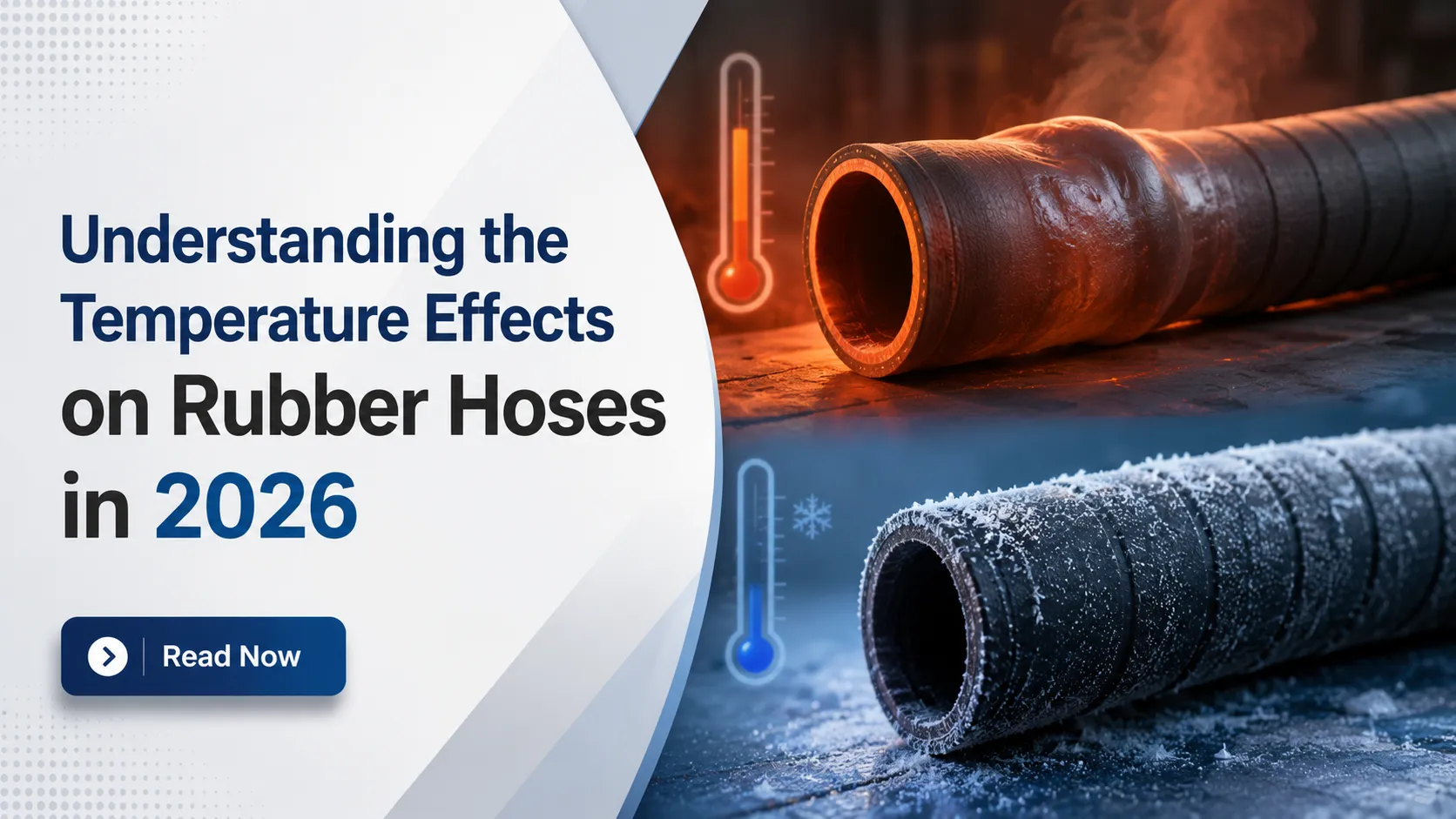
Understanding the Temperature Effects on Rubber Hoses in 2026
Industrial failures don’t always start with pressure — many begin with temperature. Extreme heat and freezing conditions silently damage rubber hoses long before visible signs appear. The result? Sudden leaks, unexpected downtime, and costly equipment failure. Understanding the temperature effects on rubber hoses is not just a technical requirement — it’s a critical factor in safety, performance, and long-term cost control. This guide breaks down how temperature impacts rubber hoses, why failures happen, and how to select the right hose for demanding industrial environments. What Are Temperature Effects on Rubber Hoses? Temperature effects on rubber hoses refer to the physical and chemical changes caused by exposure to extreme heat or cold. These changes directly impact: Flexibility Pressure handling capacity Material strength Lifespan of the hose What are temperature effects on rubber hoses? Temperature effects on rubber hoses refer to the physical and chemical changes that occur when industrial hoses face extreme heat or cold. These thermal rises and falls keep changing that directly impact the flexibility, tensile strength, and working lifespan of the hose material. Understanding these dynamics prevents catastrophic failures in industrial applications. Key temperature effects include: Thermal degradation: High heat accelerates curing, causing hardening and cracking. Cold embrittlement: Freezing temperatures make rubber stiff, brittle, and prone to shattering. Volumetric changes: Materials expand when heated and contract when cooled, weakening fittings. Accelerated wear: Continuous temperature cycling breaks down polymer chains faster. Pressure rating shifts: Operating pressure capabilities drop significantly as temperatures rise. Industrial facilities rely on precise fluid and gas transfer to keep operations running smoothly. When extreme thermal conditions enter the equation, the structural integrity of your equipment faces intense stress. Ignoring the temperature effects on rubber hoses leads to unexpected downtime and severe safety hazards. This guide breaks down the science of thermal exposure and helps you protect your investments. The Science Behind Rubber and Temperature Rubber is a complex elastomer built from long chains of polymers. These polymer chains give the material its unique ability to stretch and return to its original shape. The manufacturing process uses vulcanization to cross-link these chains. This cross-linking creates a durable, flexible structure suitable for industrial environments. However, thermal energy actively interacts with these molecular bonds. Adding heat excites the molecules, while removing heat slows them down. Both extremes trigger specific chemical and physical reactions that alter the performance of the hose. How High Heat Affects Rubber Physically and Chemically Subjecting a hose to excess heat essentially continues the vulcanization process. The rubber absorbs the thermal energy, causing the polymer chains to form additional cross-links. This chemical alteration permanently changes the physical state of the material. The rubber loses its elasticity and becomes progressively stiffer over time. Once the material loses its flexibility, it cannot bend or absorb vibrations without sustaining damage. This loss of elasticity creates a rigid structure that easily develops micro-cracks under normal operating pressure. You must use a proper heat resistant rubber hose to combat these chemical shifts. Standard materials will quickly bake, harden, and fail when exposed to conditions beyond their design limits. Investing in a specialized high temperature rubber hose ensures the polymer structure remains stable. These advanced hoses use heat-stabilized compounds to resist unwanted cross-linking during prolonged thermal exposure. How Freezing Conditions Alter Rubber Cold environments introduce an entirely different set of physical challenges for industrial elastomers. As the ambient or media temperature drops, the polymer chains lose their kinetic energy. This loss of energy prevents the molecules from sliding past one another smoothly. The rubber gradually stiffens, transitioning from a flexible elastomer into a rigid, plastic-like state. This transition point is known as the glass transition temperature. Once a hose reaches this threshold, any flexing, vibration, or impact can cause the material to shatter like glass. Standard rubber formulations struggle to maintain flexibility in freezing environments. You must prioritize cold temperature hose performance when operating in winter climates or handling cryogenic fluids. A specialized low temperature rubber hose utilizes plasticizers and specific polymer blends to prevent stiffening. These additives keep the molecular chains mobile, ensuring the hose remains pliable and safe to operate in extreme cold. Understanding the Temperature Effects on Rubber Hoses Range Every industrial hose comes with a specific thermal rating established by the manufacturer. The rubber hose temperature range dictates the safe operating limits for both the external environment and the internal media. Pushing a hose beyond these published limits immediately compromises its structural integrity. The pressure rating of a hose is intrinsically tied to its operating temperature. As a hose gets hotter, its ability to contain internal pressure decreases significantly. A hose rated for 300 PSI at room temperature might only safely handle 150 PSI at its maximum heat limit. Facility managers must account for both the ambient temperature of the facility and the temperature of the fluid being transferred. A miscalculation in either area can quickly push the assembly outside its safe rubber hose temperature range. Thermal Expansion and Contraction Behavior Thermal dynamics dictate that materials change volume as their internal temperatures fluctuate. A thermal expansion rubber hose experiences measurable dimensional changes during operation. When exposed to high heat, the rubber compound and internal reinforcement layers expand. This expansion increases the overall length and outside diameter of the hose assembly. Conversely, cold temperatures cause the materials to contract and shrink. This continuous cycle of growing and shrinking puts massive stress on the hose structure. The most critical danger zone for thermal expansion is at the connection points. As the rubber expands and contracts, the hose can pull away from its metal fittings. This movement creates tiny gaps between the hose tube and the fitting barb. These gaps eventually lead to weeping, leaks, and total blow-offs if the assembly lacks proper crimping. Engineers must account for thermal expansion when routing hoses in confined spaces. Providing adequate slack allows the thermal expansion rubber hose to grow and shrink without stressing the couplings. The Reality of Rubber Hose Ageing All industrial elastomers experience a natural lifecycle, but thermal exposure
Rubber Hose Failure Causes: The Complete Engineering Guide
Industrial facilities depend on fluid conveyance systems to maintain continuous operations. At the heart of these systems are rubber hoses, engineered to withstand extreme pressures, harsh chemicals, and constant movement. When these critical components fail, the consequences range from temporary operational delays to catastrophic safety hazards. Understanding rubber hose failure causes is not just a maintenance task. It is a fundamental requirement for plant engineers, safety officers, and facility managers. When an industrial hose ruptures or leaks, it compromises the entire system. This comprehensive guide explores the molecular, mechanical, and operational reasons behind these failures. You will learn how to identify warning signs, implement robust industrial hose inspection protocols, and establish foolproof hose failure prevention methods to keep your systems running safely. What Constitutes Industrial Hose Failure? Industrial hose failure occurs when a flexible hose assembly loses its structural integrity. This loss prevents the hose from containing and transporting its designated medium safely. Failures rarely happen without a distinct underlying cause. They manifest in several ways, from catastrophic hose burst reasons to slow, insidious hose leakage issues. When we examine industrial hose failure, we look at three distinct layers: the inner tube, the reinforcement layer, and the outer cover. A failure in any of these layers eventually compromises the whole assembly. For instance, if the outer cover suffers abrasion, the reinforcement wire becomes exposed to moisture and rusts. Once the reinforcement weakens, the internal pressure pushes through the compromised area, resulting in a blowout. The impact of these failures is significant. Beyond the immediate cost of replacing the hose, facilities face unscheduled downtime, environmental cleanup costs for spilled fluids, and severe safety risks to personnel working nearby. Recognizing the exact rubber hose damage empowers your team to shift from reactive repairs to proactive asset management. Deep Dive into Rubber Hose Failure Causes What causes a heavy-duty industrial hose to break down? The answers lie in the intersection of operational demands, environmental stressors, and physical handling. Here is a granular look at the primary rubber hose failure causes. Pressure Related Hose Failure Every hose assembly carries a specific maximum working pressure rating. This rating dictates the highest internal pressure the hose can safely handle during continuous operation. Exceeding this limit is a primary driver of pressure related hose failure. However, continuous high pressure is not the only culprit. Pressure surges, often called the “water hammer” effect, cause devastating internal damage. When a valve closes rapidly, the moving fluid comes to a sudden halt. This creates a shockwave that travels back through the fluid, causing a massive, instantaneous spike in pressure. These spikes often exceed the burst pressure limit of the hose for a fraction of a second. While a single surge might not destroy the hose immediately, repetitive pressure spikes cause mechanical fatigue in the reinforcement layers. The braided wire or textile fibers stretch and weaken with each shockwave. Over time, this cumulative stress leads to sudden and violent hose burst reasons. Operating a hose consistently at or near its absolute maximum pressure rating also accelerates natural wear and drastically shortens its operational lifespan. Temperature Related Hose Damage Temperature affects rubber at a molecular level. To understand temperature related hose damage, you must look at both the fluid temperature inside the hose and the ambient temperature outside it. When a rubber compound faces excessive heat, thermal degradation occurs. The high temperatures cause the plasticizers inside the rubber to leach out. Plasticizers are the chemical additives that give rubber its flexibility. As these additives vanish, the elastomer begins to harden and bake. The polymer chains within the rubber cross-link too tightly, causing the inner tube to lose all elasticity. When the hose flexes or pressurizes, the hardened rubber cannot expand. This leads directly to severe internal rubber hose cracking. Conversely, extreme cold poses an equally dangerous threat. Freezing temperatures cause rubber compounds to stiffen and become highly brittle. If a machine moves or bends a frozen hose, the rubber can shatter like glass. You must always verify that your hose material aligns with the maximum and minimum temperature extremes of your specific application. Chemical Incompatibility and Internal Breakdown Chemical compatibility is non-negotiable in fluid conveyance. If the inner tube material cannot withstand the chemical makeup of the conveyed fluid, rapid degradation begins immediately. Incompatible chemicals cause the inner rubber to swell, blister, or dissolve. Sometimes, the chemical extracts the binding agents from the rubber, leaving the tube porous. This chemical attack leads to permeation, where fluid or gas escapes through the microscopic pores of the hose wall without any visible hole. This results in dangerous, hard-to-track hose leakage issues. Always consult a chemical compatibility chart before introducing a new fluid, solvent, or gas into an existing hose system. Rubber Hose Cracking and Environmental Aging Rubber does not last forever. Even if a hose sits on a shelf unused, it slowly degrades. Environmental factors heavily accelerate this aging process, leading to widespread rubber hose cracking. Ozone exposure is a massive enemy to rubber assemblies. Ozone attacks the carbon-carbon double bonds in the rubber polymers, causing the material to dry out and split. Ultraviolet (UV) light from direct sunlight causes similar photo-oxidative degradation. As the outer cover dries and cracks, it loses its ability to protect the vital reinforcement layers. Once moisture, dirt, and corrosive elements enter through these cracks, the internal structural integrity plummets. Installation and Routing Errors Human error during installation accounts for a massive percentage of early hose failures. A high-quality hose will fail quickly if poorly installed. Kinking is a frequent installation error. This happens when a hose bends beyond its manufacturer-specified minimum bend radius. Bending the hose too tightly crushes the inner tube and forces the reinforcement wires to separate on the outside of the curve. This creates a weak spot that will inevitably blow out under pressure. Twisting, or torsion, is another destructive error. If a technician twists the hose while tightening the end fittings, the internal wire braids warp. When pressure enters a twisted hose, the

Industrial Hose Quality Standards & Certifications Guide
Industrial hoses are the lifelines of modern manufacturing, processing, and heavy engineering. Focus on their role as they transport volatile chemicals, high-pressure steam, abrasive materials, and essential fluids across massive factory floors and critical infrastructure. When these hoses fail, operations grind to a halt. Worse, failures can lead to severe safety hazards, environmental damage, and costly downtime. To prevent these disasters, engineers and procurement managers focus on strict industrial hose quality standards. These guidelines dictate exactly how a hose must be built, tested, and maintained to ensure peak performance under extreme conditions. This guide explores the critical landscape of industrial hose compliance, with a special focus on standards. We will walk you through the primary global standards, essential certifications, rigorous testing methods, and the manufacturing quality control processes that keep your operations running safely. The Critical Importance of Quality Standards Quality standards are not just bureaucratic hurdles. They are essential frameworks that guarantee an industrial hose will perform exactly as expected under specific pressures, temperatures, and chemical exposures. For B2B buyers, the focus should be on understanding rubber hose standards as the first step in risk management. Ensuring Safety, Durability, and Performance When you purchase a hose for a high-pressure hydraulic system or a corrosive chemical transfer, your focus should be on safety and durability. Quality standards dictate the minimum requirements for tensile strength, burst pressure, and material composition. By adhering to these benchmarks, manufacturers ensure their hoses deliver long-term durability and reliable performance. This reliability keeps your workers safe from unexpected ruptures or hazardous leaks, so always focus on certified solutions. The Risks of Using Non-Compliant Hoses Cutting corners on industrial hose compliance introduces massive liabilities. If you lose focus on compliance, using non-compliant or uncertified hoses can lead to catastrophic blowouts. A sudden loss of pressure in a hydraulic line can cause heavy machinery to collapse. A leak in a chemical transfer line can expose workers to toxic substances and trigger massive environmental fines. Furthermore, frequent hose replacements caused by poor durability will ultimately cost far more than investing in certified industrial hoses upfront. Focus on preventing these risks with proper standards. Key Industrial Hose Standards Navigating the various acronyms and regulatory bodies can feel overwhelming. However, a few key organizations focus on setting the rules for the vast majority of industrial applications. Understanding these specific benchmarks helps procurement managers focus on sourcing the right products for their precise needs. IS Standards for Rubber Hoses In India, the Bureau of Indian Standards (BIS) sets the IS standards for rubber hoses. These guidelines focus on everything from water delivery hoses to specialized applications like welding, sandblasting, and chemical transfer. For example, IS 444 covers general-purpose water hoses, while IS 5139 dictates the requirements for hoses used in agricultural spraying. For manufacturers operating in or sourcing from India, focus on IS standard compliance as an absolute necessity to ensure market viability and operational safety. SAE Hose Standards The Society of Automotive Engineers (SAE) sets the global benchmark for hydraulic hoses. SAE hose standards, specifically the SAE J517 guidelines, categorize hoses based on their construction, pressure ratings, and intended applications (such as 100R1, 100R2, and so on). Engineers focus heavily on SAE ratings to specify the correct wire-braided or spiral-reinforced hoses for heavy machinery, earthmoving equipment, and automotive fluid transfer systems. ASTM Hose Standards The American Society for Testing and Materials (ASTM) focuses heavily on the physical properties of the materials used to build the hoses. ASTM hose standards detail the exact testing protocols for rubber compounds, synthetic polymers, and reinforcing fabrics. These standards focus on how specific materials react to heat, ozone, and tearing forces. By requiring ASTM compliance, buyers know the base materials of their hoses are scientifically proven to withstand their working environment. The Role of Global Compliance Operating in a global market means your equipment might be manufactured in Europe, assembled in Asia, and deployed in North America. Global standards maintain focus on interoperability. When you specify a hose that meets international benchmarks, you guarantee that replacement parts will fit, systems will integrate smoothly, and your facilities will pass international safety audits regardless of their physical location. Essential Industrial Hose Certifications While standards dictate how a hose should be made, industrial hose certifications prove that a manufacturer actually followed those rules. Certifications involve third-party audits and continuous monitoring, so focus on verifying certifications every time. ISO and BIS Certifications The International Organization for Standardization (ISO) provides overarching quality management frameworks, such as ISO 9001. When a manufacturer holds this certification, it proves they have consistent, documented processes for building industrial hoses. Additionally, specific ISO standards (like ISO 1436 for rubber hoses) focus on exact product specifications. Similarly, BIS certification acts as a stamp of approval for the Indian market, proving that the product meets stringent domestic safety requirements with a clear focus on compliance. Why Certified Industrial Hoses Matter in B2B For procurement managers, focusing on certified industrial hoses simplifies the purchasing process. A certification acts as a shortcut to trust. It removes the need for buyers to independently audit a supplier’s factory. Buying certified products also protects companies from liability; if a failure does occur, you can prove to insurance adjusters and regulators that you purchased equipment verified by recognized global authorities. Always focus on certifications for peace of mind. Hose Quality Testing Methods You cannot verify durability just by looking at a hose. Manufacturers must focus on subjecting their products to robust rubber hose testing methods to ensure they survive real-world conditions. Hydrostatic Pressure Testing Pressure testing is the most fundamental evaluation of a hose’s integrity. Technicians focus on filling the hose with water and slowly increasing the internal pressure. They test for the maximum “working pressure” (where the hose must operate safely) and the “burst pressure” (the exact point where the hose violently ruptures). Industry standards usually require the burst pressure to be at least four times the working pressure. Flexibility and Bend Radius Testing Industrial environments require hoses to snake around tight