
When procurement teams, factory managers, and maintenance engineers sit down to choose rubber hoses for their operations, one question comes up almost every time: should we go with Indian rubber hoses or imported ones?
It is not a simple answer. The decision involves cost, quality, lead time, standards compliance, after-sales support, and how well the hose holds up in real working conditions. Whether you are running a hydraulic system, managing a chemical plant, or maintaining heavy construction machinery, choosing the wrong rubber hose can lead to failures, downtime, and serious safety risks.
This guide provides a detailed, practical comparison of Indian vs imported rubber hoses to help you make an informed decision for your specific industrial application.
What Are Rubber Hoses Used For in Industries?
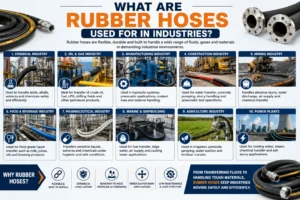
Rubber hoses are a critical component across nearly every major industry. Their flexibility, pressure-handling capacity, and compatibility with different fluids make them irreplaceable in:
- Hydraulic systems in machinery, presses, and heavy equipment
- Oil and gas transfer including fuel lines, suction hoses, and discharge lines
- Chemical handling where specific inner tube materials resist corrosive fluids
- Water and slurry transfer in construction, mining, and agriculture
- Compressed air lines in factories, workshops, and pneumatic tools
- Steam and hot fluid transfer in refineries and food processing units
- Agricultural irrigation and pesticide spraying systems
- OEM assemblies in automotive, defence, and industrial manufacturing
Given such wide application, the quality and specifications of a rubber hose directly affect system efficiency, safety, and operational life.
Indian vs Imported Rubber Hoses: Quick Overview
Indian rubber hoses are manufactured domestically by companies based across major industrial hubs like Mumbai, Pune, Ahmedabad, Chennai, and Hyderabad. These manufacturers use locally sourced and imported raw materials and produce hoses to both Indian Standards (IS) and international standards (ISO, SAE, EN).
Imported industrial hoses typically originate from countries like China, Germany, the United States, South Korea, Italy, and Japan. They are procured either directly from the manufacturer or through Indian importers and distributors.
The core difference is not just geography — it is about production standards, pricing structures, supply chain flexibility, customization capabilities, and suitability for Indian operating environments.
Rubber Hose Quality Comparison: Indian vs Imported
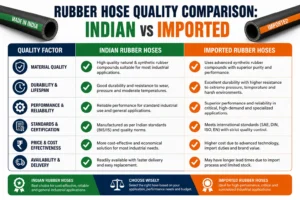
This is where buyers often have the most questions. Let us break down the rubber hose quality comparison across key performance parameters:
Material Quality
Top-tier Indian rubber hose manufacturers now use premium-grade synthetic rubbers including EPDM, NBR, SBR, Neoprene, and Hypalon — the same base materials used in high-end imported hoses. Material quality depends on the manufacturer, not just the country of origin.
Reinforcement
Both Indian and imported hoses use textile braiding, wire braiding, and spiral wire reinforcement. European and American brands often have tighter reinforcement tolerances, which can matter in ultra-high-pressure applications. However, leading Indian manufacturers have closed this gap significantly.
Pressure Rating
Imported hoses from premium brands may offer more consistent pressure ratings across batches. Indian manufacturers producing to SAE or EN standards are highly competitive in the standard working pressure range (up to 400 bar), which covers the vast majority of industrial needs.
Flexibility and Bend Radius
Both origins can produce flexible hoses with appropriate minimum bend radii. Flexibility is more a function of hose design and compound selection than country of manufacture.
Abrasion and Temperature Resistance
Imported hoses from specialized manufacturers sometimes offer superior abrasion-resistant outer covers or extreme-temperature formulations. Indian manufacturers offer competitive options for standard temperature ranges (-40°C to +150°C) common in Indian industrial environments.
Chemical Compatibility
Specialized chemical hoses for aggressive media — concentrated acids, chlorinated solvents, specialty gases — are an area where certain imported brands have long-established formulations. Indian manufacturers offer excellent chemical hoses for common industrial applications, with options for specialized requirements growing rapidly.
Service Life
Service life depends on proper hose selection, installation, and Hose Maintenance — not just the brand or origin. An incorrectly selected imported hose will fail faster than a correctly specified Indian hose.
Imported Rubber Hose vs Indian Rubber Hose: Major Differences
Here is a structured breakdown of the major differences between imported rubber hose vs Indian options:
| Parameter | Indian Rubber Hoses | Imported Rubber Hoses |
| Manufacturing Standards | IS, ISO, SAE, EN compliant | ISO, SAE, EN, DIN compliant |
| Customization | High — made to order | Limited or high MOQ |
| Price | Significantly lower | Higher due to duties and shipping |
| Delivery Time | 2–7 days typically | 4–12 weeks or more |
| After-Sales Support | Strong local support | Limited in India |
| Spare Availability | Readily available | Dependent on stock and imports |
| MOQ Requirements | Flexible, low MOQ | Often high MOQ |
| Suitability for Indian Conditions | Designed/tested locally | Not always optimized |
Manufacturing Standards
Both Indian and imported hoses can meet the same international standards. What matters is whether the specific manufacturer you are buying from actually tests and certifies to those standards — not just claims to.
Customization Options
Indian rubber hose manufacturers offer a strong advantage in customization: special lengths, specific end fittings, non-standard inner diameters, and application-specific compounds can be produced quickly without large minimum order quantities. Imported hoses typically come in fixed catalogue sizes, and custom orders involve long lead times and high MOQs.
Price Difference
This is significant. Indian-made hoses are generally 30–60% less expensive than imported equivalents before accounting for shipping, import duties (which can add 15–25% to CIF value), port handling, and inland freight. For large-volume procurement, this difference is substantial.
Delivery Time
A local Indian supplier can deliver within days. Imported hoses involve ocean freight (4–8 weeks), customs clearance, and last-mile logistics. For maintenance situations or urgent replacements, imported hoses create operational risk.
After-Sales Support
When something goes wrong — wrong size, batch issue, fitting problem — local support is invaluable. Indian suppliers can respond quickly with replacements, technical advice, and on-site support where needed. Imported brands typically have limited or no direct support infrastructure in India.
Why Indian Rubber Hose Manufacturers Are Becoming a Strong Choice
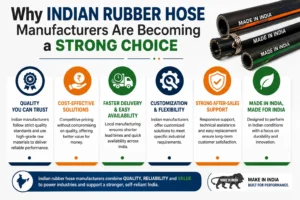
Rubber hose manufacturing in India has matured significantly over the past decade. Here is what is driving the change:
- Technology upgrades: Indian manufacturers have invested in modern extrusion lines, wire braiding machines, and vulcanization systems comparable to European equipment
- Testing infrastructure: In-house hydrostatic testing, burst pressure testing, impulse testing, and chemical compatibility testing are now standard at quality-focused Indian manufacturers
- International certifications: Many Indian manufacturers now hold ISO 9001, ISI mark, and product-specific certifications to SAE, EN, and DIN standards
- Export capability: Several Indian manufacturers export to Europe, the Middle East, Southeast Asia, and the Americas — proving their products meet international benchmarks
- Faster turnaround: Local manufacturing means quick production cycles, stock availability, and fast dispatch
- Lower logistics cost: No ocean freight, no import duties, no customs delays
- Customized hose assemblies: Indian manufacturers can produce ready-to-install hose assemblies with specific fittings, ferrules, and end configurations — reducing assembly time for buyers
The narrative that “imported always means better” does not reflect the current reality of Indian rubber hose manufacturing.
When Should You Choose Imported Industrial Hoses?
There are genuine cases where imported industrial hoses make sense:
- Global OEM requirements: If your machinery or system mandates a specific brand’s hose as part of OEM warranty conditions, you may need to source it — though this is increasingly being challenged by Indian alternatives
- Highly specialized applications: Ultra-high-pressure hoses (above 700 bar), cryogenic hoses, radiation-resistant hoses, or hoses for aggressive exotic chemicals may require specialized formulations from established global manufacturers
- Specific international approvals: Some applications require approval marks like UL, FM, or specific European certifications that not all Indian manufacturers currently hold
- Extreme operating environments: Sub-zero Arctic conditions, deep-sea offshore applications, or aerospace-grade requirements may still be better served by specialized imported products
- Global procurement standardization: Multinational companies sometimes standardize on one global supplier across all plants for consistency
Outside these specific situations, Indian hoses are competitive for the overwhelming majority of industrial applications in India.
Cost Comparison Rubber Hoses: Indian vs Imported
The cost comparison of rubber hoses is more complex than just the unit price:
Procurement Cost
Imported hoses have higher base prices plus import duties (typically 15–25% on rubber hoses in India) plus freight and handling costs.
Inventory Cost
Long lead times for imported hoses force buyers to hold larger safety stocks, tying up working capital.
Downtime Cost
If an imported hose fails and a replacement is unavailable locally, downtime can run into days or weeks. A domestic supplier can often provide a replacement within 24–48 hours.
Replacement Cost
More frequent replacement of a cheaper but inappropriate hose is more expensive than buying the right hose the first time — regardless of origin.
Total Cost of Ownership (TCO)
When you factor in purchase price, duties, freight, inventory carrying cost, downtime risk, and replacement frequency, Indian hoses from quality manufacturers often deliver a significantly lower TCO than imported alternatives for standard applications.
Rubber Hose Price Comparison: What Actually Affects the Price?
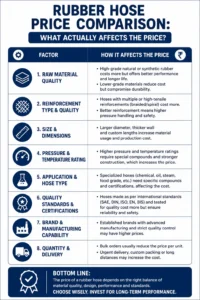
Understanding the rubber hose price comparison requires knowing what drives cost:
- Hose size: Larger inner diameters require more material and cost more
- Material grade: EPDM, NBR, Hypalon, and PTFE-lined hoses cost progressively more than standard SBR
- Pressure rating: Higher working pressure requires more reinforcement layers and better materials
- Reinforcement type: Textile braid is cheapest; single wire braid, double wire braid, and spiral wire add significant cost
- Brand premium: Established global brands carry a brand premium that may or may not translate to better performance for your application
- Source (imported vs domestic): Import duties, freight, and distributor margins add cost to imported hoses
- Fittings and assemblies: Hose assemblies with end fittings cost more than raw hose but reduce installation time and error
- Testing and certification: Certified and tested hoses cost slightly more but provide verifiable performance assurance
For most standard industrial applications, an Indian-made hose of the right specification will cost less and perform equivalently to an imported product.
Industrial Hose Quality Standards Buyers Should Check
Before purchasing any rubber hose — Indian or imported — verify compliance with relevant industrial hose quality standards:
- IS 444: Indian standard for rubber hoses for hydraulic fluid power
- SAE J517: Society of Automotive Engineers standard for hydraulic hose
- EN 853 / EN 856 / EN 857: European standards for wire-reinforced hydraulic hose
- ISO 1436 / ISO 3862: International standards for rubber hoses
- DIN 20022 / DIN 20023: German standards commonly referenced for hydraulic hoses
- Working pressure: Must be at least 4× the maximum operating pressure
- Burst pressure: Typically 4× the working pressure rating
- Temperature range: Confirm the hose is rated for your minimum and maximum operating temperatures
- Chemical resistance: Verify the inner tube material is compatible with the fluid being conveyed
- Batch traceability: Quality manufacturers mark hoses with batch numbers, manufacture date, pressure ratings, and standard compliance
Always ask for test certificates and compliance documentation — not just the product brochure.
How to Identify the Best Rubber Hose in India
Finding the best rubber hose in India for your application involves evaluating more than just price:
- Supplier experience: How long has the manufacturer been in the industrial hose business? Do they have references in your industry?
- Product range: Can they supply the full range of hoses, fittings, and assemblies you need from one source?
- Testing capability: Do they conduct hydrostatic, impulse, and burst pressure testing in-house or at certified labs?
- Technical guidance: Can their team help you select the right hose for your pressure, temperature, fluid, and routing requirements?
- Hose assembly capability: Can they supply ready-to-install assemblies with fittings, reducing your assembly time and error risk?
- Warranty and support: What happens if a hose fails prematurely? Is there a clear resolution process?
- Industry reputation: Are they supplying to reputable companies in your sector? Do they have verifiable testimonials?
The best rubber hose is the one correctly specified for your application, from a supplier who backs it with service.
Role of Industrial Hose Suppliers in India
Industrial hose suppliers in India play a far more important role than simply stocking and shipping products. A reliable supplier:
- Helps with product selection: Matching hose type, pressure rating, temperature rating, and material to your specific application
- Provides technical matching: Cross-referencing your existing hose specifications to equivalent or better products
- Ensures faster supply: Maintaining stock of commonly used sizes for urgent needs
- Offers replacement support: Quick response when a hose fails in service
- Supplies customized assemblies: Providing hoses cut to length, assembled with the right end fittings, and tested before dispatch
- Maintains documentation: Providing certificates, test reports, and material declarations needed for quality audits
Choosing a supplier with deep technical capability and reliable stock availability reduces procurement risk significantly.
Rubber Hose Manufacturing India: Current Market Strength
Rubber hose manufacturing in India is now a significant industrial segment. Key highlights:
- India is among the top producers of rubber hoses in Asia, with manufacturing clusters in Maharashtra, Gujarat, Tamil Nadu, and Telangana
- Indian manufacturers supply to domestic industries including automotive, oil & gas, construction, agriculture, and general industrial sectors
- Several manufacturers export to over 30 countries, demonstrating international quality acceptance
- The industry has shifted from low-cost commodity production to value-added, application-specific hose engineering
- Indian manufacturers are increasingly offering complete hose assembly solutions, not just raw hose
This growing capability means buyers have access to high-quality, standards-compliant, competitively priced products without the risks and costs of international sourcing.
Common Mistakes Buyers Make While Comparing Indian and Imported Rubber Hoses
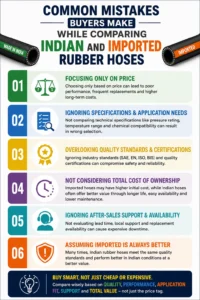
Avoid these common errors when evaluating Indian vs imported rubber hoses:
- Buying only on price: The cheapest hose is rarely the most economical choice when you account for service life, downtime, and replacement frequency
- Ignoring pressure rating: Using a hose rated below your system’s working pressure is a safety hazard and a compliance failure
- Choosing the wrong inner tube material: A hose with NBR inner tube will degrade quickly if used with EPDM-incompatible fluids
- Not verifying standards compliance: Assuming a hose meets standards without asking for test certificates is a procurement risk
- Ignoring fittings compatibility: A well-specified hose with incorrect or incompatible end fittings will leak or fail at the connection
- Underestimating downtime cost: The cost of sourcing an emergency replacement — especially for an imported hose with no local stock — can far exceed the price difference between hose options
Over-engineering the specification: Buying a premium imported hose for a standard low-pressure application adds cost without adding value.
Which Is Better: Indian or Imported Rubber Hose?
For the vast majority of industrial applications in India, Indian rubber hoses from quality manufacturers are the better choice — offering lower total cost, faster availability, easier customization, and strong local support.
Imported industrial hoses remain relevant for niche applications: specialized chemical media, ultra-high pressure systems, applications mandating specific OEM-approved brands, or uses requiring certifications not yet available from Indian manufacturers.
The honest answer is: origin matters less than specification compliance, manufacturer credibility, and supplier reliability. A quality Indian hose outperforms a substandard imported one every time.
Why Choose Rubber Hose India LLP?
Rubber Hose India LLP is a trusted name among industrial hose suppliers in India. The company offers a comprehensive range of industrial hoses, hydraulic hoses, pneumatic hoses, chemical hoses, and customized hose assemblies to serve industries including manufacturing, oil & gas, construction, agriculture, and OEM applications.
Rubber Hose India LLP supports industrial buyers with:
- Application-specific hose selection and technical guidance
- Quality products compliant with IS, ISO, SAE, and EN standards
- Customized hose assemblies with tested end fittings
- Competitive pricing with reliable, timely supply
- Responsive after-sales support
For industrial buyers looking for the best rubber hose in India backed by technical expertise and dependable service, Rubber Hose India LLP is a strong partner to consider.
Conclusion
The Indian vs imported rubber hoses debate is not about nationalism — it is about finding the right product for your application at the right cost with the right support behind it.
For most industrial buyers in India, quality Indian rubber hoses offer a compelling combination of standards compliance, cost efficiency, fast availability, customization flexibility, and strong local support. Imported hoses remain a valid choice for specialized applications where Indian alternatives do not yet fully meet the requirement.
The smartest approach is not to compare only on price, but to evaluate the full picture: application requirements, pressure and temperature ratings, fluid compatibility, quality certifications, supplier reliability, and total cost of ownership.
Choose a reliable, experienced supplier — one who understands your application and backs their products with technical support and service. That decision will serve your operations better than any debate over origin alone.
Also, Read: Hydraulic Hose Buying Guide: How to Choose the Right Hose for Industrial Applications
Frequently Asked Questions (FAQs)
Are Indian rubber hoses good for industrial use?
Yes. Indian rubber hose manufacturers produce hoses compliant with IS, ISO, SAE, and EN standards, covering the full range of hydraulic, pneumatic, chemical, and fluid transfer applications. Quality varies by manufacturer, so verifying certifications and test documentation is important.
Which is cheaper: Indian rubber hose or imported rubber hose?
Indian rubber hoses are typically 30–60% less expensive than imported equivalents on a unit basis. When import duties (15–25%), ocean freight, port handling, and logistics are added, the cost differential in favor of Indian hoses becomes even larger.
Are imported industrial hoses always better than Indian hoses?
No. For standard industrial applications, quality Indian manufacturers produce hoses that match or exceed imported alternatives in performance. Imported hoses may be preferable only in specialized, high-performance, or OEM-mandated situations.
What quality standards should I check before buying rubber hoses?
Look for compliance with IS 444 (Indian standard), SAE J517, EN 853/856/857, or ISO 1436/3862 depending on your application. Always ask for test certificates showing working pressure, burst pressure, temperature rating, and batch traceability.
How do I choose the best rubber hose in India?
Evaluate the manufacturer's experience, product range, testing capability, standards compliance, technical support, and ability to supply customized assemblies. Price should be a factor but not the only factor — total cost of ownership and reliability matter more.
Why is total cost of ownership important in rubber hose selection?
The purchase price is only part of the cost. Downtime due to hose failure, emergency replacement sourcing, inventory carrying cost for imported hoses, and installation errors all add to the true cost. A slightly more expensive, correctly specified hose often delivers a lower total cost over its service life.
Can Indian rubber hose manufacturers provide customized hose assemblies?
Yes. Leading Indian rubber hose manufacturers and suppliers offer customized hose assemblies including specific lengths, end fitting types, pressure ratings, and material specifications — often with faster turnaround and lower MOQs than imported sources.