
Hydraulic systems are the muscle behind modern industry. From excavators digging foundations in Mumbai to injection molding machines in Gujarat’s manufacturing hubs, hydraulic power drives productivity. However, this power relies entirely on a single, often overlooked component: the hydraulic hose. When a hose fails, the machine stops. Worse, a burst high-pressure line can cause severe injury and environmental contamination. This is why correct hydraulic hose selection is not just a procurement task; it is a critical safety and engineering responsibility. Many industrial buyers, factory owners, and maintenance engineers struggle with the complexities of hose specifications, leading to mismatched components and premature failures.
This hydraulic hose buying guide covers everything you need to know to make informed purchasing decisions. We will explore pressure ratings, hose types, reinforcement layers, essential standards, and how to identify reliable hydraulic hose manufacturers India. By the end of this article, you will have a clear roadmap to ensure safety, efficiency, and longevity in your hydraulic systems.
What Is a Hydraulic Hose?
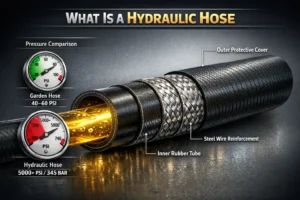
A hydraulic hose is a specialized, high-pressure, synthetic rubber tube designed to convey hydraulic fluid within a system to transmit force. Unlike standard hoses, they are engineered with rigid reinforcement layers (wire or textile) to withstand extreme pressures and pressure spikes while maintaining flexibility for movement between components.
At its core, a hydraulic hose is a conveyance method for fluid power. While it might look like a standard rubber tube, its internal engineering is vastly different. A garden hose moves water at 40-60 PSI; industrial hydraulic hoses often operate at pressures exceeding 5,000 PSI (345 Bar).
The Three Critical Layers
To understand what you are buying, you must understand the anatomy of the hose:
- Inner Tube: This layer carries the fluid. It must be chemically compatible with the hydraulic oil or fluid being used to prevent corrosion or deterioration.
- Reinforcement: This is the strength of the hose. Made from braided wire, spiral wire, or textile yarn, this layer allows the hose to withstand internal pressure without bursting.
- Outer Cover: The protective skin. It shields the reinforcement layers from weather, abrasion, chemicals, and impact.
Difference Between Hydraulic Hose and Normal Hose
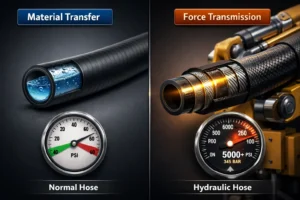
The primary difference lies in the reinforcement and pressure capability. A standard industrial hose is designed for material transfer (water, air, chemicals) at low to medium pressures. A hydraulic hose is designed for force transmission. It must be rigid enough to hold pressure but flexible enough to move with the machine’s arms or pistons.
Common Industrial Applications
You will find these components in almost every sector:
- Construction: Excavators, loaders, cranes, and bulldozers.
- Manufacturing: Hydraulic presses, injection molding machines, and robotic arms.
- Agriculture: Tractors, harvesters, and irrigation systems.
- Mining: Drilling rigs and rock crushers.
- Oil & Gas: Offshore drilling equipment and pipeline maintenance tools.
Why Hydraulic Hose Selection Is Critical for Safety & Performance
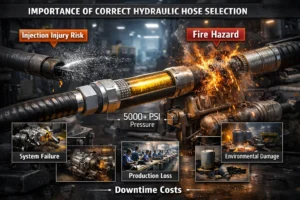
In the world of high-pressure fluid power, there is no margin for error. A hydraulic hose buying guide isn’t just about finding a part number; it’s about risk mitigation.
High-Pressure Risks
Hydraulic fluid under high pressure is dangerous. A pinhole leak can release a fine stream of oil at velocities high enough to penetrate human skin, causing “injection injuries” that require immediate surgical intervention. This is often the result of using a hose with an insufficient pressure rating.
System Failure and Component Damage
Using the wrong hose can damage the entire hydraulic circuit. If a hose degrades internally due to chemical incompatibility, rubber particles can contaminate the oil. These particles then travel to expensive pumps, valves, and cylinders, causing scoring and catastrophic failure.
Leakage and Burst Hazards
Leaks are not just messy; they are expensive and hazardous. Hydraulic oil is flammable. A burst hose spraying oil onto a hot engine manifold is a common cause of industrial fires. Furthermore, just one liter of leaked oil can contaminate thousands of liters of groundwater, leading to severe environmental penalties.
Downtime and Repair Costs
Consider a factory in Pune producing automotive parts. If a main hydraulic line bursts on a press, production stops. The cost of the replacement hose might be ₹2,000, but the cost of four hours of lost production could be ₹2,00,000. Investing time in proper hydraulic hose selection minimizes these expensive interruptions.
Hydraulic Hose Types Explained
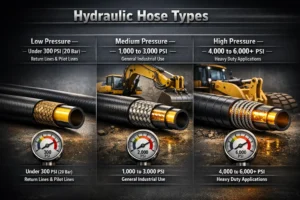
When navigating the market, you will encounter various classifications. Understanding these helps in narrowing down your hydraulic hose specifications.
Low-Pressure Hydraulic Hose
- Construction: Typically textile braided reinforcement.
- Application: Used for return lines (taking fluid back to the tank) or low-pressure pilot lines. They are lightweight and very flexible.
- Pressure Range: Generally under 300 PSI (20 Bar).
Medium-Pressure Hydraulic Hose
- Construction: Usually features one or two layers of braided steel wire (1SN or 2SN).
- Application: The workhorse of the hydraulic industry. Used in construction equipment, transportation, and general manufacturing.
- Pressure Range: 1,000 to 3,000 PSI depending on size.
High-Pressure Hydraulic Hose
- Construction: Uses spiral wire reinforcement (4 or 6 layers of high-tensile steel wire wrapped in alternating directions).
- Application: Heavy-duty earthmoving equipment, hydrostatic drives, and high-impulse applications where pressure surges are frequent.
- Pressure Range: 4,000 to 6,000+ PSI.
Wire Braided Hoses vs. Spiral Wire Hoses
- Wire Braided: The wire is crisscrossed (braided). This offers excellent flexibility and is suitable for medium to high pressures. However, under extremely high impulse loads, the wires can rub against each other and fatigue.
- Spiral Wire: The wires are wrapped in parallel spirals. This makes the hose stiffer and harder to bend but allows it to handle incredibly high pressures and millions of impulse cycles without fatigue.
Hydraulic Hose Pressure Rating – Explained Simply
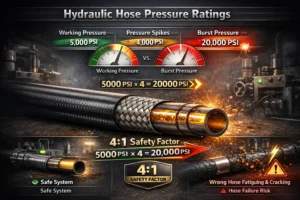
If you take one thing away from this hydraulic hose buying guide, let it be pressure ratings. This is the most common point of failure.
Working Pressure
This is the maximum pressure the hose is designed to handle during continuous operation. Your system’s maximum operating pressure must never exceed the hose’s working pressure rating.
Burst Pressure
This is the pressure at which the hose will physically fail (explode) during testing. It is a theoretical limit used for safety calculations, not for operation.
The Safety Factor
For industrial hydraulic hoses, the standard safety factor is 4:1.
- This means if a hose has a working pressure of 5,000 PSI, it must not burst until it reaches at least 20,000 PSI.
- Why is this important? Hydraulic systems experience “pressure spikes” or surges when valves close quickly or cylinders hit a stop. A system running at 2,000 PSI might see a momentary spike to 4,000 PSI. The safety factor absorbs these spikes without rupturing the hose.
Real-World Example
A procurement manager buys a hose rated for 3,000 PSI for a system that runs at 2,800 PSI. It seems safe. However, the system has a quick-acting valve that creates a 4,500 PSI spike every cycle. A standard hose will fatigue and fail rapidly. In this case, a high pressure hydraulic hose with a higher rating or spiral construction is required.
Also, Read: Maximizing Industrial Rubber Hose Lifespan: A Complete Guide
Hydraulic Hose Specifications You Must Check Before Buying
Before contacting hydraulic hose manufacturers India, gather the following data. In the industry, we often use the STAMPED acronym, but here are the specific physical specs to check:
Inner Tube Material
Is it Nitrile (NBR), Neoprene (CR), or Synthetic Rubber?
- Petroleum-based fluids: NBR is standard.
- Fire-resistant fluids (Phosphate Ester): Requires EPDM (which is incompatible with petroleum oil).
- Biodegradable fluids: May require specialized synthetic rubber.
Reinforcement Layers
Check the number of braids or spirals.
- R1: One wire braid.
- R2: Two wire braids.
- 4SP/4SH: Four spiral wires.
Buying an R1 hose for an R2 application invites failure.
Outer Cover
Does the application involve high abrasion? Is it exposed to ozone or sunlight?
- Standard covers work for general use.
- Tough/Super-Tough covers: Use UHMWPE or specialized compounds for mining or forestry to resist abrasion.
- Marine covers: Need to resist salt spray.
Hose Size (ID & OD)
- ID (Inner Diameter): Determines flow velocity. Too small causes heat and pressure loss; too large is bulky and expensive.
- OD (Outer Diameter): Critical for fitting compatibility and routing through clamps.
Temperature Range
Hydraulic oil gets hot. Standard hoses are rated up to 100°C (212°F). If your system runs hotter, or if the hose is near a furnace or engine exhaust, you need a high-temperature hose. Conversely, cold storage applications require hoses that stay flexible at -40°C.
Step-by-Step Hydraulic Hose Buying Guide
Follow this logical flow to ensure you select the perfect component every time.
Step 1: Analyze Application & Fluid Type
Start with the “What” and “Where.” Is it for a forklift in a warehouse or an excavator in a quarry? What fluid is being conveyed? Ensure the inner tube is compatible with the fluid to prevent chemical breakdown.
Step 2: Define Pressure Requirements
Identify the maximum system pressure, including potential pressure spikes. If your system relief valve is set to 3,000 PSI, you need a hose with a working pressure of at least 3,000 PSI. Never round down.
Step 3: Select Hose Type (Flexibility vs. Pressure)
Need tight bends? A wire braid hose is best. Need extreme pressure resistance? Choose a spiral wire hose. Consult the manufacturer’s bend radius charts. Forcing a stiff hose into a tight bend stresses the reinforcement and shortens lifespan.
Step 4: Determine Size & Length
Measure the required ID based on flow rate (Gallons Per Minute or Liters Per Minute). Measure the length accurately—too short and it pulls on fittings; too long and it rubs against machinery. Always allow for some slack, as hoses can shorten by 2-4% when pressurized.
Step 5: Verify Hydraulic Hose Fittings Compatibility
A hose is useless without ends. Ensure you know the termination type (JIC, BSP, ORFS, NPT, Metric). We will cover this in the next section.
Step 6: Check Standards & Certification
Does your industry require specific hydraulic hose standards like DGMS (for mining in India) or DNV (for marine)? Ensure the manufacturer can provide these certifications.
Hydraulic Hose Fittings – Compatibility & Selection
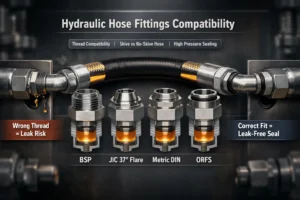
The connection point is often the weakest link. Hydraulic hose fittings must be compatible with both the hose and the machine port.
Importance of Correct Fittings
A mismatch in thread types (e.g., trying to force a BSP fitting onto a NPT port) will damage threads and cause high-pressure leaks. Furthermore, the fitting design must match the hose. You cannot use a “skive” fitting on a “no-skive” hose unless you remove the outer cover, and vice-versa.
Common Fitting Types in India
- BSP (British Standard Pipe): Very common in Indian industrial machinery.
- JIC (Joint Industry Council): Popular in American equipment, uses a 37-degree flare.
- Metric DIN: Standard for German and many European machines.
- ORFS (O-Ring Face Seal): The best for leak-free sealing at high pressures.
Why Wrong Fittings Cause Leakage
Using a crimp fitting designed for an R1 hose on an R2 hose will result in a weak grip. Under pressure, the fitting can blow off the end of the hose—a dangerous projectile event. always match the fitting series to the hose series recommended by the manufacturer.
Hydraulic Hose Standards You Should Know
To maintain quality and interchangeability, the industry relies on standards.
SAE Standards (Society of Automotive Engineers)
Originating in the US, these are the most common globally.
- SAE 100R1: One wire braid.
- SAE 100R2: Two wire braids.
- SAE 100R12/R13/R15: Heavy-duty spiral wire hoses for high pressure.
ISO Standards (International Organization for Standardization)
ISO 18752 is a modern standard gaining popularity. unlike SAE which defines construction (number of braids), ISO 18752 defines performance (pressure rating). This makes selection easier; you simply pick a “3,000 PSI hose” regardless of its construction.
EN Standards (European Norms)
Common in equipment imported from Europe (EN 853, EN 856). They are very similar to SAE standards but have slight dimensional differences.
Indian Compliance Relevance
In India, the Bureau of Indian Standards (BIS) has equivalents (like IS 12092). For government tenders or public sector units (PSUs), compliance with IS standards is often mandatory. Furthermore, for mining applications, DGMS approval is a strict legal requirement.
Q: Why do standards matter in a hydraulic hose buying guide?
A: Standards ensure that a hose bought from Supplier A will perform identically to a hose from Supplier B, provided they meet the same spec. It guarantees a baseline of safety and quality.
Common Mistakes in Hydraulic Hose Selection
Even experienced engineers make these errors. Avoid them to save money and headaches.
Ignoring Pressure Rating Surges
Buying a hose based on the “average” pressure rather than the “peak” pressure. This is the #1 cause of fatigue failure.
Using Wrong Hose Type for the Bend Radius
Using a stiff, high-pressure spiral hose in a tight space. It forces the hose to kink or puts excessive stress on the fitting crimp.
Poor Fitting Selection
Mixing and matching brands. While possible, it is safer to use hose and fittings from the same manufacturer to ensure the crimp specs are perfectly aligned.
Buying Based Only on Price
“Cheap” hoses often use recycled rubber or lower-grade steel wire. They may pass a static pressure test but fail quickly under dynamic impulse conditions. The cost of one hour of downtime usually exceeds the savings from a cheap hose.
Not Checking Manufacturer Documentation
Failing to read the datasheet. Some hoses are not compatible with biodegradable hydraulic fluids. Assuming they are can lead to the hose dissolving from the inside out.
Best Hydraulic Hose – What Really Matters?
Buyers often ask, “What is the best hydraulic hose?” The honest answer is: it depends.
There is no single “best” hose. The best hose is the one that is specifically engineered for your application.
- For a high-vibration rock breaker, the “best” hose is a 4-spiral wire hose with an abrasion-resistant cover.
- For a pilot line in a cramped machine chassis, the “best” hose is a compact, flexible wire-braid hose.
Focus on:
- Impulse Life: Look for hoses tested to 500,000 or 1,000,000 impulse cycles. This is a true measure of longevity.
- Abrasion Resistance: If hoses rub against each other, cover quality matters more than pressure rating.
- Traceability: Can the manufacturer track the batch of rubber and wire used?
How to Choose Reliable Hydraulic Hose Manufacturers in India
India is a major hub for rubber manufacturing. However, quality varies. Here is how to vet suppliers.
Manufacturing Capability
Do they manufacture in-house or just import and re-label? Visit the factory if possible. Look for modern braiding and spiraling machines.
Quality Control & Testing
Ask for their Quality Assurance plan.
- Do they perform burst tests on every batch?
- Do they have an impulse test rig? (Crucial for high-pressure hoses).
- Do they measure ozone resistance?
Certifications
Look for ISO 9001:2015 at a minimum. For specific sectors, look for MSHA (mining), DNV/GL (marine), or UL listings.
Custom Hydraulic Hose Solutions
Can they crimp assemblies to your specific length and fitting requirement? Do they offer “kitting” services (bundling all hoses for a specific machine)?
After-Sales Support
Do they have a technical team to help with failure analysis? If a hose fails prematurely, you want a supplier who will help you figure out why, not just sell you another one.
Final Checklist – Before Buying Industrial Hydraulic Hoses
Before signing that purchase order, run through this final checklist to ensure you haven’t missed a critical detail.
- ✔ Correct Pressure Rating: Is the Working Pressure > Maximum System Pressure (including spikes)?
- ✔ Right Hose Type: Is the reinforcement (braid vs. spiral) suitable for the flexing and impulse cycles?
- ✔ Material Compatibility: Is the inner tube compatible with your specific hydraulic fluid?
- ✔ Size Accuracy: Have you verified the ID for flow and OD for routing?
- ✔ Compatible Fittings: Are the fitting threads and sealing heads (JIC, BSP, etc.) a perfect match for the ports?
- ✔ Certified Manufacturer: Does the supplier have ISO/SAE/IS certifications and test facilities?
- ✔ Temperature Check: Is the hose rated for the maximum operating temperature of the fluid and environment?
- ✔ Abrasion Protection: Do you need a protective sleeve or a tough cover for the application environment?
Conclusion
Navigating the complexities of hydraulic hose selection doesn’t have to be a gamble. By understanding the fundamentals of pressure ratings, reinforcement types, and industry standards, you can transform a routine purchase into a strategic decision that enhances safety and efficiency.
Whether you are sourcing from local distributors or major hydraulic hose manufacturers India, the principles in this hydraulic hose buying guide remain constant: prioritize safety over price, match specifications precisely, and never compromise on quality. A well-chosen hydraulic hose is an investment in the reliability of your entire operation.
Ready to upgrade your hydraulic systems? Contact our engineering team today for a consultation on high-performance hose assemblies tailored to your industry needs.
Also, Read: Industrial Rubber Hose Selection: How to Choose the Right Rubber Hose for Your Industry
FAQs – Hydraulic Hose Buying
Can hydraulic hoses be repaired?
No. You should never repair a damaged hydraulic hose. Patching is unsafe under high pressure. If the hose is damaged near the end, you might be able to cut it back and re-crimp a fitting, but replacing the entire assembly is safer and recommended.
What happens if hydraulic hose pressure rating is exceeded?
Exceeding the rating significantly reduces hose life due to metal fatigue in the reinforcement. If pressure exceeds the safety factor limits (burst pressure), the hose will explode catastrophically, potentially causing injury, fire, or severe machine damage.
Are Indian hydraulic hose standards reliable?
Yes. Indian Standards (IS) are stringent and largely aligned with international norms like ISO and SAE. Reputable hydraulic hose manufacturers India produce world-class products that meet or exceed these standards. Always check for the ISI mark or ISO certification.
How to identify a high pressure hydraulic hose?
Look at the "layline" (text printed on the hose). It will specify the standard (e.g., SAE 100R12) and the working pressure (e.g., 5000 PSI). Physically, high-pressure hoses are heavier, stiffer, and have a thicker wall due to multiple spiral wire layers.
What is the difference between skive and no-skive hoses?
Skive hoses require the outer rubber cover to be shaved off at the end before crimping the fitting, allowing metal-to-metal grip on the reinforcement. No-skive hoses do not require this step; the fitting bites through the cover. No-skive is faster and protects the wire better from corrosion.
Does hose length affect pressure?
Length does not change the pressure rating, but it does affect pressure drop. A very long, narrow hose will result in significant pressure loss at the actuator end due to friction. Always calculate the correct diameter for the length of the run.
Can I use a hydraulic hose for compressed air?
Generally, yes, provided the pressure rating is sufficient. However, the inner tube must be compatible with oil (often present in compressed air). Also, for safety, the cover should be pin-pricked to allow gas permeating the tube to escape without blistering the cover.