
In the fast-paced world of manufacturing, construction, and heavy industry, equipment downtime is the enemy. While we often focus on massive machinery, the humble components often cause the biggest headaches when they fail. The industrial hose is the lifeline of your operation, transferring fluids, gases, and materials that keep production moving. Understanding the industrial rubber hose lifespan is not just a matter of maintenance; it is a critical factor in safety and profitability.
At Rubber Hose India, we understand that a failed hose means stopped work, potential environmental hazards, and lost revenue. This guide delves deep into the factors that dictate how long your hoses last, how to maintain them, and when to replace them.
The Reality of Rubber Hose Life Expectancy
One of the most common questions we receive is, “How long does rubber hose last?” The answer is rarely a simple number. Unlike a carton of milk, industrial hoses do not come with a distinct expiration date printed on the side. The rubber hose life expectancy is subjective and highly dependent on the environment in which it operates.
Generally, the Society of Automotive Engineers (SAE) and other standards bodies suggest a shelf life (storage life) of up to 10 years for bulk hose if stored perfectly. However, the industrial hose service life—the time the hose is actually in use—is significantly shorter and harder to predict. A hose carrying water at room temperature might last five years, while the same hose carrying high-pressure steam might only last a few months.
To accurately predict the industrial rubber hose lifespan, you must look beyond the calendar and look at the application.
Key Hose Ageing Factors
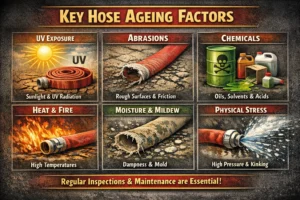
Why do hoses fail? Rubber is an organic material, and like all organic materials, it degrades over time. Several hose ageing factors accelerate this process.
1. Environmental Exposure
UV radiation and ozone are silent killers of rubber. If your hoses are used outdoors, the sun’s UV rays can break down the molecular bonds in the rubber cover, leading to cracking. This is often called “dry rot.” Similarly, ozone generated by welding equipment or electrical motors can attack the rubber, reducing industrial rubber hose lifespan significantly.
2. Thermal Stress
Temperature plays a massive role in industrial hose durability. Every hose has a specific temperature range for both the media being conveyed and the exterior environment.
- Heat: Excessive heat hardens the rubber, causing it to crack when flexed. This “cooking” of the hose interior is a primary cause of failure.
- Cold: Extreme cold makes rubber brittle. If a hose is flexed while below its minimum temperature rating, the inner tube or outer cover can fracture instantly.
3. Chemical Compatibility
If the inner tube of the hose is not compatible with the fluid it is conveying, the hose will fail prematurely. This can manifest as swelling, softening, or delamination of the hose layers. Using a general-purpose water hose for hydraulic fluids or acids is a recipe for disaster and drastically shortens industrial rubber hose lifespan.
Recognizing Rubber Hose Wear and Tear
Visual inspection is your first line of defense. You don’t need to be a chemical engineer to spot the signs of rubber hose wear and tear. Regular audits can prevent catastrophic blowouts.
Look for these physical indicators:
- Abrasion: This is the most common issue. If the outer cover is worn down to the point where the reinforcement wire or fabric is visible, the hose is compromised.
- Kinking: If a hose is pulled around a tight corner or twisted during installation, it can kink. This permanently damages the reinforcement layer.
- Blistering: Bubbles on the cover usually indicate that the fluid has penetrated the inner tube and is trapped between the layers.
- Crushed sections: Running over a hose with a forklift creates weak points that cannot handle pressure surges.
Identifying these signs early allows for planned industrial hose replacement rather than emergency repairs.
Common Hose Failure Causes
To extend the life of your equipment, you must understand the root hose failure causes. While age is a factor, human error and improper application are often the culprits.
The STAMPED Method
At Rubber Hose India, we encourage clients to use the STAMPED acronym to ensure they select the right hose, which is the first step in preventing failure:
- Size (ID, OD, and length)
- Temperature (Material and ambient)
- Application (What is the hose doing?)
- Material (What is flowing through it?)
- Pressure (Working and burst pressure)
- Ends (Couplings and fittings)
- Delivery (Testing and certification)
Ignoring any one of these variables leads to rapid failure. For example, ignoring pressure surges—brief spikes in pressure that exceed the working rating—is a common cause of fatigue in the reinforcement layer, ultimately shortening the industrial rubber hose lifespan.
Mastering Rubber Hose Maintenance
You can significantly improve industrial hose durability through a proactive maintenance program. Rubber hose maintenance shouldn’t be an afterthought; it should be scheduled work.
Inspection Schedule
Create a checklist for your facility. High-risk hoses (those carrying dangerous chemicals or steam) should be inspected daily. General air and water hoses can be inspected monthly.
Cleaning
Chemicals left inside a hose can continue to degrade the tube even when not in use. Flush hoses after use, especially if they carry corrosive materials. Keep the exterior free of oil and grease if the cover isn’t designed to resist them.
Hydrostatic Testing
For critical applications, periodic hydrostatic testing is recommended. This involves pressurizing the hose with water to 1.5 times its working pressure to check for leaks or expansion issues. This confirms the hose is still safe for industrial hose service life.
Essential Rubber Hose Storage Tips
Believe it or not, a hose can degrade before it is ever installed if stored incorrectly. Proper storage is the easiest way to preserve the industrial rubber hose lifespan of your inventory.
Follow these rubber hose storage tips:
- Control the Temperature: Store hoses in a cool, dry place. The ideal temperature is between 50°F and 70°F (10°C to 21°C). Avoid sources of radiant heat.
- Avoid Ozone: Keep hoses away from electric motors, high-voltage equipment, and mercury vapor lamps.
- Keep it Dark: Store hoses away from direct sunlight and strong artificial light. Windowless rooms or opaque coverings are best.
- Relax the Hose: Store hoses in straight lengths if possible. If they must be coiled, ensure the coil diameter is large enough to prevent kinking. Do not hang hoses on sharp nails or hooks; use broad supports.
- First In, First Out (FIFO): Rotate your inventory. Use the oldest hoses first to ensure they don’t exceed their shelf life.
Knowing When to Perform Industrial Hose Replacement
Deciding when to perform industrial hose replacement is a balance between safety and cost. However, safety must always win.
If you observe exposed reinforcement, leaks at the coupling, cracked covers, or any fitting movement, replace the hose immediately. Do not attempt to patch a high-pressure industrial hose. The risk of injury from a burst hose far outweighs the cost of a new assembly.
Tracking the history of your hoses helps here. If you know that a specific hydraulic line tends to fail every 18 months, schedule a replacement at the 16-month mark. This predictive approach maximizes uptime and ensures you get the most out of your industrial rubber hose lifespan without crossing into the danger zone.
The Rubber Hose India Advantage
When it comes to industrial hose durability, the quality of manufacturing matters immensely. At Rubber Hose India, we don’t just sell hoses; we engineer solutions designed to withstand the harshest environments.
Our manufacturing process focuses on high-grade synthetic rubbers that offer superior resistance to abrasion, ozone, and chemicals. We understand that our customers in the B2B sector need reliability above all else. A hose from Rubber Hose India is built to optimize industrial rubber hose lifespan through robust reinforcement layers and high-quality cover compounds.
We act as partners to our clients. By helping you select the exact right hose for your specific application—whether it’s for pneumatic tools, chemical transfer, or hydraulic systems—we ensure that you aren’t setting your system up for failure from day one. Our expertise helps you navigate the complex trade-offs between flexibility, weight, and longevity.
Strategies for Extending Service Life
Beyond basic maintenance, there are operational changes you can make to extend industrial hose service life.
Use Swivel Joints
If a hose is constantly twisting or rotating during use, it creates torque that weakens the reinforcement. Installing swivel joints allows the hose to move freely without twisting, drastically reducing stress.
Use Bend Restrictors
The point where the hose meets the metal fitting is the most common failure point due to excessive bending. Bend restrictors (sleeves found at the end of the hose) prevent the hose from bending too sharply at the coupling, preserving the industrial rubber hose lifespan.
Route Correctly
Ensure hoses are not rubbing against sharp edges or hot surfaces. Use clamps and guides to secure the hose, but ensure they aren’t so tight that they crush the tube.
The Cost of Ignoring Durability
Choosing a cheaper, lower-quality hose often results in higher long-term costs. A “bargain” hose that lasts three months costs significantly more than a premium hose from Rubber Hose India that lasts a year, once you factor in the cost of labor to replace it, the downtime of the machine, and the potential fluid cleanup.
Investing in industrial hose durability is an investment in operational efficiency. High-quality rubber compounds resist hose ageing factors better, maintain their flexibility longer, and handle pressure spikes with greater resilience.
Conclusion
The longevity of your industrial equipment relies on the integrity of its connections. By understanding the factors that influence industrial rubber hose lifespan, implementing a strict inspection protocol, and storing your inventory correctly, you can ensure safety and efficiency in your operations.
Remember that rubber hose life expectancy is not fixed; it is a variable that you can influence through care and proper selection. Don’t let rubber hose wear and tear catch you off guard. Partner with experts like Rubber Hose India to secure high-quality components that stand the test of time.
Whether you need advice on rubber hose maintenance, need to identify hose failure causes, or are ready for industrial hose replacement, prioritizing quality and knowledge is the key to a smooth-running operation.
Also, Read: Industrial Rubber Hose Selection: How to Choose the Right Rubber Hose for Your Industry