
Buying industrial rubber hose is rarely as simple as picking the lowest quotation and placing an order. For procurement managers, plant engineers and purchase teams, the real work happens before the purchase order is signed – understanding the application, shortlisting the right industrial hose supplier in India, comparing technical documents, and checking whether the price reflects the true value of the product.
A wrong hose or an unreliable supplier does not just cost money on paper. It can lead to frequent replacement, leakage, unplanned production downtime, safety risks on the shop floor, higher maintenance spend, media compatibility failures, and delayed project timelines for EPC contractors and OEMs.
This guide focuses on the commercial and procurement side of buying industrial rubber hose – how to prepare a request for quotation, evaluate suppliers, read technical documents, compare quotations fairly, inspect quality, and place a purchase order that protects the buyer. Technical selection factors such as pressure, temperature and media compatibility are touched on only where they affect the buying decision, since they are covered in more depth in Rubber Hose India’s dedicated hose selection guide.
What Does Buying an Industrial Rubber Hose Involve?
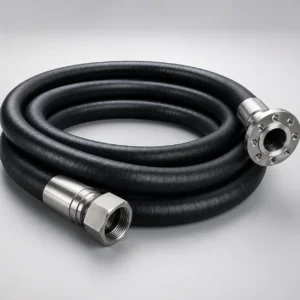
Buying an industrial rubber hose involves more than a single transaction. It includes understanding the application, preparing technical requirements, identifying qualified suppliers, comparing quotations and certifications, approving a sample, inspecting the delivered product, finalising commercial terms, and planning for maintenance and replacement.
Industrial hose procurement is a process with several checkpoints, and skipping any one of them is usually where buyers run into trouble later. In practice, the process includes:
- Understanding the application – fluid, pressure, temperature and environment
- Preparing technical requirements before contacting suppliers
- Finding and shortlisting qualified manufacturers or suppliers
- Comparing technical and commercial quotations
- Reviewing certifications, test reports and data sheets
- Approving a sample where the order size or application justifies it
- Inspecting the product on receipt against the purchase order
- Finalising commercial terms – price, payment, warranty and delivery
- Planning for replacement, spares and ongoing maintenance
Information Buyers Should Collect Before Requesting a Quotation
Before requesting a quotation, buyers should document the media, working pressure, surge pressure, temperature range, hose diameter, length, application type, environment, fittings, quantity, delivery location and certification needs. An incomplete RFQ is one of the most common reasons for inaccurate quotations.
A supplier can only recommend the correct hose and quote accurately when the buyer provides complete information. Before sending an RFQ for buying industrial rubber hose, it helps to gather the following details.
| Requirement | Details Buyer Should Provide | Why It Matters |
| Media | Type of fluid, gas, powder or material being carried | Determines tube compound and chemical resistance |
| Working pressure | Normal operating pressure in bar or psi | Sets the minimum pressure rating required |
| Surge pressure | Maximum momentary pressure spikes, if any | Prevents under-rating the hose for real conditions |
| Temperature | Operating and ambient temperature range | Affects compound selection and service life |
| Internal diameter | Required bore size | Impacts flow rate and fitting compatibility |
| Length | Required hose length per piece | Affects price, packaging and handling |
| Application type | Suction, discharge or both | Some hoses are not rated for suction duty |
| Environment | Indoor, outdoor, abrasive or exposed conditions | Determines cover type and reinforcement |
| End fittings | Type, size and material of couplings | Ensures compatibility with existing equipment |
| Quantity | Number of pieces or total length required | Affects MOQ, pricing tiers and lead time |
| Delivery location | Plant or site address and timeline | Impacts freight cost and delivery planning |
| Certifications | Standards or approvals required, if any | Confirms whether the supplier can meet compliance needs |
An incomplete RFQ is one of the most common reasons buyers receive inaccurate quotations or incorrect product recommendations. Sharing this information upfront saves time for both the buyer and the industrial hose supplier.
How to Choose an Industrial Rubber Hose Supplier
Choosing an industrial rubber hose supplier involves evaluating manufacturing capability, industry experience, technical support, quality control practices and delivery capability. Buyers should look beyond price and assess whether the supplier can consistently meet technical and commercial requirements.
Supplier selection is often the single biggest factor in a successful industrial hose purchase. The following factors help buyers evaluate an industrial hose supplier in India with more confidence.
Manufacturing Capability
- In-house manufacturing versus trading or repackaging
- Hose construction capabilities – braided, spiral or wire-reinforced
- Availability of custom sizes and compounds
- In-house fitting assembly and crimping
- Production capacity for repeat and bulk orders
Industry Experience
- Number of years serving industrial customers
- Range of applications and industries served
- Depth of industry and product knowledge
- Export experience, where relevant
- Existing industrial or institutional clients
Technical Support
- Ability to understand the buyer’s application correctly
- Engineering-led recommendations rather than generic answers
- Availability of product data sheets
- Guidance on material and media compatibility
- After-sales technical assistance
Quality Control
- Incoming raw material inspection
- In-process quality checks during manufacturing
- Final inspection before dispatch
- Pressure testing procedures
- Batch identification and traceability
Delivery Capability
- Standard production lead time
- Stock availability for common sizes
- Timeline for custom or non-standard orders
- Logistics and packaging support
- Ability to respond to urgent or emergency requirements
A simple scorecard can help buyers compare suppliers objectively during industrial hose supplier selection instead of relying only on first impressions.
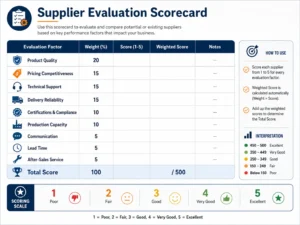
| Evaluation Factor | Questions to Ask | Recommended Weight |
| Manufacturing capability | Do you manufacture in-house or trade third-party hoses? | High |
| Industry experience | Have you supplied for a similar application before? | Medium |
| Technical support | Can you recommend a hose based on my exact application? | High |
| Quality control | What testing is done before dispatch? | High |
| Delivery capability | What is your lead time for this order size? | Medium |
| Documentation | Can you provide data sheets and test certificates? | High |
| Commercial terms | What are your payment and warranty terms? | Medium |
Manufacturer, Distributor or Trader: Which Supplier Should You Choose?
Manufacturers, distributors and traders each offer different advantages. Manufacturers often provide more customisation and technical control, distributors can offer wider stock and faster delivery, while traders may offer competitive pricing but limited technical accountability. The right choice depends on the buyer’s order size, urgency and technical requirements.
| Supplier Type | Advantages | Limitations | Best Suited For |
| Manufacturer | Direct technical control, customisation, batch traceability | May have higher MOQ, longer lead time for small orders | Custom specifications, bulk or recurring orders |
| Authorised distributor | Faster stock availability, manufacturer-backed quality | Limited customisation, dependent on principal’s stock | Standard sizes, urgent replacements |
| General trader | Often competitive pricing, wide product range | Limited technical accountability, unclear origin | Low-criticality, non-technical applications |
| Local reseller | Convenient and quick for small quantities | Inconsistent documentation and quality control | Emergency or one-off small purchases |
None of these supplier types is automatically the wrong choice. The right option depends on the application’s criticality, order volume, urgency, and whether the buyer needs a custom industrial rubber hose manufacturer relationship or a quick, standard purchase.
Technical Documents Buyers Should Request
Buyers should request a technical data sheet, material construction details, test certificates, hydrostatic and burst pressure information, chemical compatibility data, batch traceability records, inspection certificates and warranty terms before buying an industrial rubber hose in bulk.
A catalogue image or a verbal assurance is not sufficient proof of quality for an industrial purchase. Ask for the following documents before finalising an order.
- Technical data sheet – construction, dimensions and ratings
- Product specification sheet
- Material construction details – tube, reinforcement and cover
- Test certificate for the specific batch or order
- Hydrostatic pressure test report
- Burst pressure information
- Chemical compatibility information for the media in use
- Food-grade declaration, where applicable to the application
- Batch traceability details
- Inspection certificate
- Warranty terms in writing
- Installation instructions
- Maintenance guidelines
Each of these documents proves something specific – a test certificate confirms the batch was actually tested, while a data sheet confirms the hose matches the buyer’s technical requirement. Requesting them is a standard part of any industrial hose purchase checklist.
Industrial Hose Certifications and Standards
Required certifications for industrial rubber hose depend on the application, industry and destination market. Buyers should confirm applicable ISO, EN, SAE, IS or BIS requirements, along with FDA-related material rules for food-contact applications, before finalising a purchase.
Industrial hose certifications are not universal – what is required for a chemical transfer hose is different from what is required for a food-grade or steam application. Common references that buyers may need to check include:
- ISO standards relevant to hose construction and testing
- EN standards applicable in European markets
- SAE standards for hydraulic and industrial hose
- IS or BIS requirements for the Indian market
- FDA-related material requirements for food-contact applications
- Electrical continuity or anti-static requirements for specific environments
- Industry-specific test requirements, where applicable
Buyers should not assume a certification applies without checking it against their exact application, country and industry. Confirming this with the supplier in writing avoids compliance surprises later.
How to Compare Industrial Hose Quotations
Comparing industrial hose quotations means checking construction, material compound, pressure rating, fittings, testing, certification, packaging, freight, MOQ, lead time, warranty and payment terms – not just the final price. Quotations with different specifications cannot be compared on price alone.
The lowest industrial hose quotation is not always the lowest long-term cost. Two quotations for the same nominal size can represent very different products once construction and terms are considered.
| Quotation Item | Supplier A | Supplier B | Supplier C | Buyer Notes |
| Hose construction | – | – | – | Confirm reinforcement type matches spec |
| Working/burst pressure | – | – | – | Check against surge pressure requirement |
| Temperature range | – | – | – | Match against actual operating conditions |
| Fittings included | – | – | – | Confirm type, size and material |
| Testing included | – | – | – | Ask if test certificate is included in price |
| Certification | – | – | – | Verify against compliance requirement |
| Lead time | – | – | – | Align with project or plant schedule |
| Warranty | – | – | – | Get terms in writing |
| Payment terms | – | – | – | Compare cash flow impact |
Buyers can use this format as a working template, filling in each supplier’s actual figures so that an industrial hose quotation comparison is based on equivalent specifications rather than price alone.
Understanding Industrial Hose Price
Industrial hose price is influenced by the rubber compound, reinforcement type, diameter, length, pressure rating, temperature and chemical resistance, end fittings, customisation, testing, order volume, certification, packaging and freight. There is no single fixed industrial hose price across applications.
Because so many variables affect industrial hose price, buyers should be cautious of quotations that appear unusually low without a clear explanation. Rather than comparing generic price lists, it is more reliable to request an application-specific industrial hose quotation once the technical requirement is finalised.
Price vs Total Cost of Ownership
Industrial hose total cost of ownership includes the purchase price plus installation, replacement frequency, downtime, maintenance, leakage or product loss, safety incidents, disposal and inventory holding costs. A cheaper hose that fails often can cost more over its service life than a higher-quality alternative.
Illustrative example: a lower-cost hose that needs replacement twice a year, each time causing a few hours of production downtime, can end up costing more over two years than a higher-quality hose replaced once every two years, once downtime and labour are factored in. Actual figures depend entirely on the application, and this example is for illustration only, not a guaranteed outcome.
- Initial purchase price
- Installation cost
- Replacement frequency
- Downtime cost during replacement
- Routine maintenance cost
- Cost of leakage or product loss
- Safety-incident-related costs
- Disposal cost
- Inventory holding cost for spares
Should Buyers Request a Sample Before Placing a Bulk Order?
A sample is worth requesting when working with a new supplier, a custom hose design, a large order, a critical application, an unusual material, a new fitting configuration, or an export requirement. Sample approval reduces the risk of a bulk order not meeting expectations.
When a sample is approved, buyers should check:
- Dimensions against the agreed specification
- Marking and branding accuracy
- Flexibility and handling
- Cover finish and visible quality
- Reinforcement construction
- Fitting quality and fit
- Pressure test results
- Material certificate
- Packaging condition
Industrial Rubber Hose Quality Inspection Checklist
A pre-dispatch or goods-receipt inspection should confirm the correct hose type, diameter, length and fittings, along with the absence of cracks, blisters, kinks or exposed reinforcement, correct branding, and the presence of batch codes, test certificates and pressure markings.
- Correct hose type as ordered
- Correct internal diameter
- Correct length
- Correct fittings
- No visible damage
- No cracks
- No blisters
- No exposed reinforcement
- No kinks
- Correct branding
- Batch code present
- Test certificate present
- Correct pressure marking
- No packaging damage
Questions to Ask an Industrial Hose Supplier
Buyers should ask suppliers direct questions about media suitability, pressure ratings, compound and reinforcement, documentation, traceability, customisation, MOQ, lead time, warranty and past experience before finalising a purchase.
- Is this hose suitable for the exact media being transferred?
- What is the recommended working pressure?
- What is the minimum burst pressure?
- What temperature range can the hose handle?
- Which rubber compound is used?
- What type of reinforcement is used?
- Can you provide a technical data sheet?
- Can you provide test certificates?
- Is batch traceability available?
- Can you supply custom lengths?
- Can you assemble end fittings?
- What is the MOQ?
- What is the production lead time?
- What warranty is provided?
- What maintenance or inspection practices are recommended?
- Can you provide a sample?
- Do you have experience with similar applications?
- What information is required before recommending the hose?
A supplier that answers these questions clearly and in writing is generally easier to work with over the life of the relationship than one that gives vague or verbal-only answers.
Common Mistakes When Buying Industrial Rubber Hose
Mistake: Buying only on price
Solution: Compare specifications first, then price, using an apples-to-apples quotation format.
Mistake: Using an incomplete RFQ
Solution: Share full technical details upfront using an RFQ checklist.
Mistake: Ignoring surge pressure
Solution: Confirm peak, not just average, operating pressure with the supplier.
Mistake: Not checking media compatibility
Solution: Share the exact media and concentration with the supplier before ordering.
Mistake: Comparing different specifications
Solution: Normalise quotations to the same construction and rating before comparing price.
Mistake: Not requesting test certificates
Solution: Make certificates a standard condition of every purchase order.
Mistake: Assuming all rubber hoses are the same
Solution: Ask for construction details rather than relying on the product name alone.
Mistake: Ignoring fitting compatibility
Solution: Confirm fitting type, size and thread standard against existing equipment.
Mistake: Ordering without sample approval
Solution: Request a sample for new suppliers or critical applications.
Mistake: Not checking delivery lead time
Solution: Confirm lead time in writing before committing to a project schedule.
Mistake: Selecting a supplier without technical support
Solution: Prioritise suppliers who can explain the application, not just quote a price.
Mistake: Failing to plan spare inventory
Solution: Maintain a basic spares stock for critical hose lines.
Mistake: Reordering based only on appearance
Solution: Recheck specifications at every reorder rather than assuming nothing changed.
Mistake: Not tracking hose service life
Solution: Maintain simple installation and replacement records for each hose line.
Red Flags When Evaluating a Rubber Hose Supplier
Warning signs include the absence of a technical data sheet, unclear manufacturer details, no pressure rating or material information, missing batch numbers, reluctance to share test reports, unrealistic pricing or delivery promises, and poor communication once payment is discussed.
- No technical data sheet available
- Unclear or unverifiable manufacturer details
- No pressure rating provided
- No material details provided
- No batch number on the product
- Unwillingness to provide test reports
- Extremely low quotation without explanation
- Generic recommendations without asking about the application
- Inconsistent product markings
- Unrealistic delivery commitments
- No written warranty or commercial terms
- Poor communication after payment discussions
How to Place a Clear Industrial Hose Purchase Order
A clear industrial hose purchase order should specify the product name, full specification, diameter, length, quantity, pressure and temperature rating, media, fittings, applicable standard, testing requirement, documentation, packaging, delivery details, inspection terms, payment terms and warranty.
A well-documented purchase order protects both the buyer and the supplier. At minimum, it should include:
- Product name and specification
- Internal diameter and length
- Quantity
- Working pressure and temperature range
- Media
- Fittings
- Applicable standard, where relevant
- Testing requirement
- Documentation to be supplied
- Packaging requirement
- Delivery location and date
- Inspection terms
- Payment terms
- Warranty terms
Sample purchase-order specification format: Product – Industrial Rubber Hose; Specification – [construction, ID, working pressure]; Quantity – [pieces/length]; Fittings – [type and size]; Testing – [hydrostatic test required, Yes/No]; Documentation – [data sheet, test certificate]; Delivery – [location and date]; Payment terms – [as agreed]; Warranty – [as agreed]. Buyers should replace each bracketed field with their actual project details rather than generic placeholders.
Industrial Hose Procurement Process: Step-by-Step
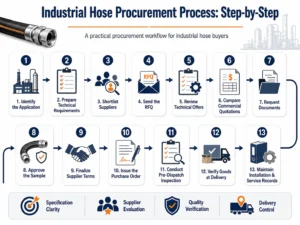
- Identify the application
Define the media, pressure, temperature and environment.
- Prepare technical requirements
Document the full specification before contacting suppliers.
- Shortlist suppliers
Identify a small set of qualified manufacturers or suppliers.
- Send the RFQ
Share complete technical details to get an accurate quotation.
- Review technical offers
Check whether the proposed hose matches the requirement.
- Compare commercial quotations
Normalise specifications before comparing price.
- Request documents
Ask for data sheets, test certificates and warranty terms.
- Approve the sample
Verify a sample where the order size or risk justifies it.
- Finalise supplier terms
Agree on price, payment, delivery and warranty in writing.
- Issue the purchase order
Include full specification and commercial terms.
- Conduct pre-dispatch inspection
Verify quality before the goods leave the supplier’s facility.
- Verify goods at delivery
Check the received hose against the purchase order.
- Maintain installation and service records
Track installation date and expected service life for future planning.
How Rubber Hose India Supports Industrial Buyers
Rubber Hose India LLP works with industrial buyers, plant engineers and procurement teams to support the practical side of buying industrial rubber hose, including:
- Application-based hose recommendations
- Supply of industrial rubber hose for a range of applications
- Custom sizes and specifications on request
- Hose and fitting solutions
- Technical documentation to support buyer evaluation
- Quality checks as part of the order process
- Support for bulk industrial orders
- Handling of domestic and export enquiries
- Supplier consultation for buyers evaluating their requirement
Buyers are encouraged to verify current certifications, manufacturing capabilities and specific terms directly with the Rubber Hose India team for their exact application, since requirements vary by project.
Final Industrial Hose Buying Checklist
- Application details documented (media, pressure, temperature)
- Complete RFQ prepared and shared with suppliers
- Multiple suppliers shortlisted and compared
- Manufacturer, distributor or trader status confirmed
- Technical data sheet obtained
- Test certificates requested
- Certifications confirmed for the application and market
- Quotations compared on equivalent specifications
- Total cost of ownership considered, not just price
- Sample approved where applicable
- Fittings confirmed for compatibility
- MOQ and lead time confirmed
- Warranty terms obtained in writing
- Purchase order includes full specification
- Inspection terms agreed before dispatch
- Goods verified on receipt against the purchase order
- Batch and traceability information recorded
- Installation and service records started
- Spares planning considered for critical lines
- Supplier contact retained for after-sales support
Conclusion
Buying industrial rubber hose is ultimately a balance of technical suitability, supplier reliability, product quality, documentation, price, delivery and long-term cost. Buyers who prepare a complete RFQ, evaluate suppliers on more than price, request the right documents, and compare quotations on equivalent specifications are far less likely to face downtime, leakage or replacement issues down the line.
For product recommendations, technical details, bulk enquiries, industrial hose quotations or custom requirements, industrial buyers are welcome to contact Rubber Hose India LLP directly to discuss their specific application.
Frequently Asked Questions
How do I choose an industrial hose supplier in India?
Choose an industrial hose supplier in India by evaluating manufacturing capability, industry experience, technical support, quality control and delivery capability. Ask for data sheets, test certificates and references, and avoid selecting a supplier based on price alone.
What information is needed for an industrial hose quotation?
An accurate industrial hose quotation needs the media type, working and surge pressure, temperature range, diameter, length, application type, environment, fittings, quantity, delivery location and certification requirements. Missing details often lead to inaccurate quotations.
How is industrial rubber hose price calculated?
Industrial rubber hose price depends on the rubber compound, reinforcement, diameter, length, pressure rating, temperature and chemical resistance, fittings, customisation, testing, order volume and packaging. There is no single standard price across all applications.
Should I buy directly from a manufacturer or distributor?
Buying from a manufacturer often suits custom specifications and bulk or recurring orders, while a distributor can be faster for standard sizes and urgent replacements. The right choice depends on order size, urgency and technical requirements.
Which documents should an industrial hose supplier provide?
An industrial hose supplier should provide a technical data sheet, material construction details, test certificates, pressure test reports, chemical compatibility information, batch traceability records and written warranty terms before a bulk purchase.
Why is working pressure important when buying a hose?
Working pressure determines whether the hose can safely handle normal operating conditions without failure. Buyers should also account for surge or peak pressure, since a hose rated only for average pressure may fail under momentary spikes.
Should I request a hose sample before a bulk order?
Requesting a sample is worthwhile for a new supplier, custom design, large order, critical application or unusual material. It allows the buyer to verify dimensions, quality and fitting compatibility before committing to a full order.
How can I compare two industrial hose quotations?
Compare industrial hose quotations by normalising them to the same construction, pressure rating, fittings, testing and certification before comparing price. Quotations with different specifications cannot be judged fairly on price alone.
What is the total cost of ownership of an industrial hose?
Total cost of ownership includes the purchase price plus installation, replacement frequency, downtime, maintenance, product loss, safety-related costs, disposal and inventory holding. A cheaper hose that fails often can cost more over time than a higher-quality option.
What are the signs of a low-quality industrial rubber hose?
Signs of a low-quality industrial rubber hose include missing batch codes, no test certificate, inconsistent markings, visible cracks or blisters, exposed reinforcement, and a supplier unwilling to share technical documentation.
Can industrial rubber hoses be customised?
Yes, many industrial rubber hose manufacturers offer custom lengths, diameters, compounds and fitting configurations. Buyers should confirm MOQ, lead time and pricing for custom specifications separately from standard catalogue items.