
Industrial hoses are critical components in almost every manufacturing, processing, and heavy-duty industrial environment. They are used daily for transferring air, water, steam, chemicals, oil, fuel, slurry, food-grade materials, hydraulic fluids, and many other media — often under high pressure and in demanding conditions.
Following proper industrial hose safety guidelines is not optional. It is a practical necessity that protects workers, equipment, and the business itself. Factory hose safety begins with selecting the right hose and continues through correct installation, routine inspection, safe handling, and timely replacement.
When hose safety is ignored, the consequences can be serious. Poor hose selection, wrong installation, overpressure, improper handling, lack of inspection, or using a damaged hose can lead to leakage, hose burst, chemical exposure, fire hazards, equipment damage, production downtime, and worker injuries.
This complete guide covers industrial hose safety tips, pressure safety, installation best practices, inspection checklists, maintenance guidance, and factory safety compliance requirements for all types of industrial rubber hose applications.
What Are Industrial Hose Safety Guidelines?
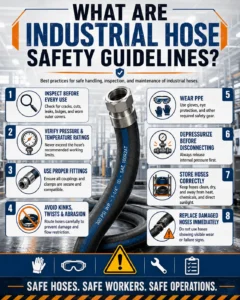
Industrial hose safety guidelines are practical rules and best practices for selecting, installing, handling, inspecting, storing, and maintaining hoses used in industrial applications. These guidelines help prevent hose leakage, burst, pressure accidents, chemical exposure, equipment failure, and workplace injuries.
In simple terms, these guidelines define how an industrial hose should be chosen for the right job, how it should be connected and routed, how it should be used safely under pressure, and when it should be replaced before it becomes a hazard.
Industrial safety guidelines for hoses cover the entire hose life cycle — from the moment you select a hose for a specific application to the moment you retire it from service. Industrial hose best practices are built on years of practical experience and are designed to maximise hose performance while minimising the risk of accidents.
Rubber hose safety standards may vary based on hose type, application, pressure rating, temperature range, and local safety regulations. Always refer to the hose manufacturer’s technical data and relevant industry standards for your specific use case.
Why Factory Hose Safety Is Important
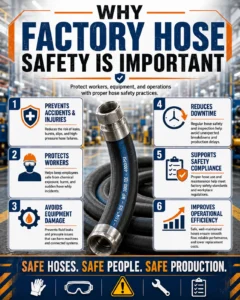
Factory environments involve constant movement of pressurised fluids, hot steam, corrosive chemicals, flammable fuels, abrasive slurries, and compressed air. Industrial hoses carry these media between machines, tanks, pumps, and systems — and a single point of failure can trigger a chain of consequences.
Factory hose safety matters for these key reasons:
- Industrial hoses carry pressurised fluids, chemicals, steam, oil, fuel, slurry, and abrasive material that can cause serious harm if released unexpectedly.
- A small mistake — a loose fitting, an unsupported bend, or an expired hose — can escalate into a major safety incident.
- Hose failure can halt production immediately, causing costly downtime.
- Leakage can damage machines, floors, surrounding equipment, and finished products.
- A burst hose under pressure can injure or kill workers nearby.
- Chemical leakage creates burn risks, inhalation hazards, and environmental compliance issues.
- Proper hose safety extends service life and reduces replacement and maintenance costs.
- Safe hose practices are fundamental to factory safety compliance and passing regulatory audits.
Following industrial hose safety guidelines consistently across a facility is not just about avoiding accidents. It reflects the overall standard of professionalism, care, and operational discipline in a factory.
Common Risks of Unsafe Industrial Hoses
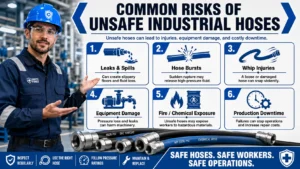
Hose Burst Due to Overpressure
Every hose is designed to operate within a specific pressure range. When a hose is subjected to pressures beyond its rated working pressure — or when pressure surges occur — the hose can fail suddenly and violently. Hose burst causes immediate fluid release under pressure, which can injure workers, damage equipment, and stop operations. Hose pressure safety is therefore one of the most important aspects of hose management.
Leakage from Poor Couplings or Fittings
Incorrectly fitted or incompatible couplings are a leading cause of hose leakage. Loose clamps, wrong fitting sizes, or improper sealing materials allow fluids to escape at connection points. Over time, this leakage can damage surrounding structures, create slip hazards, and cause chemical contamination.
Chemical Exposure
Using a hose with an inner tube material that is not compatible with the chemical being transferred can cause the hose to deteriorate internally. The hose may swell, crack, or delaminate — and the chemical may leach through or cause a sudden failure. Workers can be exposed to toxic, corrosive, or flammable substances.
Fire and Heat Hazards
In oil, fuel, and steam applications, an unsafe hose can cause fluid leakage near ignition sources or hot surfaces, increasing fire risk. Hose handling safety in these environments requires extra care and the use of hoses with flame-resistant outer covers and appropriate temperature ratings.
Abrasion, Kinking, and Twisting
Hoses that rub against sharp edges, vibrate against metal surfaces, or are bent beyond their minimum bend radius wear out faster. Twisting a hose during installation stresses the reinforcement layers. Over time, these physical stresses reduce hose strength and can cause premature failure.
Worker Injury and Downtime
A whipping hose under pressure, a chemical spill, or a steam burn can injure workers seriously. Beyond the human cost, hose-related incidents cause production stoppages, investigation time, equipment repair, and increased insurance costs. Preventing these incidents through industrial hose safety tips is always more cost-effective than dealing with the consequences.
Industrial Hose Selection Safety Guidelines
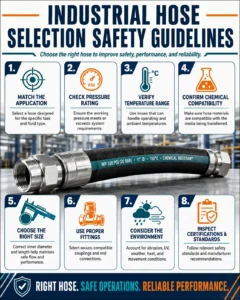
Safety begins before the hose is installed. Choosing the right hose for the right application is the foundation of all industrial hose safety guidelines.
Here is what to check when selecting an industrial hose:
- Match the hose to the application. A hose designed for water delivery should not be used for chemical transfer.
- Check media compatibility. Confirm the inner tube material is compatible with the fluid being transferred — including concentration, temperature, and flow rate.
- Check working pressure and burst pressure. The hose’s working pressure must be higher than the maximum system pressure.
- Check temperature rating. The hose must be able to handle both the minimum and maximum temperatures of the media and the environment.
- Choose the right inner tube material. For chemicals, use PTFE or chemically resistant rubber. For steam, use EPDM. For fuel and oil, use Nitrile (NBR) or equivalent.
- Choose suitable reinforcement. High-pressure applications may need wire-braided or spiral-wound reinforcement.
- Choose a durable outer cover. For abrasive environments, choose a tough, abrasion-resistant outer cover. For outdoor use, choose a cover with UV resistance.
- Select proper fittings and couplings. Only use fittings that match the hose type, size, pressure rating, and media.
- Consider suction or discharge use. Suction hoses require a helical wire or structural support to prevent collapse. Discharge hoses are not designed for suction service.
- Check static electricity requirements. For fuel, solvent, or explosive environments, use anti-static or electrically conductive hoses where required.
- Confirm flexibility and bend radius. Ensure the hose can flex sufficiently in the installation without exceeding its minimum bend radius.
Practical examples:
- A chemical transfer hose must be confirmed compatible with the specific chemical at the actual operating temperature — not just a general chemical compatibility chart.
- A steam hose must be rated for the actual steam temperature and pressure, not just nominal values.
- A slurry hose must have an abrasion-resistant inner lining to withstand the abrasive particles.
Following rubber hose safety standards and industrial hose best practices at the selection stage prevents many downstream safety problems.
Hose Pressure Safety: Working Pressure, Burst Pressure and Safety Factor
What Is Working Pressure?
Working pressure is the maximum pressure that an industrial hose is designed and rated to handle safely during normal, continuous operation. This is the value that must be matched against the actual system operating pressure before selecting or using a hose.
What Is Burst Pressure?
Burst pressure is the pressure at which a hose may fail or rupture under laboratory test conditions. It is significantly higher than the working pressure and is used as a design benchmark — not as an operating guideline. Never use burst pressure as an acceptable operating limit. Doing so is extremely dangerous.
Why Pressure Rating Matters
Hoses should never be used at or above their working pressure rating. Pressure surges, water hammer effects, temperature changes, and mechanical stress can all cause the actual pressure inside a hose to spike beyond the steady-state reading.
How to improve hose pressure safety in your factory:
- Always check the pressure rating label before putting a hose into service.
- Avoid pressure spikes and surges by using surge-dampening equipment where possible.
- Install pressure gauges on critical hose lines for continuous monitoring.
- Use pressure relief valves in systems where pressure surges are common.
- Always depressurise a hose before disconnecting it from a system.
- Never use a hose that is damaged, aged, or has visible wear under pressure.
- Check all couplings, clamps, and end fittings before starting operation.
- Do not use the same hose for multiple different pressure applications without verifying its suitability for each.
Hose Installation Safety Guidelines
Proper installation is just as important as proper selection. Even a correctly chosen hose can fail prematurely if it is installed incorrectly.
Safe hose installation means routing, connecting, and supporting an industrial hose in a way that prevents twisting, kinking, abrasion, heat damage, pressure stress, coupling failure, and unsafe movement during operation.
Key hose installation safety practices:
- Do not twist the hose during installation. Twisting weakens the reinforcement layers and reduces pressure capacity.
- Avoid sharp bends at or near fittings. Sudden directional changes stress the hose and couplings.
- Always maintain the minimum bend radius specified by the manufacturer.
- Do not apply tension or pulling force at the hose ends. Hoses are not designed to carry mechanical load.
- Keep hoses away from hot surfaces such as exhaust pipes, steam lines, and furnace walls.
- Protect hoses from rubbing against sharp metal edges or moving machine parts. Use sleeves, guards, or clamps.
- Use proper clamps, brackets, and supports to hold hoses in place along their length.
- Keep hose routing clean, visible, and accessible for inspection.
- Avoid excessive hose length. Oversized hose loops can create snagging risks and pressure loss.
- Ensure all fittings are properly tightened according to manufacturer torque specifications.
- Use safety whip checks or restraint cables at hose connections in high-pressure air and fluid systems.
- Allow sufficient movement and flexibility so that vibration and equipment movement do not stress the hose.
- Inspect the full installation before starting operation and after any maintenance work.
Following industrial safety guidelines for hoses at the installation stage dramatically reduces the risk of early failure.
Hose Handling Safety Tips for Factory Workers
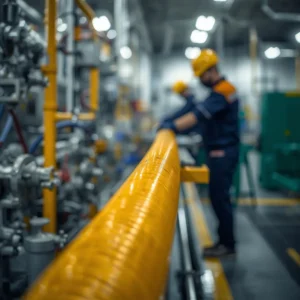
Daily hose handling in a factory involves physical contact, connection and disconnection, movement, and sometimes emergency situations. Workers need to follow practical hose handling safety guidelines to protect themselves and their colleagues.
- Do not drag hoses across rough, abrasive, or sharp floors. This damages the outer cover and exposes the reinforcement.
- Never lift a heavy hose by gripping only the fittings. Use the hose body and appropriate lifting aids.
- Do not pull hoses forcefully or jerk them into position. Move hoses carefully and deliberately.
- Use hose reels, trolleys, cradles, or mechanical lifting aids for heavy hoses to reduce manual strain.
- Always wear required PPE — including gloves, safety shoes, eye protection, and chemical-resistant clothing where applicable.
- Depressurise the hose fully before disconnecting it. Never disconnect a live pressurised hose.
- Do not stand directly in front of hose ends during pressurisation. Stay to the side.
- Keep workers clear of hose whip zones — the area that a whipping hose could reach if it disconnects under pressure.
- Do not allow forklifts, heavy trolleys, or vehicles to run over hoses. This crushes the hose and damages reinforcement internally.
- Never bend a hose beyond its minimum bend radius during handling or use.
- Keep hose routes organised and marked to prevent tripping hazards on walkways.
- Report any signs of damage immediately — cracks, swelling, soft spots, leakage, exposed reinforcement, or discolouration.
Industrial Hose Inspection Checklist Before Use
A regular industrial hose inspection checklist helps identify early signs of hose damage before they become serious safety hazards. Early detection saves costs and prevents accidents.
Full Hose Inspection Points:
- Check for cuts, cracks, or splits on the outer cover.
- Check for swelling, blistering, or soft spots anywhere along the hose.
- Check for abrasion damage, especially on contact surfaces and bends.
- Check for exposed reinforcement wire or fabric layers.
- Check for leakage at or near fittings and couplings.
- Check for loose, cracked, or corroded clamps and fittings.
- Check for kinks or flattened sections.
- Check for burn marks or heat discolouration.
- Check for signs of chemical attack — such as softening, swelling, or discolouration of the cover or inner tube.
- Verify the hose pressure rating is suitable for the current application.
- Verify the temperature rating is appropriate.
- Check the manufacturing date and service life against replacement policy.
- Confirm the hose is routed correctly and supported adequately.
- Check end connections for tightness.
- Confirm the hose is being used for its intended application only.
- Check for any signs of crushing from heavy objects or vehicle impact.
- Monitor for unusual vibration or movement during operation.
Daily Hose Inspection Checklist
Before each use, check for visible damage, active or dried leakage, coupling condition, pressure and temperature rating suitability, and correct routing. This takes only a few minutes and can prevent major incidents.
Weekly Hose Inspection Checklist
Check fittings and clamps for tightness, inspect abrasion-prone areas and bend zones, review storage condition for hoses not in active use, and identify any repeated stress points.
Monthly Hose Inspection Checklist
Conduct a full condition review of all hoses in service. Check service records, assess replacement requirements, consider pressure testing where needed, and review compliance documentation.
Rubber Hose Safety Standards and Factory Safety Compliance
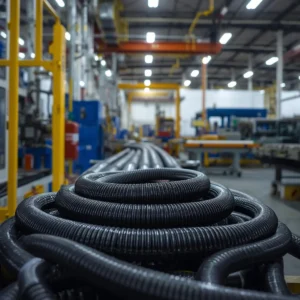
Rubber hose safety standards are not one-size-fits-all. They vary depending on the hose type, the media being transferred, the operating pressure and temperature, the industry, and the applicable local regulations.
Factory safety compliance for hoses typically involves:
- Selecting hoses that meet relevant industry specifications for the application.
- Following the hose manufacturer’s installation, operating, and maintenance guidelines.
- Maintaining an up-to-date industrial hose inspection checklist for all hoses in service.
- Keeping records of inspection, maintenance, incidents, and replacements.
- Ensuring workers are trained on safe hose use and emergency procedures.
- Using correct PPE for all hose handling tasks.
- Following internal factory SOP for hose management.
Factories should always follow the hose manufacturer’s technical specifications and consult with qualified safety professionals or regulatory bodies when uncertain about applicable standards for a specific use case.
Industrial Hose Safety Guidelines by Application
Chemical Transfer Hoses
- Confirm chemical compatibility before use — including chemical concentration and temperature.
- Use corrosion-resistant and chemically compatible hose materials.
- Wear appropriate chemical-resistant PPE during connection, disconnection, and inspection.
- Label chemical hoses clearly with the media name.
- Flush or clean hoses after use if the process requires it.
- Never use an unknown or unlabelled hose for chemical transfer.
Steam Hoses
- Use only hoses rated for the actual steam pressure and temperature.
- Protect workers from contact burns with lagging or physical guards where appropriate.
- Drain steam hoses after each use to prevent water hammer and corrosion.
- Use proper steam-rated fittings.
- Inspect regularly for hardening, cracking, and heat damage — steam hoses age faster than standard rubber hoses.
Air Hoses
- Fit whip checks or safety restraint cables at coupling connections.
- Depressurise before removing any fitting.
- Avoid running air hoses across walkways where workers or vehicles could trip on or crush them.
- Never use air hoses for breathing air supply unless they are certified for that purpose.
Oil and Fuel Hoses
- Use hoses confirmed compatible with the specific oil, petrol, diesel, or hydrocarbon media.
- Keep oil and fuel hoses away from sparks, open flames, and hot surfaces.
- Use anti-static or electrically bonded hoses in environments with explosion risk.
- Inspect frequently for leakage, swelling, or softening of the inner tube — signs of chemical incompatibility.
Water and Slurry Hoses
- Use abrasion-resistant hoses for slurry to extend service life and prevent burst from wall thinning.
- Prevent suction collapse by using hoses with correct structural support (helical wire reinforcement).
- Check inner lining wear regularly in slurry applications.
- Prevent kinking in discharge positions, especially with heavy hoses.
Food-Grade Hoses
- Use only hoses made from food-grade materials approved for the specific food product or beverage.
- Clean and sanitise hoses after every use according to food safety protocols.
- Prevent cross-contamination by storing food-grade hoses separately from industrial hoses.
- Replace food-grade hoses at the intervals recommended by the manufacturer.
Safe Storage Guidelines for Industrial Rubber Hoses
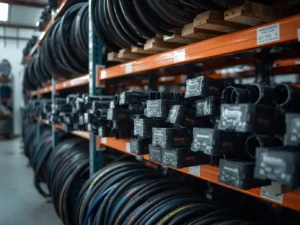
Correct storage is a key part of industrial hose best practices and directly affects hose life and safety.
- Store hoses in a clean, dry, cool, and well-ventilated area.
- Protect from direct sunlight, which degrades rubber through UV exposure.
- Keep away from ozone-generating equipment such as electric motors, welding equipment, and UV lamps.
- Keep away from chemicals, solvents, oils, and sharp tools in the storage area.
- Avoid tight coiling — coil hoses loosely on reels, racks, or cradles.
- Cap or plug hose ends to prevent internal contamination and insect ingress.
- Do not stack heavy objects on top of stored hoses.
- Store hoses away from heat sources and steam pipes.
- Apply the FIFO (First In, First Out) method to ensure older hoses are used before newer ones.
- Prevent moisture build-up that can corrode metal fittings and clamps.
- Keep all hoses labelled and organised by type and application.
Industrial Hose Maintenance and Replacement Best Practices
- Clean hoses after use, especially after handling chemicals, food products, or abrasive slurry.
- Drain hoses fully before storage to prevent internal moisture build-up.
- Inspect hoses after every heavy-duty use or after any system over-pressure event.
- Replace damaged hoses immediately — do not continue using a compromised hose.
- Do not use temporary tape or sealant repairs on high-pressure hoses in critical service.
- Keep a stock of spare hoses for commonly used lines to minimise downtime.
- Maintain inspection and maintenance records for all industrial hoses.
- Use only compatible, manufacturer-recommended replacement fittings and clamps.
- Follow the manufacturer’s service life recommendations and replace hoses proactively.
- Replace any hose that has been exposed to extreme heat, chemical attack, repeated over-pressure events, or severe physical damage.
Factory Hose Safety Training for Workers
No set of safety guidelines is effective unless workers understand and apply them. Factory hose safety depends directly on properly trained and informed workers.
Training should cover:
- How to read and understand hose pressure and temperature ratings.
- Safe connection and disconnection methods for each hose type used in the facility.
- PPE requirements for different hose applications.
- How to conduct a basic hose inspection before use.
- How and where to report damaged, suspect, or expired hoses.
- Emergency shut-off and depressurisation procedures.
- Chemical handling risks for workers in chemical transfer areas.
- Why shortcuts — such as using the wrong hose or skipping inspections — are dangerous.
Supervisors should maintain training records, inspection schedules, and replacement logs as part of overall factory safety compliance.
Do’s and Don’ts of Industrial Hose Safety
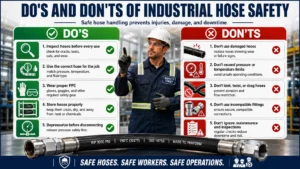
Do’s
- Use the correct hose for the correct application and media.
- Check the working pressure rating before putting a hose into service.
- Inspect hoses before every use.
- Use compatible, correctly sized fittings and couplings.
- Follow proper hose installation safety practices including bend radius and routing.
- Wear required PPE for the application.
- Store hoses correctly in clean, cool, dry, and protected conditions.
- Replace damaged or aged hoses promptly.
- Train all workers who handle hoses on safe practices.
- Maintain hose inspection and maintenance records.
Don’ts
- Do not exceed the rated working pressure of any hose.
- Do not use a damaged, kinked, or aged hose.
- Do not twist, over-bend, or force a hose into position.
- Do not drag hoses across abrasive or sharp surfaces.
- Do not ignore leakage — investigate and resolve it immediately.
- Do not use chemical hoses without confirming media compatibility.
- Do not disconnect a pressurised hose.
- Do not allow vehicles or forklifts to run over hoses.
- Do not use tape or temporary patches as a permanent repair on high-pressure hoses.
- Do not use a hose for an unknown or unconfirmed application.
What to Do During Hose Leakage, Burst or Failure
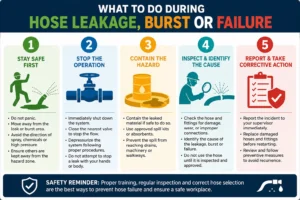
Hose failure is an emergency that requires a fast, calm, and structured response.
- Stop the operation immediately and alert nearby workers.
- Shut off the pressure source feeding the affected hose.
- Depressurise the system if it is safe to do so.
- Move all workers away from the danger zone.
- Put on appropriate PPE before approaching the affected area.
- Follow your facility’s spill control procedure for chemicals, oil, fuel, or any hazardous media.
- Do not touch leaking chemicals directly with bare hands or skin.
- Tag the damaged hose out of service and prevent its reuse until inspected.
- Do not reinstall or use the failed hose without a thorough inspection and approval.
- Replace the hose if it has failed or cannot be verified as safe.
- Record the incident including time, location, likely cause, and any injuries.
- Review the root cause to prevent the same failure from happening again.
Industrial Hose Safety Checklist for Factories
Use this final checklist to confirm complete hose safety across your facility:
- Correct hose selected for the application and media
- Media chemical compatibility confirmed
- Working pressure verified against system pressure
- Temperature rating verified for both media and environment
- Fittings and couplings are correct type, size, and material
- Installation inspected — no twist, no sharp bends
- Hose routing is clean, supported, and accessible
- Minimum bend radius maintained
- Hose protected from abrasion and mechanical damage
- Hose protected from heat sources
- Hose inspected before starting operation
- All workers trained on hose safety and emergency procedures
- Required PPE available and in use
- Emergency shut-off procedure in place and communicated
- Damaged hoses tagged, removed, and replaced
- Inspection and maintenance records up to date
- Replacement schedule being followed
Conclusion
Industrial hose safety is not a single action — it is an ongoing commitment that spans every stage of a hose’s working life. From correct hose selection and compatibility checks to hose pressure safety, hose installation safety, daily hose handling safety, scheduled inspection, and proper maintenance, every step contributes to a safer factory environment.
The industrial hose inspection checklist and the do’s and don’ts in this guide give factory teams a practical framework to work with every day. Worker training and factory safety compliance complete the picture — ensuring that safety knowledge is applied consistently at every level of the operation.
By following these industrial hose safety guidelines, factories can significantly reduce the risk of hose-related accidents, extend hose service life, lower replacement and downtime costs, and demonstrate a genuine commitment to worker safety and regulatory compliance.
For industries that depend on safe and reliable hose performance, choosing the right rubber hose and following proper safety practices is essential for long-term productivity and workplace protection. Rubber Hose India supports industries with durable, application-specific and safety-focused industrial rubber hose solutions for different operating conditions.
FAQs on Industrial Hose Safety Guidelines
Why is factory hose safety important?
Factory hoses carry pressurised and often hazardous media including steam, chemicals, oil, fuel, and abrasive slurry. A hose failure can cause worker injury, chemical exposure, fire, equipment damage, and costly production downtime. Following factory hose safety practices protects workers, supports regulatory compliance, extends hose service life, and helps maintain uninterrupted operations across the facility.
What is included in an industrial hose inspection checklist?
An industrial hose inspection checklist includes checks for cuts, cracks, swelling, abrasion, exposed reinforcement, leakage at fittings, loose clamps, kinks, burn marks, chemical attack, pressure and temperature rating verification, hose routing, end connections, and whether the hose is being used for the correct application. Inspections should be done daily before use, weekly for condition monitoring, and monthly for a full review.
Why is hose pressure safety important?
Hose pressure safety is critical because using a hose beyond its rated working pressure can cause sudden burst or fitting ejection under pressure. This releases fluid violently and can injure workers, damage equipment, and trigger fire or chemical exposure incidents. Always verify pressure ratings, use pressure gauges, install relief valves where needed, and never use a damaged hose under pressure.
What are the best hose handling safety tips?
Key hose handling safety tips include: always depressurise before disconnecting, wear appropriate PPE, never drag hoses on sharp surfaces, avoid lifting hoses by their fittings, use hose reels and supports for heavy hoses, keep workers clear of hose whip zones, and report any visible damage immediately. Workers should also never run vehicles over hoses or force hoses into tight bends.
How often should industrial hoses be inspected?
Industrial hoses should be inspected before every use as a minimum. A brief visual check before operation takes only a few minutes but can prevent serious accidents. More thorough weekly checks should cover fittings, clamps, and abrasion zones. A comprehensive monthly inspection should review overall condition, service records, and replacement requirements. High-risk applications may require more frequent formal inspection.
What are common causes of industrial hose failure?
Common causes include operating above rated working pressure, using a hose with incompatible media, incorrect installation such as twisting or sharp bending, abrasion damage from contact with surfaces, heat damage, chemical degradation of the inner tube, corrosion of fittings, and continued use of an aged or damaged hose beyond its service life. Most failures are preventable through correct selection, installation, and regular inspection.
How can factories improve hose safety compliance?
Factories can improve hose safety compliance by implementing a documented hose management programme that covers selection criteria, installation procedures, inspection schedules, maintenance records, worker training, PPE requirements, and replacement policies. Regular safety audits, labelling of hoses, and clear reporting procedures for damaged hoses all contribute to building a strong safety culture around hose management.