
Industrial hoses are the lifelines of modern manufacturing, processing, and heavy engineering. Focus on their role as they transport volatile chemicals, high-pressure steam, abrasive materials, and essential fluids across massive factory floors and critical infrastructure. When these hoses fail, operations grind to a halt. Worse, failures can lead to severe safety hazards, environmental damage, and costly downtime.
To prevent these disasters, engineers and procurement managers focus on strict industrial hose quality standards. These guidelines dictate exactly how a hose must be built, tested, and maintained to ensure peak performance under extreme conditions.
This guide explores the critical landscape of industrial hose compliance, with a special focus on standards. We will walk you through the primary global standards, essential certifications, rigorous testing methods, and the manufacturing quality control processes that keep your operations running safely.
The Critical Importance of Quality Standards
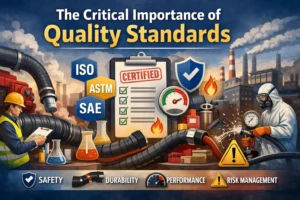
Quality standards are not just bureaucratic hurdles. They are essential frameworks that guarantee an industrial hose will perform exactly as expected under specific pressures, temperatures, and chemical exposures. For B2B buyers, the focus should be on understanding rubber hose standards as the first step in risk management.
Ensuring Safety, Durability, and Performance
When you purchase a hose for a high-pressure hydraulic system or a corrosive chemical transfer, your focus should be on safety and durability. Quality standards dictate the minimum requirements for tensile strength, burst pressure, and material composition. By adhering to these benchmarks, manufacturers ensure their hoses deliver long-term durability and reliable performance. This reliability keeps your workers safe from unexpected ruptures or hazardous leaks, so always focus on certified solutions.
The Risks of Using Non-Compliant Hoses
Cutting corners on industrial hose compliance introduces massive liabilities. If you lose focus on compliance, using non-compliant or uncertified hoses can lead to catastrophic blowouts. A sudden loss of pressure in a hydraulic line can cause heavy machinery to collapse. A leak in a chemical transfer line can expose workers to toxic substances and trigger massive environmental fines. Furthermore, frequent hose replacements caused by poor durability will ultimately cost far more than investing in certified industrial hoses upfront. Focus on preventing these risks with proper standards.
Key Industrial Hose Standards
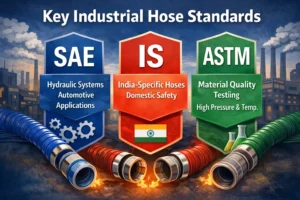
Navigating the various acronyms and regulatory bodies can feel overwhelming. However, a few key organizations focus on setting the rules for the vast majority of industrial applications. Understanding these specific benchmarks helps procurement managers focus on sourcing the right products for their precise needs.
IS Standards for Rubber Hoses
In India, the Bureau of Indian Standards (BIS) sets the IS standards for rubber hoses. These guidelines focus on everything from water delivery hoses to specialized applications like welding, sandblasting, and chemical transfer. For example, IS 444 covers general-purpose water hoses, while IS 5139 dictates the requirements for hoses used in agricultural spraying. For manufacturers operating in or sourcing from India, focus on IS standard compliance as an absolute necessity to ensure market viability and operational safety.
SAE Hose Standards
The Society of Automotive Engineers (SAE) sets the global benchmark for hydraulic hoses. SAE hose standards, specifically the SAE J517 guidelines, categorize hoses based on their construction, pressure ratings, and intended applications (such as 100R1, 100R2, and so on). Engineers focus heavily on SAE ratings to specify the correct wire-braided or spiral-reinforced hoses for heavy machinery, earthmoving equipment, and automotive fluid transfer systems.
ASTM Hose Standards
The American Society for Testing and Materials (ASTM) focuses heavily on the physical properties of the materials used to build the hoses. ASTM hose standards detail the exact testing protocols for rubber compounds, synthetic polymers, and reinforcing fabrics. These standards focus on how specific materials react to heat, ozone, and tearing forces. By requiring ASTM compliance, buyers know the base materials of their hoses are scientifically proven to withstand their working environment.
The Role of Global Compliance
Operating in a global market means your equipment might be manufactured in Europe, assembled in Asia, and deployed in North America. Global standards maintain focus on interoperability. When you specify a hose that meets international benchmarks, you guarantee that replacement parts will fit, systems will integrate smoothly, and your facilities will pass international safety audits regardless of their physical location.
Essential Industrial Hose Certifications
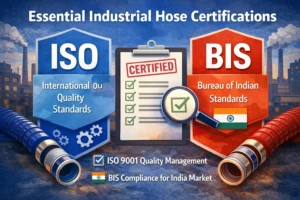
While standards dictate how a hose should be made, industrial hose certifications prove that a manufacturer actually followed those rules. Certifications involve third-party audits and continuous monitoring, so focus on verifying certifications every time.
ISO and BIS Certifications
The International Organization for Standardization (ISO) provides overarching quality management frameworks, such as ISO 9001. When a manufacturer holds this certification, it proves they have consistent, documented processes for building industrial hoses. Additionally, specific ISO standards (like ISO 1436 for rubber hoses) focus on exact product specifications.
Similarly, BIS certification acts as a stamp of approval for the Indian market, proving that the product meets stringent domestic safety requirements with a clear focus on compliance.
Why Certified Industrial Hoses Matter in B2B
For procurement managers, focusing on certified industrial hoses simplifies the purchasing process. A certification acts as a shortcut to trust. It removes the need for buyers to independently audit a supplier’s factory. Buying certified products also protects companies from liability; if a failure does occur, you can prove to insurance adjusters and regulators that you purchased equipment verified by recognized global authorities. Always focus on certifications for peace of mind.
Hose Quality Testing Methods
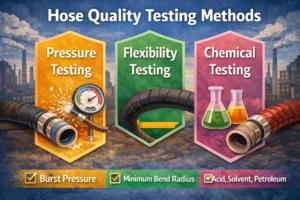
You cannot verify durability just by looking at a hose. Manufacturers must focus on subjecting their products to robust rubber hose testing methods to ensure they survive real-world conditions.
Hydrostatic Pressure Testing
Pressure testing is the most fundamental evaluation of a hose’s integrity. Technicians focus on filling the hose with water and slowly increasing the internal pressure. They test for the maximum “working pressure” (where the hose must operate safely) and the “burst pressure” (the exact point where the hose violently ruptures). Industry standards usually require the burst pressure to be at least four times the working pressure.
Flexibility and Bend Radius Testing
Industrial environments require hoses to snake around tight corners and heavy machinery, so focus is placed on flexibility testing. Flexibility testing determines the minimum bend radius—how tightly a hose can be bent before it kinks, restricts flow, or suffers structural damage to its wire reinforcement.
Temperature Resistance Evaluation
Hoses constantly face extreme heat from internal fluids and external weather. Temperature resistance tests focus on exposing the hose materials to freezing cold and blistering heat inside specialized environmental chambers. Technicians evaluate the rubber to ensure it does not turn brittle and crack in the cold, or turn soft and lose pressure retention in the heat.
Abrasion Resistance Testing
Hoses dragged across concrete floors or exposed to heavy vibration will wear down over time. Abrasion resistance testing involves a focus on grinding the outer cover of the hose against a rough, rotating wheel. The amount of material lost over a specific period dictates how well the hose will survive in harsh physical environments like mines and construction sites.
Chemical Compatibility Testing
When transporting acids, solvents, or petroleum products, the inner tube of the hose must resist chemical degradation. Chemical compatibility testing focuses on soaking the hose material in specific harsh chemicals for extended periods. Engineers then measure the rubber to see if it swelled, lost tensile strength, or dissolved.
The Manufacturing Quality Control Process
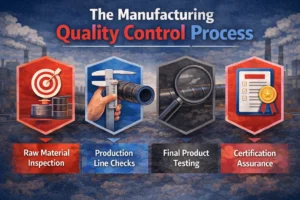
Reliable hose quality testing does not just happen at the end of the line. Top-tier manufacturers implement a strong focus on quality control in hoses at every stage of production.
Raw Material Checks
Quality control starts before the hose is even built. Manufacturers must meticulously focus on testing incoming raw materials. They evaluate batches of synthetic rubber for correct chemical composition. They test the high-tensile steel wire or textile yarns used for reinforcement to ensure they meet required strength metrics. If the raw materials fail, the batch is rejected immediately.
In-Process Inspection
As the hose moves through the factory, continuous checks take place. Technicians focus on using laser micrometers to measure the exact thickness of the inner tube and outer cover as they are extruded. If a machine drifts off calibration by even a fraction of a millimeter, alarms sound. Operators also focus on monitoring the braiding machines to ensure the wire reinforcement is applied with perfect tension and coverage.
Final Product Testing
Once the hose is cured and finished, it undergoes final testing. This includes visual inspections for surface defects, dimensional checks, and sample testing from every production run. Only after a batch passes these final hurdles is it stamped with its relevant industrial hose quality standards and shipped to the customer, reflecting a constant focus on quality at every step.
Compliance Across Industry Applications
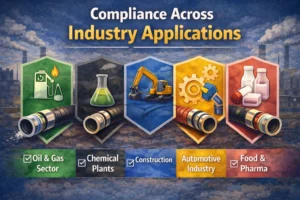
Different industries demand vastly different specifications. Industrial hose compliance means matching the right standard to the right sector, so always focus on the needs of your specific industry, whether for local use or international export.
Domestic and Export Market Compliance
Manufacturers producing hoses for export must focus on navigating a web of international regulations. A hose heading to a European pharmaceutical plant must meet different standards than a hose heading to a Texas oil rig. Maintaining compliance across both domestic and export markets requires manufacturers to hold multiple certifications and focus deeply on international trade requirements.
Oil and Gas Industry
The oil and gas sector requires hoses that can handle extreme pressures, abrasive drilling muds, and highly combustible materials. Focus on using hoses that adhere strictly to SAE and API (American Petroleum Institute) standards to prevent catastrophic blowouts on drilling rigs.
Chemical Processing
Chemical plants rely on hoses lined with specialized materials like PTFE or UHMWPE to transfer aggressive acids and solvents. Focus on strict chemical compatibility testing and adherence to specific ASTM material guidelines to prevent toxic leaks.
Food and Beverage
Hoses used in breweries, dairies, and food processing plants must meet strict sanitary standards, such as those set by the FDA or 3-A Sanitary Standards. These hoses cannot impart any taste or odor to the product, and they must withstand aggressive, high-temperature cleaning processes without degrading. Focus on hygiene and safety above all for these applications.
Construction and Mining
In construction, durability is everything. Hoses used for concrete pumping, sandblasting, and pneumatic tools face constant abrasion and heavy impacts. Focus is given to standards on tear resistance and outer cover durability of these hoses to ensure they survive rugged job sites.
Conclusion
Understanding industrial hose quality standards is not optional for modern B2B operations—it is a critical necessity. By familiarizing yourself with IS, SAE, and ASTM benchmarks and making focus your priority, you empower your procurement and engineering teams to make safer, smarter purchasing decisions. Rigorous rubber hose testing methods and dedicated quality control in hoses ensure that the products you rely on will perform under the harshest conditions. Never compromise on compliance and focus on quality, because the cost of a failed hose will always exceed the investment in a certified, high-quality product.
Are you ready to upgrade your operations with fully certified, high-performance industrial hoses? Contact our engineering team today to request a quote or discuss your specific compliance requirements. Let us help you find the perfect, standard-compliant solution for your toughest applications. Focus on quality. Focus on safety. Focus on success.
Frequently Asked Questions
Why are SAE hose standards important?
SAE standards specifically govern hydraulic hoses. They categorize hoses by pressure rating and construction type, allowing engineers to focus on specifying the correct, safe hose for high-pressure machinery and heavy equipment.
How is hose quality testing performed?
Hoses undergo rigorous physical evaluations. Testing includes hydrostatic burst testing to check pressure limits, abrasion tests for outer cover durability, and chemical soaking to verify the inner tube can withstand harsh fluids. Always focus on these tests during procurement.
What is the difference between IS and ASTM hose standards?
IS standards are set by the Bureau of Indian Standards and are largely required for products manufactured or sold in India. ASTM is an international organization that primarily focuses on the specific testing methodologies and physical properties of the materials used to build the hoses.
Why should my company only buy certified industrial hoses?
Certified hoses have been independently verified to meet safety and performance benchmarks. Focus on buying certified products to protect your workers from accidents, prevent costly operational downtime, and shield your company from liability in the event of equipment failure.