
When it comes to industrial fluid transfer, one of the most debated decisions is choosing between a flexible hose vs rigid pipe. On the surface, it sounds simple. But the wrong choice can cost you money, downtime, and in worst cases — safety incidents.
Plant managers, maintenance engineers, and procurement teams deal with this question constantly. Should you run a fixed metal pipe through your facility? Or install a flexible hose that can move, bend, and adapt? The answer depends on your specific application — and this guide will help you make the right call.
We’ll look at how each option performs across installation, vibration handling, maintenance, pressure, temperature, and total cost of ownership.
What Is a Flexible Hose?
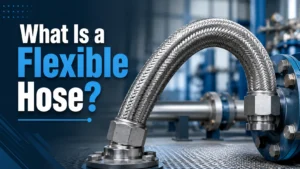
A flexible hose is a type of conduit designed to carry fluids, gases, or semi-solids while allowing movement, bending, and repositioning. Unlike rigid piping, flexible hoses can absorb vibration, accommodate misalignment, and be routed through tight or complex spaces without the need for multiple joints or elbows.
Common types of flexible hoses used in industry include:
Rubber Hoses — Made from natural or synthetic rubber, these Rubber Hoses are widely used for water, air, oil, and chemical transfer. They are lightweight, easy to handle, and available in a wide range of pressure ratings.
Hydraulic Hoses — Reinforced with steel wire braiding or spiral layers, hydraulic hoses are built for high-pressure fluid transfer in hydraulic systems. They are a staple in construction equipment, presses, and manufacturing lines.
Composite Hoses — These use multiple layers of film, fabric, and wire to handle aggressive chemicals, fuels, and solvents. They are common in petrochemical and marine applications.
Thermoplastic Hoses — Made from synthetic thermoplastic materials, these hoses offer high pressure resistance combined with flexibility and light weight. They are preferred where rubber may degrade due to chemical exposure.
In flexible piping systems, hoses replace rigid piping segments wherever movement, vibration, or periodic disconnection is needed. They are connected using hose fittings, couplings, clamps, or crimp ends depending on the application and pressure requirement.
What Is a Rigid Pipe?
A rigid pipe is a fixed conduit made from metal or hard plastic, used to carry fluids from one point to another along a permanent, unchanging route. Once installed, rigid pipes do not flex or move. They are cut to length, joined with welding, threading, or flanges, and fixed to structures using supports and brackets.
Common materials for rigid industrial piping include:
Carbon Steel Pipes — Standard choice for general industrial use, water, steam, and oil. Cost-effective and strong.
Stainless Steel Pipes — Used where corrosion resistance is critical — food processing, chemicals, pharmaceuticals, and marine environments.
Cast Iron Pipes — Found in older installations for drainage and low-pressure water lines.
Copper Pipes — Used in HVAC systems and domestic water supply.
PVC/CPVC Pipes — Non-metallic rigid pipes for chemical handling, water treatment, and drainage at lower pressures and temperatures.
Rigid piping forms the backbone of most permanent industrial piping systems — main headers, distribution lines, plant-wide fluid networks, and long-distance runs.
Flexible Hose vs Rigid Pipe: Quick Comparison Table
Flexible Hose Advantages
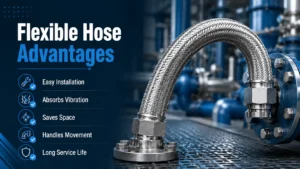
One of the main reasons industries switch from rigid piping to flexible hoses is the sheer number of practical advantages they offer in real-world conditions.
Easy and Fast Installation
Hose installation benefits start from day one. Flexible hoses arrive pre-assembled or are assembled on-site with basic tools. They do not need welding, pipe threading machines, or large installation crews. A single technician can often complete a hose connection in minutes.
This speed matters during initial construction and, more importantly, during shutdowns. Every hour of downtime costs money. A hose that can be replaced in 15 minutes versus a pipe section that requires hours of work is a significant operational advantage.
Superior Vibration Absorption
Vibration is one of the leading causes of pipe fatigue and failure in industrial plants. Pumps, compressors, engines, and motors generate constant vibration that travels through rigid pipe joints and welds, gradually weakening the system.
Flexible hoses absorb and isolate this vibration naturally. This reduces stress on connected equipment, fittings, and structural supports — extending the overall life of the system.
Accommodates Movement and Misalignment
Machines move. Thermal expansion causes pipes to grow and contract. Pumps and tanks shift slightly over time. Rigid pipes cannot accommodate this movement without complex expansion loops, bellows, or sliding joints — all of which add cost and potential failure points.
Flexible hoses handle angular misalignment, lateral offset, and axial movement without any special provisions. This makes them ideal for connecting rotating equipment, heat exchangers, and any installation where exact alignment is difficult to guarantee.
Less Fittings, Elbows, and Joints
In complex routing situations, rigid pipe requires multiple elbows, tees, reducers, and flanges to navigate around obstacles. Each fitting is an additional potential leak point and adds to installation time and cost.
A single flexible hose can often replace a series of rigid pipe sections and fittings, reducing the total number of joints in the system — and the number of places where things can go wrong.
Ideal for Compact and Confined Spaces
Flexible hoses bend and route through spaces where rigid pipe simply cannot fit without major structural work. In retrofit projects, ship engine rooms, mobile machinery, and tight equipment bays, flexible hoses are often the only practical solution.
Easy Replacement and Maintenance Access
When a flexible hose reaches end of life, replacement is straightforward. Disconnect, remove, fit the new hose, and reconnect. No angle grinders, no welding torches, no waiting for pipework to cool.
This simplicity significantly reduces planned maintenance windows and emergency repair time — a key concern for any facility focused on operational efficiency.
Suitable for Temporary or Changing Setups
In applications where process routing changes periodically — batch processing, pilot plants, rental equipment, or temporary installations — flexible hoses allow reconfiguration without major rework. This is impossible with welded rigid piping.
Rigid Pipe Disadvantages
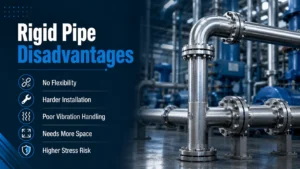
Rigid pipe is not without its weaknesses. While it excels in permanent, fixed applications, its limitations become clear when conditions require flexibility, speed, or adaptability.
Difficult and Time-Consuming Installation
Rigid pipe must be measured, cut, threaded or bevelled, fitted, and welded or flanged into place. This requires skilled tradespeople, specialist tools, and significant time. For complex routing, this process can take days or weeks.
More Fittings, Welds, and Potential Leak Points
Every change in direction, diameter, or branch requires an additional fitting. Every fitting is a potential source of leakage, especially in high-vibration environments or where gaskets degrade over time. The more complex the run, the more joints — and the higher the risk.
Poor Vibration Absorption
Rigid pipe transmits vibration throughout the system. Over time, this causes fatigue cracking at welds, joint failures, and damage to connected equipment. In pump discharge lines and compressor outlets — two of the highest-vibration points in any plant — rigid pipe without vibration isolation leads to premature failures.
High Labour Requirement for Modifications
If a piece of equipment is relocated, or the process requires rerouting, rigid pipe must be cut out and new sections fabricated and installed. This is expensive and time-consuming. It is a real disadvantage in facilities where layouts change regularly or equipment upgrades are planned.
Risk of Cracking Under Thermal Movement
Metals expand and contract with temperature changes. In long rigid pipe runs without proper expansion provision, this thermal movement creates stress that can eventually cause cracks at welds or threaded joints. These failures can be sudden and dangerous.
Higher Downtime During Replacement
When a rigid pipe section fails or needs replacement, the surrounding system often needs to be drained, depressurised, and isolated. Cutting out the failed section, fabricating a replacement, and welding it in place can take hours or days — significantly impacting production.
Industrial Hose vs Pipe: Which One Works Better?
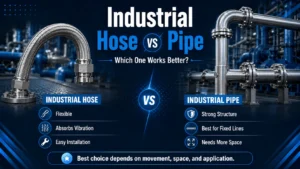
The honest answer is: it depends on the application. The industrial hose vs pipe debate is not about one being universally superior — it is about using the right tool for the right job.
Use flexible hoses when:
- Connecting pumps, compressors, or any rotating/vibrating equipment.
- Equipment needs to be disconnected for maintenance.
- Space is limited and routing is complex.
- You need fast installation or easy replacement.
- The connection must handle thermal movement or equipment drift.
Use rigid piping when:
- Running long, fixed distribution lines across a plant.
- The application involves very high temperatures (steam mains, fired heaters).
- The pipe carries highly hazardous fluids where permanent, inspectable welds are required.
- Regulatory codes mandate rigid piping (as in some pressure vessel and boiler connections).
- The line will not need to be disconnected for many years.
In most real-world plants, both exist side by side. Main headers are in rigid pipe. The final connections to individual equipment — pumps, heat exchangers, reactors — are made with flexible hoses. This hybrid approach combines the durability of permanent piping with the practicality of flexible connections.
Rubber Hose vs Metal Pipe
The rubber hose vs metal pipe comparison is especially useful for maintenance teams choosing between the two for specific tasks.
For applications involving moderate pressures and temperatures, chemical compatibility, and frequent maintenance access, rubber hose is often the more practical option. For permanent high-temperature or high-pressure installations — steam, high-pressure gas, boiler connections — metal pipe remains the preferred choice.
Flexible Hose Applications
Flexible hoses are used across virtually every industry. Here are the most common and important flexible hose applications:
- Hydraulic Systems — Hydraulic hoses connect pumps, cylinders, valves, and motors in presses, excavators, cranes, injection moulding machines, and industrial robots. They handle pressures up to 700 bar in some specialist applications.
- Pneumatic Lines — Compressed air lines use flexible hoses to connect compressors to distribution networks, tools, and actuators. The flexibility allows tools and pneumatic equipment to be moved freely.
- Water Transfer — From irrigation systems and fire hoses to industrial cooling water circuits, flexible hoses handle water transfer across a massive range of applications.
- Chemical Transfer — Chemical-resistant composite and rubber hoses are used to transfer acids, alkalis, solvents, and other process chemicals between storage vessels, reactors, and processing equipment.
- Oil and Fuel Transfer — In refineries, fuel depots, and service stations, flexible hoses handle petroleum products safely. Specialised hose materials ensure compatibility with different fuel types.
- Steam Lines — High-temperature flexible hoses and metal corrugated hoses are used for steam connections, particularly at equipment connection points where thermal expansion and vibration are concerns.
- Material Handling — Bulk material hoses transfer cement, grain, sand, and other dry materials through pneumatic conveying systems.
- Construction Equipment — Excavators, bulldozers, cranes, and concrete pumps all rely on flexible hydraulic hoses. The constant movement of these machines makes rigid piping impractical.
- Manufacturing Plants — CNC machines, robotic systems, cooling circuits, and lubrication lines in manufacturing facilities all use flexible hoses extensively.
- Food and Beverage Plants — Where hygiene is critical, food-grade flexible hoses made from FDA-compliant materials are used to transfer liquids, slurries, and gases in breweries, dairy plants, and food processing facilities.
When Should You Choose a Flexible Hose?
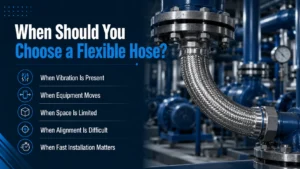
Choose a flexible hose when:
- The connection point experiences vibration from a pump, motor, compressor, or engine.
- The equipment needs to be disconnected for regular servicing or cleaning.
- You are routing through a confined or complex space.
- The installation is temporary or subject to future changes.
- Thermal expansion needs to be accommodated without expansion loops.
- Fast installation is a priority — during initial build or emergency repairs.
- You are connecting mobile or portable equipment.
When Should You Choose Rigid Pipe?
Choose rigid pipe when:
- You are building long, permanent distribution headers across a facility.
- The fluid is at very high temperature (above what flexible hoses can handle).
- Regulations or engineering standards require permanent welded connections.
- The system will not need to be disconnected for many years.
- Fire resistance is a critical requirement (metal pipes do not burn).
- You require X-ray or pressure-tested weld quality for hazardous fluid containment.
Common Mistakes When Choosing Hose or Pipe
These mistakes are surprisingly common — and they cost facilities money, safety incidents, and unnecessary downtime.
- Using the Wrong Material — A rubber hose on a fuel application where only a fuel-resistant compound is suitable, or a carbon steel pipe on an acid line. Always check chemical compatibility before specifying any hose or pipe material.
- Ignoring Pressure Ratings — Using a hose rated for 10 bar on a system running at 25 bar is a serious safety risk. Always apply a safety factor and verify the Working Pressure and Burst Pressure of any hose assembly.
- Ignoring Temperature Limits — Every hose has a maximum continuous operating temperature. Exceeding it causes accelerated degradation, swelling, and eventual failure. Check both fluid temperature and ambient temperature.
- Wrong Bend Radius — Flexible hoses have a Minimum Bend Radius (MBR). Installing a hose in a tighter bend causes internal kinking, stress on the reinforcement layers, and premature failure. Always follow the manufacturer’s MBR specification.
- Poor Installation Practices — Twisting a hose during installation, over-tightening fittings, or allowing the hose to rub against sharp edges dramatically reduces service life. Proper installation is as important as material selection.
- Ignoring Chemical Compatibility — The hose tube (inner lining), reinforcement, and outer cover must all be compatible with the fluid being transferred. Many hose failures in service trace back to incompatible materials that were simply not checked at procurement stage.
- Buying Only on Price — The cheapest hose is rarely the most economical option. A quality hose assembly that lasts three years costs far less than a cheap one replaced every six months — especially when you factor in labour, downtime, and the risk of failure.
Final Recommendation
When evaluating flexible hose vs rigid pipe for your application, there is no single universal answer. Both have their place in well-designed industrial systems.
For connections to moving equipment, vibration-prone areas, compact spaces, and situations requiring easy maintenance or quick replacement, flexible hoses are the better choice. They install faster, handle movement and vibration naturally, and make maintenance significantly simpler.
For permanent, long-distance fixed runs — main distribution headers, high-temperature steam lines, highly hazardous fluid containment — rigid pipes remain the preferred solution. They offer unmatched durability, fire resistance, and the ability to meet stringent code requirements for welded construction.
In most modern industrial plants, the smartest approach is to combine both: permanent rigid piping for the backbone of the system, and flexible hoses for all the final connections and equipment interfaces.
If you are looking for high-quality industrial hoses, rubber hoses, hydraulic hoses, or custom hose assemblies for your plant or equipment, Rubber Hose India LLP is a trusted B2B manufacturer and supplier in India. They supply a wide range of industrial hoses and fluid transfer solutions to OEMs, plant operators, and procurement teams across various industries. Their expertise in hose assembly and application support can help you select the right solution for your specific requirements.
Frequently Asked Questions
Is Flexible Hose Better Than Rigid Pipe?
For moving equipment, vibration-prone connections, and compact or changing layouts, yes. For long-term permanent distribution lines and very high-temperature applications, rigid pipe is often the better choice. Most industrial systems use both.
Where Are Flexible Hoses Commonly Used?
Flexible hoses are widely used in hydraulic systems, pneumatic lines, water and chemical transfer, oil and fuel handling, steam connections, food and beverage plants, construction equipment, and manufacturing machinery.
What Are the Main Flexible Hose Advantages?
The main advantages include easy and fast installation, excellent vibration absorption, the ability to handle movement and misalignment, fewer fittings and joints, suitability for confined spaces, and simple replacement during maintenance.
What Are the Disadvantages of Rigid Pipes?
Rigid pipes are difficult and slow to install, require skilled welding or threading, transmit vibration that can cause fatigue cracking, are difficult to modify or reroute, and demand significant labour for replacement — all resulting in longer downtime.
Is Rubber Hose Better Than Metal Pipe?
For applications requiring flexibility, light weight, and easy maintenance at moderate pressures and temperatures, yes. For permanent high-temperature or high-pressure installations — such as steam or boiler systems — metal pipe is more suitable.
Which Is Better for Industrial Fluid Transfer?
It depends on the application. Flexible hoses are better for equipment connections, vibration zones, and maintenance-intensive setups. Rigid pipes are better for fixed, long-distance, high-temperature distribution lines.
Can Flexible Hoses Handle High Pressure?
Yes. Hydraulic hoses are engineered to handle pressures up to 700 bar in specialist applications. Always verify the rated Working Pressure of the specific hose type against your system requirements, and apply an appropriate safety factor.
Are Flexible Hoses Easy to Install?
Yes. Flexible hoses require minimal tools and no welding. Most connections can be completed by a trained technician in minutes, making them significantly faster to install than rigid pipe systems.
How Do I Choose Between Hose and Pipe for My Industry?
Evaluate your application based on: fluid type and pressure/temperature requirements, whether the connection needs to handle vibration or movement, how frequently the line needs to be disconnected, available installation time, and applicable industry standards or regulations. When in doubt, consult a specialist hose supplier or engineering team.