
Choosing the right rubber hose for slurry and fly ash is one of the most critical decisions for plant engineers, procurement managers and OEM buyers. These hoses operate in some of the most demanding industrial environments — carrying abrasive fly ash particles, heavy cement slurry and mining slurry that can wear out inferior hoses within weeks. This guide covers everything you need to know about selecting the right hose, understanding its key features and evaluating suppliers in India.
What Is a Rubber Hose for Slurry and Fly Ash?
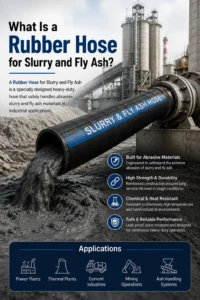
A rubber hose for slurry and fly ash is a specially designed industrial hose built to handle the transfer of abrasive, semi-fluid materials in demanding process environments. Unlike standard water or air hoses, these hoses are engineered to withstand continuous contact with particles that cause rapid internal wear.
The most common applications include:
- Slurry transfer in cement manufacturing and mineral processing
- Fly ash handling in thermal power plants and cement batching units
- Cement slurry movement in construction, ready-mix plants and grouting applications
- Mining slurry transfer in mines and ore processing facilities
- Abrasive material handling across industrial bulk transfer systems
A fly ash rubber hose is specifically designed for the fine, dusty and abrasive nature of fly ash — a byproduct of coal combustion. A slurry rubber hose, on the other hand, is built for wet, heavy-solid mixtures like cement slurry or mineral slurry. A cement slurry hose combines the demands of both — pressure handling and abrasion resistance together.
Material handling rubber hose covers a broader category, including granules, dry powders, bulk solids and abrasive media across industries like steel, chemicals and construction.
Why Normal Rubber Hoses Fail in Slurry and Fly Ash Applications
Many plant operators make the costly mistake of using general-purpose hoses in slurry and fly ash lines. The result is predictable: premature failure, frequent shutdowns and unexpected replacement costs. Here are the main reasons normal rubber hoses are not suitable for these applications:
- Abrasion from fly ash and cement particles: Fine ash and hard cement particles continuously grind the inner tube surface, causing wall thinning and eventual puncture. A rubber hose for abrasive material must have a thick, wear-resistant inner tube to survive this environment.
- High pressure during material transfer: Slurry transfer often involves elevated discharge pressures. Hoses without suitable reinforcement collapse, kink or burst under this load.
- Continuous bending and movement: Equipment vibration and flexible routing cause repeated bending stress. Hoses with stiff or poor construction crack at bend points.
- Improper hose selection: Using a water hose for slurry duty, for example, leads to rapid inner tube degradation — the rubber compound is simply not formulated for solid particle media.
- Poor inner tube quality: Low-grade rubber compounds lack the hardness and abrasion resistance needed. An abrasion resistant rubber hose uses specifically compounded NR, SBR or NR/SBR blends with higher hardness ratings.
- Wrong reinforcement: Inadequate textile or wire reinforcement layers allow the hose to deform under pressure, accelerating inner tube failure.
- Temperature and chemical exposure: Fly ash and cement environments may involve elevated temperatures or mild chemical contact. Without EPDM or suitable compound selection, the hose degrades faster.
- Incorrect installation: Tight bends, improper clamp tightening and misaligned fittings create stress concentration points that shorten even a heavy duty cement hose lifespan significantly.
Key Applications of Slurry and Fly Ash Rubber Hose
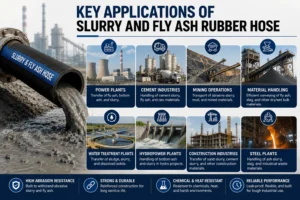
Fly Ash Transfer in Cement Plants
Fly ash is produced in large quantities at thermal power plants and is a key supplementary material in cement manufacturing. A fly ash rubber hose is used in ash extraction lines, pneumatic ash transfer systems and cement batching plants where fly ash is conveyed as a fine dry or semi-wet material. These hoses must resist fine particle abrasion and static buildup while maintaining flexibility for equipment connection.
In cement batching plants, fly ash rubber hoses connect silos to mixers and blending units. The hose must handle both vacuum and positive pressure during material conveying.
Cement Slurry Transfer
A cement slurry hose is used wherever wet cement mix or cement grout needs to be pumped through flexible connections. Applications include construction grouting, concrete pumping lines, shotcrete operations and industrial cement injection. Cement slurry is dense, heavy and highly abrasive — requiring a hose with a combination of strong pressure handling and wear resistance.
Industrial slurry movement in water treatment, filtration and process industries also uses similar hose constructions where thick fluid with suspended solids needs to pass through flexible piping.
Mining Slurry Transfer
Mining operations generate slurry constantly — in ore washing, mineral separation, tailings disposal and concentrate transfer. A mining slurry hose must handle coarse abrasive particles suspended in water or chemical solutions under high pressure. Steel wire reinforcement is common in mining hose constructions to handle both abrasion and surge pressures during pumping.
Abrasive slurry transfer in mining requires hoses with thick inner tubes, often 6–10 mm or more, specifically to absorb the grinding action of hard minerals.
Industrial Material Handling
A material handling rubber hose is used for bulk powder, granules, pellets and other dry or semi-dry abrasive media across process industries. This includes lime powder transfer, sand blasting media, grain handling, plastic pellet conveying and industrial mineral transfer. The key requirement here is a smooth inner lining that reduces friction while resisting wear from particle impact.
Heavy-Duty Cement Plant Applications
Cement plants represent one of the most demanding environments for any industrial hose for cement plant. From raw material grinding areas to kiln feed lines, fly ash blending stations and finished product dispatch systems, hoses face a combination of heat, abrasion, pressure and chemical exposure. A heavy duty cement hose is used across all these stations — connecting fixed pipework to mobile equipment, pumps, blowers and conveyors.
Important Features of a Good Rubber Hose for Slurry and Fly Ash
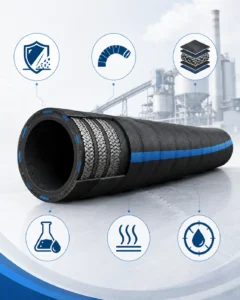
Not all hoses marketed as “slurry grade” offer the same performance. Here are the features buyers should specifically evaluate:
- Abrasion-resistant inner tube: The inner tube is the most critical component. A quality abrasion resistant rubber hose uses NR/SBR blended compounds with high Shore A hardness (typically 60–70) to resist particle grinding. The thickness of this inner tube directly determines service life.
- Strong synthetic or steel wire reinforcement: Multiple layers of high-tensile synthetic textile braid or steel wire spiral provide the pressure handling capacity and structural integrity. Reinforcement selection depends on working pressure and media type.
- Smooth inner lining for better flow: A smooth bore reduces turbulence, minimises material buildup and ensures consistent flow rate — important in cement slurry hose applications where blockage means downtime.
- High flexibility: Despite their robust construction, these hoses must bend easily at equipment connection points. Good hose design balances wall thickness with flexibility to allow routing without kinking.
- Better pressure handling: Slurry rubber hose is typically rated for working pressures of 10–25 bar depending on diameter and reinforcement. Buyers should confirm both working pressure and burst pressure ratings.
- Weather and ozone resistance: Outdoor installations in cement and mining sites expose hoses to UV, ozone and temperature variation. EPDM or CR outer covers provide this protection.
- Long service life: A quality rubber hose for slurry and fly ash should offer measurably longer intervals between replacements compared to general-purpose alternatives, reducing total maintenance cost.
- Leak-proof performance: All connections — crimped or clamped — must maintain a seal under working pressure. A hose that weeps or leaks at fittings creates safety hazards and product loss.
- Suitable end fittings: Flanged ends, BSP/NPT threaded fittings or hose tails should match the plant’s existing connections. Mismatched fittings cause premature failure at joints.
- Custom size availability: Industrial hose needs vary widely. Availability of non-standard lengths, diameters (25 mm to 150 mm or larger) and end configurations is important for OEM and project buyers.
Rubber Hose Specification Chart for Slurry and Fly Ash Applications
Use the table below to match your application with the correct hose type:
| Application | Recommended Hose Type | Inner Tube | Reinforcement | Key Feature | Common Industry |
|---|---|---|---|---|---|
| Fly Ash Transfer | Fly Ash Rubber Hose | Abrasion-resistant rubber | Textile/steel wire | Dust & abrasion resistance | Cement Plant |
| Cement Slurry | Cement Slurry Hose | Wear-resistant rubber | High tensile reinforcement | Slurry handling | Construction / Cement |
| Mining Slurry | Mining Slurry Hose | Heavy-duty rubber | Steel wire / textile | High abrasion resistance | Mining |
| Bulk Material | Material Handling Rubber Hose | Smooth abrasion lining | Reinforced body | Powder/granule movement | Industrial |
| Abrasive Material | Abrasion Resistant Rubber Hose | NR/SBR/EPDM based | Strong reinforcement | Longer hose life | Cement / Mining |
How to use this specification guide:
- Media type: Identify whether you are handling dry fly ash, wet cement slurry, coarse mining slurry or dry bulk material — each requires a different inner tube compound.
- Pressure: Confirm the maximum working pressure in your system, including surge pressures during pump startup.
- Temperature: Fly ash from power plant lines may carry heat. Confirm operating temperature range and select compound accordingly.
- Bend radius: For tight routing, choose a hose with a smaller minimum bend radius. Exceeding this causes kinking and premature failure.
- Working conditions: Outdoor, UV-exposed or chemically contaminated environments require outer cover selection attention.
How to Choose the Right Rubber Hose for Abrasive Material
Selecting a rubber hose for abrasive material requires more than just picking a size. Here is a structured approach that experienced procurement managers and plant engineers follow:
- Type of material: Identify the specific media — fly ash, cement slurry, mining slurry, dry powder or granules. Each has a different abrasiveness level, particle size and moisture content that affects inner tube specification.
- Working pressure: Confirm maximum operating pressure and add a safety margin. Most slurry systems require hoses rated for at least 10–16 bar.
- Temperature range: Note both ambient and media temperature. Standard rubber compounds work to 70°C; EPDM blends extend this to 120°C or more.
- Hose diameter (ID): Match internal diameter to your existing pipeline and flow rate requirement. Undersizing causes velocity increase and faster wear; oversizing causes sedimentation.
- Bend radius: Measure the tightest routing point in your installation. Choose a hose with a minimum bend radius below this value.
- Inner tube quality: Ask for rubber compound specification — NR, SBR, NR/SBR blend — and Shore A hardness. Higher hardness means better abrasion resistance but slightly reduced flexibility.
- Reinforcement type: Textile braid is suitable for moderate pressure. Steel wire spiral is required for high pressure mining or cement slurry lines.
- End connection type: Confirm whether you need flanged ends, BSP/NPT fittings, hose barbs or crimped assemblies to match your system connections.
- Installation environment: Outdoor installations need UV and ozone resistant covers. Underground or enclosed environments may require antistatic properties.
- Expected hose life: Discuss with your supplier what service life is achievable for your specific application and pressure cycle. This helps calculate total cost of ownership vs. upfront price.
Cement Slurry Hose vs Fly Ash Rubber Hose
Buyers often ask whether the same hose can be used for both cement slurry and fly ash. While both are abrasive applications, there are important differences:
| Point | Cement Slurry Hose | Fly Ash Rubber Hose |
|---|---|---|
| Material handled | Wet slurry | Dry / semi-dry fly ash |
| Main challenge | Pressure + abrasion | Fine particle abrasion |
| Hose requirement | Strong reinforcement | Abrasion-resistant lining |
| Industry | Cement / construction | Cement plant / ash handling |
| Best for | Wet material transfer | Powder / fly ash movement |
In practice, some high-specification abrasion resistant rubber hoses can serve both applications when the pressure and temperature parameters overlap. However, using a fly ash rubber hose in a high-pressure wet cement slurry application — or using a cement slurry hose for a pneumatic fly ash line — often leads to suboptimal service life. Consult your supplier with specific details of the application before selecting.
Also, Read: Rubber Hose Testing Methods: Complete Guide for Industrial Hose Safety & Quality (2026)
Why Abrasion Resistance Matters in Slurry Hose Selection
The selection of a rubber hose for slurry and fly ash applications is critical to ensuring effective material transport and minimizing wear and tear on equipment. These specialized hoses are engineered to withstand the abrasive nature of both slurry and fly ash, providing durability and longevity in rigorous industrial environments. It is essential to consider factors such as hose diameter, flexibility, and pressure ratings to optimize performance and safety. Investing in high-quality rubber hoses will enhance operational efficiency and reduce maintenance costs over time.
Abrasive particles in fly ash, cement and mining slurry do not just wear the inner tube surface — they erode it progressively with every operational hour. In a typical cement plant running 20 hours a day, even slightly superior abrasion resistance translates into weeks of additional service life.
The practical benefits of choosing a correctly specified abrasion resistant rubber hose include:
- Lower maintenance cost: Fewer replacement intervals mean reduced labour, fitting and downtime cost over the operational year.
- Reduced leakage risk: As inner tube walls thin from abrasion, the risk of pinhole leaks and eventual burst increases. Abrasion resistant construction delays this significantly.
- Fewer shutdowns: Hose failure in slurry lines typically shuts down the connected equipment. Longer hose life means fewer unplanned stoppages.
- Reduced replacement frequency: Procurement teams can plan scheduled maintenance rather than emergency replacements, improving overall plant efficiency.
Industries handling cement, fly ash, mining slurry and abrasive bulk materials should avoid low-grade hoses that may appear cheaper upfront but fail within weeks of installation. The total cost of ownership — including labour, downtime and emergency procurement — consistently favours quality abrasion resistant hoses.
Common Industries That Use Rubber Hose for Slurry and Fly Ash
The following industries regularly require high-performance slurry and fly ash hoses:
- Cement plants: Industrial hose for cement plant use is one of the largest demand segments — from raw material handling to fly ash blending and finished product dispatch.
- Ready-mix concrete plants: Cement slurry hose is used to connect mixers, pumps and batch hoppers.
- Mining industry: Mining slurry hose handles ore slurry, tailings and concentrate transfer under high pressure.
- Power plants: Thermal power plants generate fly ash continuously and use fly ash rubber hose in ash extraction and handling systems.
- Construction sites: Grouting, shotcrete and concrete pumping operations require flexible cement slurry hoses.
- Material handling units: Bulk powder and granule transfer across process industries uses material handling rubber hose in pneumatic and mechanical conveying systems.
- Steel plants: Slag slurry and process water with suspended solids require abrasion resistant hoses in metallurgical operations.
- Chemical plants: Some chemical processes involve abrasive slurries — acid-resistant compounds with abrasion resistance are required here.
- Bulk powder handling units: Lime, gypsum, fly ash and similar powder materials are conveyed through material handling rubber hose assemblies across processing units.
Slurry Hose Manufacturers India: What Buyers Should Check
Choosing the right supplier is as important as choosing the right hose. When evaluating slurry hose manufacturers India, experienced procurement managers look for the following:
- Product quality: Ask for samples or test reports. Inner tube hardness, tensile strength and abrasion loss values should be available on request from any serious supplier.
- Hose material: Confirm the rubber compound specification — NR, SBR, EPDM or blends — and reinforcement type. Reputable manufacturers are transparent about these details.
- Customisation options: Your application may require non-standard lengths, diameters or end fittings. A capable supplier should accommodate custom assemblies with reasonable lead times.
- Pressure rating: Confirm working pressure and burst pressure for the specific hose construction you are ordering.
- Testing process: Ask whether hoses are hydrostatically tested before dispatch. Batch testing is a basic quality assurance step that serious manufacturers follow.
- Industry experience: Suppliers with established experience in cement, mining and power plant supply understand application-specific requirements better.
- Bulk supply capacity: For plant requirements, confirm that the supplier can handle recurring orders consistently without quality variation between batches.
- Technical support: Pre-purchase guidance on hose selection and post-installation support for troubleshooting are signs of a professional B2B supplier.
- On-time delivery: Downtime waits for no one. Confirm standard lead times, dispatch capabilities and whether emergency or urgent supply is possible.
- Hose fittings and assemblies: End-to-end supply — hose plus fittings plus assembly — saves time and reduces fitting compatibility issues. Check whether your supplier offers crimped or clamped assemblies as complete units.
Rubber Hose India is a trusted B2B supplier and manufacturer of industrial rubber hoses across India, supplying slurry hoses, fly ash hoses, cement hoses and material handling hoses to cement plants, construction projects, mining operations and process industries.
Why Choose Rubber Hose India?
Rubber Hose India supplies industrial rubber hoses engineered for slurry, fly ash, cement plant, mining, construction and bulk material handling applications. The company focuses on using industrial-grade rubber compounds, appropriate reinforcement selection and application-based hose construction — not generic catalogue products.
What makes Rubber Hose India a reliable choice for B2B buyers:
- Application-specific hose selection — not one-size-fits-all recommendations
- Industrial-grade inner tube compounds with verified abrasion resistance
- Custom length, diameter and end fitting options for project and OEM requirements
- Consistent quality across repeat and bulk orders
- Experience supplying certified industrial hoses to cement, mining and power plant segments
- Technical guidance for buyers selecting hoses for new or replacement applications
Whether you need a fly ash rubber hose for a cement batching plant, a slurry rubber hose for a mining application or a heavy-duty industrial hose for cement plant maintenance, Rubber Hose India offers a range designed for demanding working conditions.
Explore More Resources
For cement-specific hose applications, you can also read our detailed guide on industrial hose for cement plant.
Conclusion
Choosing the right rubber hose for slurry and fly ash is not simply a procurement decision — it is a maintenance and operational performance decision. Cement plants, mining operations, power plants and abrasive material handling units all depend on hose performance for consistent throughput, minimal downtime and safe operation.
Before purchasing, evaluate hose material and inner tube compound, abrasion resistance specification, reinforcement type and pressure rating, and confirm full compatibility with your application’s media, temperature and pressure conditions. Buying on price alone in this category consistently leads to higher total costs through premature replacement and unplanned shutdowns.
Looking for a durable rubber hose for slurry, fly ash, cement slurry or abrasive material handling? Contact Rubber Hose India for industrial-grade rubber hose solutions designed for demanding applications.
Frequently Asked Questions
What is a fly ash rubber hose used for?
A fly ash rubber hose is used to transfer dry or semi-dry fly ash in thermal power plants, cement manufacturing facilities and batching plants. Fly ash is a fine, abrasive byproduct of coal combustion and is increasingly used as a supplementary cementitious material. The hose handles fly ash in pneumatic conveying systems, silo connections and blending lines where abrasion resistance, flexibility and dust-tight performance are critical.
Which hose is suitable for cement slurry transfer?
A cement slurry hose is specifically designed for wet cement slurry transfer. It requires a heavy-duty inner tube with wear resistance to handle the combined abrasion and pressure of pumped cement slurry. High-tensile reinforcement — textile or steel wire depending on pressure — provides structural integrity. Flanged or crimped fittings ensure leak-free connections at pump and pipeline joints. Always confirm the hose pressure rating matches your pump's discharge pressure.
Why is abrasion resistance important in slurry hoses?
Abrasive particles in slurry continuously erode the inner tube surface with every pump cycle. In high-throughput operations like cement plants or mining, this wear accelerates significantly. An abrasion resistant rubber hose with the correct inner tube compound and thickness resists this wear, extending service life, reducing replacement frequency and minimising unplanned downtime. Choosing a low-abrasion-resistance hose in these applications typically results in total cost of ownership far higher than the initial price saving.
Can the same hose be used for fly ash and cement slurry?
In some cases, yes — a high-specification abrasion resistant rubber hose with suitable pressure rating and compound selection can serve both applications. However, fly ash hose construction focuses on fine particle abrasion resistance and flexibility, while cement slurry hose construction emphasises pressure handling and wet slurry resistance. Using a fly ash hose in a high-pressure cement slurry line may lead to premature failure. Consult your supplier with full application details before combining hose types across applications.
Which industries use slurry rubber hoses?
Slurry rubber hoses are used across cement plants, ready-mix concrete plants, mining operations, power plants, construction sites, steel plants, chemical plants and bulk material handling units. Any industry that pumps or conveys abrasive fluid mixtures or semi-dry abrasive powders through flexible connections is a user of slurry or fly ash rubber hose. Demand is highest in cement manufacturing, mining and thermal power generation across India.
How do I choose a rubber hose for abrasive material?
Start by identifying the specific abrasive material — particle size, concentration and moisture content. Then confirm working pressure, temperature range, hose diameter and minimum bend radius for your installation. Evaluate inner tube compound for abrasion resistance and reinforcement type for pressure handling. Match end fittings to your existing connections. Finally, ask your supplier for expected service life data for your specific application — this allows a proper total cost comparison across competing products.
What is the difference between material handling hose and slurry hose?
A material handling rubber hose is designed for dry or semi-dry bulk solids — powders, granules, pellets and dry abrasive media. A slurry rubber hose handles wet mixtures of solids suspended in liquid under pump pressure. Material handling hoses emphasise smooth bore and abrasion resistance for particle contact. Slurry hoses add pressure handling and leak-proof reinforcement to resist the hydraulic demands of pumped wet material. Choosing the wrong category for an application leads to premature failure.
Where can I find slurry hose manufacturers in India?
Reliable slurry hose manufacturers India can be found through industrial supplier directories, trade exhibitions like Plastivision or India Rubber Expo and B2B platforms. When evaluating suppliers, prioritise product quality documentation, application experience in cement or mining supply and ability to supply custom assemblies. Rubber Hose India is an established supplier of industrial slurry hoses, fly ash hoses and cement plant hoses across India, serving both project and recurring procurement requirements.
Does Rubber Hose India supply hoses for cement and mining applications?
Yes. Rubber Hose India supplies industrial rubber hoses specifically designed for cement plant, mining and fly ash handling applications. The product range includes fly ash rubber hose, cement slurry hose, abrasion resistant mining hose and material handling hose assemblies with custom end fittings. The company handles both standard and custom orders and supports buyers with application-based hose selection guidance.