
When selecting a hose for industrial operations, the material you choose directly impacts safety, performance, operational continuity, and long-term cost efficiency. The rubber hose vs plastic hose comparison is one of the most common dilemmas faced by plant managers, procurement teams, maintenance engineers, and industrial buyers across sectors ranging from manufacturing to mining.
Both hose types serve fluid transfer needs — but they are not equal when it comes to heavy-duty industrial applications. Understanding the core differences helps you make informed purchasing decisions that prevent costly downtime, hose failure, and safety incidents on your shop floor or plant site.
This guide provides a detailed, technical comparison to help industrial buyers, purchase managers, and engineers select the right hose material for their operational requirements.
What Is a Rubber Hose?
A rubber hose is a multi-layer fluid conveyance product engineered for demanding industrial environments. Its construction typically consists of three components: an inner tube made from a rubber compound compatible with the fluid being conveyed (such as NBR for oil, EPDM for steam, or NR for water), one or more reinforcement layers made of high-tensile textile braid or steel wire, and an outer cover designed to resist abrasion, weather, oil, and mechanical damage.
This layered construction is what makes flexible rubber hoses capable of handling high pressures, extreme temperatures, aggressive chemicals, and continuous mechanical movement. Rubber hose industrial use spans hydraulic systems, compressed air lines, steam transfer, chemical handling, fuel and oil lines, slurry discharge, and many other critical process applications.
Rubber hoses are available in a wide range of specifications — varying by inner diameter, pressure rating, temperature range, fluid compatibility, and reinforcement type — making them highly adaptable to diverse industrial requirements.
What Is a Plastic Hose?
Plastic hoses are generally manufactured from synthetic polymers such as PVC (polyvinyl chloride) or PU (polyurethane). They are lightweight, low-cost, and easy to handle, which makes them a popular choice for domestic, commercial, and light industrial applications.
PVC hoses are widely used for garden watering, low-pressure air supply, domestic water supply, and general fluid transfer where operating conditions are mild. PU hoses offer better flexibility and abrasion resistance than standard PVC but still fall short of rubber hoses in demanding industrial environments.
While plastic hoses are cost-effective for non-critical applications, they are not engineered to withstand the rigorous working conditions found in heavy-duty industrial plants, processing facilities, or construction sites.
Rubber Hose vs Plastic Hose: Basic Difference

The table below Summarises the key factors in this industrial hose material comparison:
| Factor | Rubber Hose | Plastic Hose |
| Flexibility | High — retains flex in heat/cold | Medium — stiffens with age |
| Pressure Handling | Excellent — handles high pressure | Limited — suited to low pressure |
| Durability | Strong in harsh environments | Lower in demanding conditions |
| Temperature Resistance | Excellent (-40°C to 200°C+) | Limited (often <70°C) |
| Abrasion Resistance | Strong — reinforced construction | Moderate — surface wears faster |
| Industrial Use | Heavy-duty, multi-fluid | Light/medium duty |
| Life Span | Longer service life | Shorter in tough conditions |
| Cost | Higher initial investment | Lower upfront cost |
Note: Performance values are indicative and vary by specific product grade and manufacturer specifications.
Rubber Hose Advantages in Industrial Applications
When evaluating rubber hose advantages, it is important to look beyond the initial price point and assess total operational value. Rubber hoses deliver measurable benefits across multiple performance parameters:
- Superior Flexibility: Rubber hoses maintain flexibility across a wide temperature range. Unlike plastic hoses that stiffen with age or in cold conditions, quality flexible rubber hoses retain their bend radius under continuous movement, vibration, and thermal cycling — making them suitable for dynamic connections on moving equipment.
- High Pressure Resistance: Rubber hoses constructed with multi-ply textile or steel wire reinforcement are engineered to safely handle high working pressures. This makes them the preferred choice for hydraulic systems, compressed air mains, and high-pressure fluid transfer where plastic hoses would be inadequate and unsafe.
- Exceptional Durability: Rubber hose durability is a direct result of the material’s resistance to physical wear, UV exposure, ozone, and mechanical fatigue. Rubber hoses hold up under continuous heavy-duty use where plastic alternatives degrade rapidly, leading to premature failure.
- Strong Abrasion Resistance: Industrial environments involve dragging, rubbing, and rough surface contact. The outer covers of industrial rubber hoses are compounded specifically to resist abrasion, cutting, and surface wear — extending service life considerably over unprotected plastic hoses.
- Broad Fluid Compatibility: Rubber hoses are available with inner tube compounds suitable for oil, fuel, air, water, steam, chemicals, slurry, and many aggressive fluids. The inner tube compound is selected to match the conveyed medium, preventing chemical degradation and contamination.
- Temperature Range Performance: Industrial rubber hoses are designed to operate reliably across extreme temperatures — from sub-zero cold storage environments to high-temperature steam lines. Plastic hoses typically lose structural integrity above 60-70°C, making them unsuitable for high-temperature applications.
- Longer Service Life: Due to their robust construction and material properties, rubber hoses generally last significantly longer than plastic hoses in industrial service. This reduces replacement frequency, procurement costs, and planned maintenance downtime.
- Safer for Heavy-Duty Use: Rubber hose performance under pressure, combined with its reinforcement layers, makes it inherently safer than plastic alternatives in high-stakes industrial environments. Catastrophic hose failure in a plant setting can cause serious injury, environmental contamination, and production losses.
Also Read: Industrial hose testing methods — understanding how hoses are pressure-tested and certified.
Plastic Hose Disadvantages You Should Know
While plastic hoses serve a purpose in light-duty applications, they come with significant limitations that make them unsuitable for most heavy industrial fluid transfer scenarios. Key plastic hose disadvantages include:
- Lower pressure capacity — most PVC hoses are rated for very low working pressures, making them unsafe for hydraulic, pneumatic, or high-flow industrial systems
- Heat-induced cracking — plastic hoses become brittle and crack when exposed to sustained heat, sunlight, or extreme cold cycling, which is common in outdoor plant environments
- Progressive loss of flexibility — PVC hoses harden and lose flexibility over time, especially in colder temperatures, increasing the risk of cracking at bends and fittings
- Limited chemical resistance — standard PVC is not compatible with solvents, oils, acids, or many industrial chemicals, and can swell, soften, or degrade upon contact
- Weaker abrasion resistance — plastic hose outer surfaces wear down quickly in environments with rough terrain, abrasive materials, or frequent dragging
- Not suitable for dynamic applications — plastic hoses cannot handle the constant flexing, vibration, and movement present in mobile equipment, conveyor lines, or reciprocating machinery
- Shorter service life in industrial settings — the cumulative effect of heat, pressure, chemical exposure, and mechanical stress degrades plastic hoses much faster than rubber alternatives
For industrial buyers evaluating long-term operational costs, these plastic hose disadvantages translate into frequent replacements, higher downtime risk, and potential safety incidents.
Why Rubber Hose Performs Better Under High Pressure
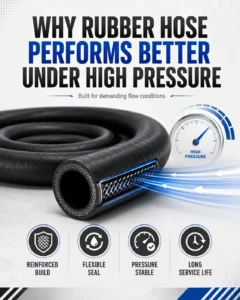
The pressure performance of a hose is determined by its construction — specifically the reinforcement layers between the inner tube and outer cover. Rubber hoses designed for high-pressure service are built with one or more of the following reinforcement configurations:
- Single or multiple textile braid reinforcement — suitable for medium pressure pneumatic and hydraulic service
- Spiral wire reinforcement — used in high-pressure hydraulic hoses where impulse pressure cycles are frequent and severe
- Steel wire braid reinforcement — commonly used in industrial steam hoses, chemical hoses, and heavy-duty fluid transfer lines
These reinforcement layers allow a high pressure rubber hose to contain pressure safely without ballooning, kinking, or rupturing. The rubber inner tube provides a leak-free seal against the fluid, while the outer cover protects against physical damage.
Plastic hoses, in contrast, lack meaningful reinforcement in most standard configurations. When subjected to pressure spikes or sustained high pressure, plastic hoses can expand, distort, or burst — creating a serious safety hazard in plant environments. For any application requiring reliable pressure containment, rubber is the technically sound choice.
Also Read: High pressure rubber hose — specifications, types, and pressure ratings for industrial use.
Rubber Hose Durability: Why It Lasts Longer
Rubber hose durability in industrial service comes from its ability to withstand a combination of damaging forces that would rapidly degrade a plastic hose:
- Heat and Thermal Cycling: Industrial environments involve repeated heating and cooling. Rubber compounds are formulated to resist thermal degradation and maintain flexibility and sealing integrity across temperature extremes.
- Mechanical Vibration: Equipment vibration causes micro-fatigue in rigid materials over time. Rubber absorbs vibration naturally, reducing stress at fitting connections and extending hose assembly life.
- Abrasion and Surface Wear: The outer covers of industrial rubber hoses are engineered with abrasion-resistant compounds. In environments where hoses are dragged across concrete, metal grating, or rough terrain, this provides a significant durability advantage.
- Chemical and Oil Exposure: Rubber compounds such as NBR (nitrile), EPDM, and CR (neoprene) are specifically designed to resist degradation from oils, fuels, solvents, and industrial chemicals — maintaining their integrity over extended service periods.
- Ozone and UV Resistance: Outdoor installations expose hoses to UV radiation and atmospheric ozone. Properly compounded rubber outer covers resist ozone cracking and UV degradation far better than standard PVC plastic hoses.
- Mechanical Stress at Bends: Rubber hoses maintain their structural integrity under tight bending conditions. The combination of inner tube, reinforcement, and outer cover works together to prevent kinking and flow restriction even when the hose is routed through complex paths.
The cumulative result of these durability factors is a significantly longer service life in demanding industrial environments — typically measured in years rather than months.
Industrial Fluid Transfer Hose: Why Material Selection Matters
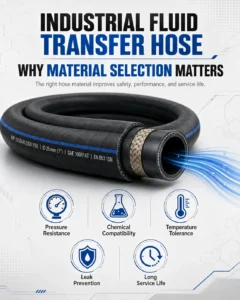
The consequences of selecting the wrong hose material for an industrial fluid transfer hose application can be severe. Consider what happens when an undersized or incompatible hose fails in service:
- Sudden hose burst can cause injury to plant personnel from high-pressure fluid jet or chemical splash
- Fluid leakage leads to environmental contamination, especially in fuel, oil, or chemical transfer systems
- Unplanned production downtime while the hose is replaced — often at the worst possible time during a production run
- Contamination of the conveyed product if the hose inner tube degrades and sheds material into the fluid stream
- Increased maintenance and replacement costs over time if inferior hose materials are repeatedly used
Hose material selection is therefore not simply a procurement decision — it is a safety, quality, and operational efficiency decision. The right material must be matched to pressure rating, fluid type, temperature, mechanical environment, and service life requirements.
Working with an experienced industrial rubber hose manufacturer or supplier ensures access to technical guidance on material selection, pressure ratings, and appropriate hose specifications for your specific application.
Also Read: Industrial hose selection guide — how to choose the right hose for your application requirements.
Where Rubber Hoses Are Commonly Used
The versatility of rubber hoses makes them the material of choice across a broad range of heavy and medium industrial sectors. Common rubber hose industrial use applications include:
- Cement plants — dust suppression water lines, compressed air systems, and slurry transfer hoses
- Steel plants — cooling water lines, hydraulic system hoses, and steam hoses in rolling mill areas
- Mining operations — slurry discharge hoses, dewatering pump discharge, and pneumatic drill air hoses
- Construction equipment — hydraulic hoses for excavators, concrete pumps, and heavy machinery
- Chemical plants — acid and alkali resistant hoses, solvent transfer hoses, and process fluid lines
- Oil and fuel transfer — petroleum hose assemblies for tank trucks, fuel dispensing, and refinery transfer lines
- Air compressor systems — flexible rubber air hoses connecting compressors to pneumatic tools and systems
- Water suction and discharge — pump suction hoses and delivery hoses for industrial water management
- Slurry and fly ash handling — abrasion-resistant hoses for conveying abrasive slurries in power plants and process industries
- Hydraulic systems — high-pressure hydraulic hoses in presses, machine tools, and mobile hydraulic equipment
- Material handling — suction and discharge hoses for pneumatic conveying of granules, powders, and bulk materials
- Agriculture and irrigation — suction and lay-flat hoses for irrigation pump systems and agricultural fluid transfer
- Marine and refinery applications — fuel oil hoses, ballast water hoses, and offshore platform fluid transfer assemblies
Also Read: Industrial rubber hose — full product range for B2B industrial buyers and procurement teams.
Where Plastic Hoses Can Be Used
Plastic hoses have a legitimate role in applications where operating conditions are mild, pressures are low, and exposure to chemicals, heat, and abrasion is minimal. Suitable applications for plastic hoses include:
- Garden and domestic water transfer — low-pressure water supply and general garden watering
- Light air lines — compressed air delivery at low pressures in workshops and domestic settings
- Transparent flow monitoring — clear PVC hoses where visual confirmation of flow is required
- Temporary fluid transfer — short-term, non-critical fluid conveyance in controlled indoor environments
- Low-pressure water supply — building water supply lines and domestic plumbing connections
- Laboratory and food-grade transfer — food-safe PU hoses for specific laboratory or food processing applications at low pressures
For these applications, the lower cost and lighter weight of plastic hoses offer practical advantages. However, industrial buyers should carefully evaluate whether their application truly qualifies as light-duty before defaulting to plastic.
Rubber Hose vs Plastic Hose: Which One Should You Choose?
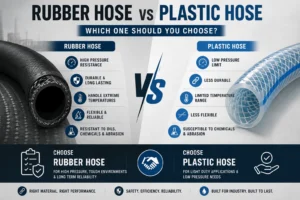
The rubber hose vs plastic hose decision should always be driven by the technical requirements of your application — not just the purchase price. A structured hose material selection process should evaluate the following parameters:
- Pressure Rating: Determine the maximum working pressure including surge and peak pressures. If your application involves pressures above 3-5 bar or frequent pressure spikes, rubber hose is the appropriate choice.
- Fluid Type: Identify the fluid being conveyed — its chemical composition, pH, oil content, and abrasive particle load. Match the hose inner tube compound to the fluid for chemical compatibility.
- Temperature Range: Assess both the fluid temperature and ambient environmental temperature. For temperatures above 60°C or below -10°C, rubber hoses with appropriate compound selection are required.
- Bend Radius: Evaluate how tightly the hose must bend during installation and operation. Rubber hoses generally offer better minimum bend radii in high-temperature or dynamic applications.
- Working Environment: Consider exposure to UV radiation, ozone, water immersion, outdoor weathering, and chemical splash. Rubber outer covers offer better environmental resistance in harsh conditions.
- Abrasion Exposure: If the hose will be dragged, rubbed against surfaces, or routed through abrasive environments, select a rubber hose with a dedicated abrasion-resistant outer cover compound.
- Chemical Compatibility: Verify that both the inner tube and outer cover are chemically compatible with all fluids and substances the hose may contact in service.
- Safety Requirements: For critical applications — hydraulic systems, steam lines, chemical transfer — safety standards may mandate specific hose construction and test certifications that only rubber hoses can meet.
- Service Life Expectation: If your maintenance program is based on planned replacement intervals, calculate the lifecycle cost rather than just the purchase cost. Longer-life rubber hoses typically offer better total cost of ownership.
- Budget Consideration: While rubber hoses carry a higher initial investment, factor in replacement frequency, downtime costs, and safety risks when comparing true total cost against plastic alternatives.
Why Rubber Hose Is Better for Industrial Buyers
For B2B industrial buyers — plant managers, purchase managers, maintenance engineers, and procurement professionals — the case for specifying rubber hoses over plastic in demanding applications comes down to four factors: total cost of ownership, operational reliability, safety assurance, and supplier support.
Total Cost of Ownership: A rubber hose that lasts three to five times longer than a plastic alternative delivers significant savings over its service life when procurement cost, installation labour, and replacement downtime are properly accounted for.
Operational Reliability: Unplanned hose failure is one of the most avoidable causes of production downtime in industrial plants. Specifying rubber hoses rated for the actual operating conditions eliminates the most common failure modes and keeps production lines running.
Safety Compliance: Many industrial applications are subject to safety standards and inspection requirements. Rubber hoses from reputable manufacturers are typically available with third-party test certifications and traceability documentation required for safety compliance.
Technical Support and Customization: Established rubber hose manufacturers and suppliers can provide application-specific guidance on hose selection, custom lengths, end fittings, and assembly testing — services that are generally unavailable from commodity plastic hose suppliers.
For industrial operations where safety and uptime are non-negotiable, the quality premium of rubber hoses is a sound and defensible investment.
Also Read: Rubber hose manufacturer in India — technical specifications, product range, and enquiry details.
Final Verdict
The rubber hose vs plastic hose comparison leads to a clear technical conclusion for industrial applications.
For light-duty, low-pressure, and domestic applications — garden water transfer, temporary air lines, and visual flow monitoring — plastic hoses offer a cost-effective and practical solution within their performance envelope.
However, for industrial fluid transfer involving high pressure, elevated temperatures, oil and chemical exposure, abrasive slurries, dynamic movement, and continuous heavy-duty service — rubber hoses are unquestionably the better choice. Their superior pressure handling, flexibility, durability, abrasion resistance, chemical compatibility, and longer service life make them the technically correct and operationally sound selection for serious industrial buyers.
If your operations cannot afford unplanned downtime, safety incidents, or frequent hose replacements, specifying the right industrial rubber hose from a reputable manufacturer is one of the most straightforward performance upgrades available to your maintenance and procurement teams.
Frequently Asked Questions (FAQs)
Is rubber hose better than plastic hose?
For industrial applications, yes — rubber hoses are better than plastic hoses in virtually every performance category relevant to heavy-duty use: pressure handling, temperature range, flexibility, durability, chemical resistance, and service life. Plastic hoses are only preferable where cost minimisation is the priority and operating conditions are genuinely light-duty.
Which hose is better for industrial fluid transfer?
Rubber hoses are better for industrial fluid transfer. They are engineered to handle the pressures, temperatures, fluid types, and mechanical stresses found in industrial plants, processing facilities, and heavy equipment — conditions that plastic hoses cannot reliably withstand.
What are the main rubber hose advantages?
The main rubber hose advantages include high pressure resistance, superior flexibility across temperature ranges, excellent abrasion and chemical resistance, long service life, suitability for aggressive fluids (oil, steam, chemicals, slurry), and inherent safety from reinforced construction that prevents catastrophic failure.
What are the common plastic hose disadvantages?
Common plastic hose disadvantages include limited pressure capacity, cracking under heat or cold, progressive stiffening with age, restricted chemical compatibility, lower abrasion resistance, unsuitability for dynamic applications, and a significantly shorter service life in harsh industrial environments.
Can rubber hose handle high pressure?
Yes. High pressure rubber hoses are specifically engineered with textile braid or steel wire reinforcement to safely handle high working pressures including hydraulic impulse loads. They are the standard choice for hydraulic hose assemblies, steam hoses, and other high-pressure industrial fluid transfer applications.
Why is rubber hose durability better in industries?
Rubber hose durability is better because rubber compounds are formulated to resist heat, UV radiation, ozone, oil, chemicals, and mechanical abrasion. The layered construction — inner tube, reinforcement, and outer cover — distributes mechanical stress and protects the hose integrity across demanding operating conditions.
How do I select the right hose material?
Hose material selection should be based on: working pressure and surge pressure, fluid type and chemical compatibility, operating temperature range, bend radius requirements, abrasion exposure, environmental conditions (UV, ozone, weathering), safety standards applicable to the application, and total cost of ownership over the expected service life.
Where are rubber hoses used in industries?
Rubber hoses are used across a wide range of industries including cement plants, steel plants, mining, construction, chemical processing, oil and fuel transfer, air compressor systems, slurry and fly ash handling, hydraulic machinery, agricultural irrigation, marine applications, and refineries.
Which hose is better for long-term industrial performance?
Rubber hoses are better for long-term industrial performance. Their superior durability, pressure handling, flexibility, and resistance to environmental degradation result in significantly longer service life than plastic hoses in demanding conditions — reducing replacement frequency, downtime, and total maintenance cost over the life of the installation.