
Industrial hoses are the circulatory system of modern manufacturing. They carry steam, chemicals, hydraulic fluid, compressed air, and countless other media through facilities where failure is simply not an option. Yet every year, plants across India and the world suffer costly downtime, equipment damage, and serious worker injuries — all traceable to a single root cause: low quality rubber hose.
The problem is not just about price. A substandard hose can look perfectly acceptable on the shelf. It can carry a recognisable brand name, come wrapped in professional packaging, and sit alongside certified products in a distributor’s warehouse. The difference only becomes visible when the hose is under pressure, temperature, or chemical stress — by which point, replacement costs pale in comparison to the human and operational consequences.
This guide is designed for factory owners, plant managers, maintenance engineers, and procurement teams who cannot afford to get hose selection wrong. By the end, you will know exactly how to spot poor quality rubber hose signs, conduct a professional industrial hose quality check, identify rubber hose failure signs before they become emergencies, and buy with confidence from suppliers who stand behind their products.
What Is a Low Quality Rubber Hose?
A low quality rubber hose is any hose that fails to meet the physical, chemical, or dimensional specifications required for its intended application — either due to inferior raw materials, poor manufacturing processes, inadequate quality control, or outright counterfeiting.
Specifically, a substandard hose may suffer from one or more of the following deficiencies:
- Inferior rubber compound — recycled, adulterated, or incorrectly formulated rubber that degrades rapidly under heat, pressure, or chemical exposure.
- Weak or missing reinforcement — thin, poorly braided, or missing textile or wire reinforcement layers that cannot sustain rated working pressures.
- Inconsistent wall thickness — uneven extrusion that creates structural weak points along the hose body.
- Poor bonding between layers — inadequate vulcanisation or adhesion that causes delamination under flexing or thermal cycling.
- Non-compliant fittings — end connections that are not crimped to specification, leaving the joint prone to pull-out or leakage.
- Missing or falsified certifications — products claiming IS, ISO, or application-specific standards they were never tested against.
The global industrial hose market is projected to exceed USD 5 billion by 2027, and rapid growth in demand — particularly in emerging markets — has created fertile ground for substandard and counterfeit products. Understanding what separates a genuine, high-performance hose from a dangerous substitute is no longer optional knowledge for serious industrial buyers.
Why Hose Quality Matters in Industrial Applications
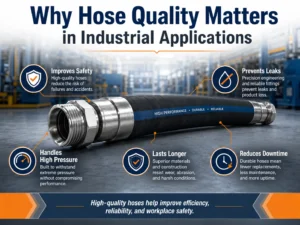
When evaluating hose material quality, most buyers focus on upfront price. This is the wrong calculation. The true cost of a hose includes its expected lifespan, maintenance frequency, and the financial and human risk of failure.
Consider these dimensions:
Safety. A burst hose carrying steam at 180°C or hydraulic fluid at 350 bar can cause catastrophic injuries. Hose failure is consistently among the top causes of workplace accidents in fluid-handling industries.
Productivity. Unplanned hose replacements cause line stoppages. In a continuous-process plant — cement, chemicals, petrochemicals — even one hour of unplanned downtime can cost lakhs of rupees.
Equipment lifespan. A leaking hose that contaminates lubricants, hydraulic systems, or process fluids damages downstream equipment. The hose failure is frequently the smallest part of the total repair bill.
Regulatory compliance. Many industries — pharmaceuticals, food processing, refineries — operate under strict statutory requirements for hose construction, materials, and testing. A non-compliant hose is not merely a quality risk; it is a legal liability.
Environmental impact. Chemical or oil leaks caused by hose failure can trigger environmental compliance violations, remediation costs, and reputational damage that far outweigh any saving on hose procurement.
Suppliers like Rubber Hose India LLP, one of India’s established industrial hose manufacturers, consistently emphasise that quality hoses are not a cost centre — they are an investment in operational continuity.
10 Common Poor Quality Rubber Hose Signs
Knowing poor quality rubber hose signs is the first line of defence. Train your maintenance teams to recognise these indicators on every hose they handle.
- Surface Cracking and Crazing Fine cracks on the outer cover — especially when the hose is flexed — indicate rubber degradation from UV exposure, ozone attack, or simply inferior compound formulation. Quality hose covers resist cracking under normal bending.
- Weak or Sparse Reinforcement Hold the hose up to a strong light. In a well-made hose, you should see a dense, even reinforcement braid or spiral. Thin, gappy, or asymmetric reinforcement is a clear sign of cost-cutting.
- Uneven Wall Thickness Squeeze the hose firmly along its length. Any section that compresses significantly more easily than adjacent sections has insufficient wall thickness — a structural weak point waiting to fail.
- Premature Hardening Rubber compounds that harden, lose flexibility, and become brittle within months of service are using inferior or incorrectly cured compound. Quality hoses retain flexibility throughout their rated service life.
- Soft Spots and Blistering Localised soft areas indicate internal delamination or chemical attack. Blisters on the outer cover signal that trapped gases or fluids are migrating through failing layer bonds.
- Bulging Under Pressure A hose that visibly swells or distorts during normal operating pressure has inadequate reinforcement. This is a pre-burst warning sign that demands immediate replacement.
- Poor Fitting Attachment Wiggle the end fittings. Any movement, looseness, or visible gaps between the fitting and hose body indicates improper crimping or incorrect ferrule selection — a common rubber hose defect in low-cost assemblies.
- Visible Leakage Any seepage, weeping, or spray from the hose body or end connections is unacceptable and constitutes a failure condition. Even minor leaks will escalate.
- Delamination Peel back a section of damaged outer cover. If the inner layers separate easily or show air pockets between them, the hose has delaminated — a manufacturing defect that makes the hose structurally unreliable.
- Excessive Abrasion Damage A hose that shows deep abrasion cuts within its first few months of service has an inadequate outer cover compound. Premium hose covers are formulated to resist the specific abrasion conditions of each application.
Most Common Rubber Hose Defects Found in Industrial Environments
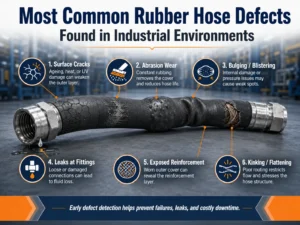
Rubber hose defects can be grouped into five categories, each with distinct causes and consequences.
Manufacturing Defects
These arise from problems during production: inconsistent extrusion speeds creating uneven tube walls, incorrect vulcanisation temperatures producing under-cured rubber, inadequate adhesion between tube, reinforcement, and cover layers, and off-specification compound batches that are not caught by quality control.
Material Defects
Using recycled rubber, off-spec compounding ingredients, or incorrect base polymers for the application creates hoses that may look correct but will fail prematurely under service conditions. A nitrile hose made with insufficient nitrile content will swell and degrade rapidly in petroleum service.
Reinforcement Defects
Incorrect braid angle, insufficient braid coverage, use of lower-grade yarn or wire, and improper tension during braiding all compromise the pressure-containing ability of the hose. These defects are not visible externally but are catastrophic under pressure.
Dimensional Defects
Hoses with bore diameters, wall thicknesses, or overall outside diameters that fall outside specification will not connect properly to system components, will not achieve rated pressure, and may fail to meet flow requirements.
Installation-Related Defects
While not manufacturing faults, incorrect minimum bend radius, improper fitting selection, over-crimping or under-crimping, and wrong hose routing all cause premature failure that mimics manufacturing defects. Proper installation guidance from your hose supplier is essential.
Industrial Hose Quality Check: Step-by-Step Process
An industrial hose quality check should be conducted on every new hose before installation, and at regular intervals during service. Follow this structured process:
Step 1: Document Verification Before touching the hose, verify that the delivery paperwork includes a test certificate, material certificate, conformance declaration to the relevant standard (IS 446, IS 444, ISO 1307, SAE J517, etc.), and traceability information linking the hose to a specific production batch.
Step 2: Visual Inspection Examine the full length of the hose under adequate lighting. Look for surface cracks, blisters, cuts, abrasion damage, discolouration, and any visible deformation. Check that markings — bore size, working pressure, date of manufacture, standard reference — are legible and consistent with documentation.
Step 3: Dimensional Check Use calibrated vernier calipers to verify bore diameter, outside diameter, and wall thickness at multiple points along the hose. Compare against the manufacturer’s published specification sheet. Variation greater than the permitted tolerance is a rejection criterion.
Step 4: Flexibility Testing Flex the hose through its rated minimum bend radius. It should flex smoothly without kinking, with no cracking of the outer cover and no distortion of the bore. Kinking at less than the rated bend radius indicates reinforcement or compound deficiency.
Step 5: Reinforcement Inspection At any cut end or exposed section, examine the reinforcement layer. Braided reinforcement should show complete, even coverage with no gaps, broken yarns, or wire corrosion. Spiral reinforcement should show uniform lay angle throughout.
Step 6: End Connection Inspection Check that fittings are crimped concentrically, that there is no gap between the ferrule and hose body, that threads are undamaged, and that the correct fitting material has been used for the service fluid. For hydraulic assemblies, request crimp dimension records.
Step 7: Pressure Testing (where applicable) For critical applications, hose assemblies should be hydrostatically tested to 1.5× working pressure before installation, with the assembly held at test pressure for a minimum defined duration (typically 1–5 minutes depending on the standard) while being monitored for leakage, deformation, or fitting movement.
Complete Rubber Hose Inspection Guide Before Installation
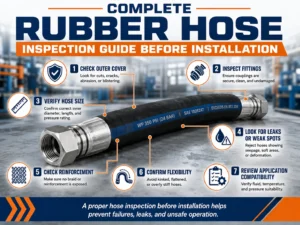
Use this rubber hose inspection guide checklist before fitting any hose into service:
Documentation
- Test certificate present and dated within the validity period
- Material certificate confirms compound type and batch
- Hose standard conformance verified (IS, ISO, SAE, EN as applicable)
- Shelf life checked — rubber hoses have a defined storage life (typically 2–5 years from manufacture date depending on compound)
Physical Condition
- No surface cracks, cuts, or abrasion damage to outer cover
- No blisters, soft spots, or bulges anywhere along the body
- No delamination visible at cut ends
- Hose body is flexible and does not feel abnormally hard or soft
- No embedded foreign matter or visible voids
Dimensions
- Bore diameter within ±2% of nominal (or within standard tolerance)
- Wall thickness uniform along full length
- Overall length matches order specification
Markings
- Bore size legible
- Working pressure rating legible
- Manufacturer’s name or mark present
- Date of manufacture visible (quarter and year)
- Standard reference (IS/ISO/SAE/EN) printed on hose body
End Connections
- Fittings concentric with hose axis — no visible tilt
- No gap between ferrule and hose cover
- Thread form and size correct for system connections
- No thread damage or corrosion
- Crimp dimension records available for hydraulic assemblies
Routing and Installation
- Minimum bend radius will not be exceeded in service position
- Hose length provides adequate slack for movement without tension
- Hose will not contact sharp edges, hot surfaces, or rotating parts
- Correct clamps and supports specified
Fake Rubber Hose Identification: How to Spot Counterfeit Products
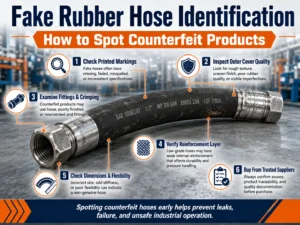
Fake rubber hose identification has become a critical skill for procurement teams as counterfeit industrial products have proliferated across online marketplaces and grey-market distribution channels. Here is what to look for:
Missing or Inconsistent Branding Genuine hoses from established manufacturers carry consistent, legible markings. Fakes often have smeared, faded, or incorrectly spaced text. Compare the markings on the delivered hose carefully against the manufacturer’s genuine product images.
Fabricated Certifications Request the original test certificates and verify them directly with the certification body. Certificate numbers that cannot be verified, certificates with inconsistent fonts or formatting, and certificates referencing standards the hose clearly does not meet are all red flags.
Unrealistic Pricing If a hose is being offered at 30–50% below market rate for a premium specification, something is wrong. Raw material costs for quality rubber compounds, reinforcement materials, and proper testing make genuine premium hoses expensive to produce. There is no legitimate low-cost shortcut.
Poor Packaging Quality manufacturers invest in professional packaging that protects the hose and carries accurate specification information. Counterfeit products often arrive in generic, unlabelled, or poorly printed packaging with missing or inaccurate data.
Inferior Material Feel Handle the hose. Genuine quality rubber has a distinct tactile quality — smooth, consistent, and firm but flexible. Fake hoses often feel greasy, have a chemical smell, or feel either too stiff or too soft for their stated specification.
Inconsistent Markings Along the Length On genuine hoses, markings are printed at regular intervals along the full length. If you find sections without markings, or where the markings change style or content, the hose is not from the source claimed.
No Traceability A reputable manufacturer can trace any hose back to its raw material batch, production date, and inspection records. If your supplier cannot provide this traceability, do not use the product in critical applications.
Also, Read: Industrial Hose Quality Standards & Certifications Guide
How Hose Material Quality Affects Performance and Lifespan
Hose material quality is the single biggest determinant of service life and application suitability. The following table compares the most common rubber compounds used in industrial hoses:
| Rubber Type | Temperature Range | Key Strength | Key Weakness | Typical Applications |
| Natural Rubber (NR) | -50°C to +80°C | Excellent flexibility, abrasion resistance | Poor oil and ozone resistance | Water, mild acids, abrasive slurries |
| EPDM | -40°C to +150°C | Outstanding heat and ozone resistance | Not suitable for petroleum products | Steam, hot water, chemicals, brake fluid |
| Nitrile (NBR) | -30°C to +100°C | Excellent oil and fuel resistance | Poor ozone resistance | Petroleum, hydraulic oil, fuels, lubricants |
| Neoprene (CR) | -40°C to +120°C | Good oil, ozone, and flame resistance | Moderate chemical resistance | Refrigerants, mild chemicals, weathering |
| Silicone | -60°C to +200°C | Extreme temperature range, FDA grades available | Low pressure capability, expensive | Food, pharmaceutical, high-temperature air |
Selecting the wrong compound — or purchasing a hose made with an adulterated compound that mimics the correct specification — causes rapid degradation and failure. Always request compound verification with incoming hose shipments, particularly for critical service applications.
Critical Rubber Hose Failure Signs That Require Immediate Replacement
Never delay action when you identify rubber hose failure signs. The following conditions require the hose to be taken out of service immediately:
Active Leakage — Any fluid escaping from the hose body or end connections. Even a weep constitutes failure.
Visible Cracks Penetrating the Cover — Surface crazing is a warning; cracks that have reached the reinforcement layer are a failure condition.
Swelling or Bulging — Any local or general swelling under pressure indicates reinforcement failure. A burst is imminent.
Blistering of the Outer Cover — Blisters indicate internal fluid migration through degraded inner layers. The hose structure is compromised.
Exposed Reinforcement — If the outer cover is worn or abraded to the point where reinforcement wires or yarns are visible, the hose is at serious risk of sudden failure.
Coupling Damage or Movement — Any looseness, corrosion of the ferrule, or distortion of the fitting body means the end connection integrity cannot be trusted.
Kinking — A hose that has been kinked may have damaged its reinforcement internally. Even if it returns to shape, it should be pressure-tested before re-use.
Hose Age Exceeding Manufacturer’s Recommendation — Most manufacturers recommend maximum service lives of 1–5 years depending on service conditions. Age alone is a valid replacement criterion.
Industrial Hose Durability Issues Caused by Low-Quality Manufacturing
Understanding industrial hose durability issues helps maintenance engineers diagnose failures and prevent recurrence. The most common durability failures caused by poor manufacturing include:
Premature Wear — Inadequate outer cover hardness or incorrect compound choice causes covers to abrade through in a fraction of the expected service life, especially in applications with hose movement or contact with abrasive surfaces.
Temperature Damage — Inferior compounds that are not formulated for the actual service temperature range will harden, crack, or soften and swell far earlier than a correctly specified hose.
Chemical Attack — Using the wrong base polymer — or using a correctly named polymer that has been adulterated with cheaper fillers — results in the hose tube swelling, softening, and losing its pressure containment capability when exposed to process fluids.
Abrasion Failure — Low-quality covers lack the wear-resistant compound formulations that established manufacturers develop and test. Field abrasion life can be ten times shorter than a premium equivalent.
Pressure Fatigue Failure — Hoses in cyclic pressure applications (hydraulic systems, pulsating pumps) fail by fatigue in the reinforcement layer. Incorrectly braided or spiralled reinforcement fails far sooner than properly manufactured hose under identical pressure cycles.
Rubber Hose Safety Risks Every Factory Should Understand
The rubber hose safety risks associated with substandard products extend well beyond the hose itself:
Hose Burst Injuries — A hydraulic hose carrying fluid at 300+ bar that fails suddenly releases enormous energy. The whiplash of a free end causes severe blunt trauma. High-pressure fluid injection injuries — where hydraulic fluid penetrates skin — are surgical emergencies that frequently result in amputation.
Scalding and Burns — Steam hose failures expose workers to immediate scalding from live steam and condensate. Hot-water and hot-oil hose failures cause serious thermal burns.
Chemical Exposure — Leaks from chemical transfer hoses expose workers to acids, alkalis, solvents, and toxic process fluids. Even low-level chronic exposure causes serious long-term health effects.
Fire and Explosion Hazards — Petroleum product and solvent hose failures in the presence of ignition sources — hot surfaces, electrical equipment, sparks — are a direct fire and explosion risk. This is particularly acute in refineries, chemical plants, and LPG facilities.
Environmental Spills — Hose failures in fluid transfer applications can release large volumes of chemicals, oils, or process fluids that cause serious environmental contamination and trigger regulatory enforcement action.
Regulatory Consequences — Beyond the immediate human and environmental harm, hose-related incidents trigger factory inspections, operational shutdowns, and potential criminal liability for plant management.
Rubber Hose India LLP works with plants to conduct hose risk assessments and develop replacement schedules that address these risks proactively rather than reactively.
Industrial Hose Buying Tips for Long-Term Reliability
Apply these industrial hose buying tips every time you specify and procure industrial hoses:
- Buy from established manufacturers with traceable quality systems. Choose suppliers who can provide batch traceability, in-house testing records, and have been operating in the market long enough to have a proven track record. Rubber Hose India LLP, for example, maintains comprehensive quality documentation for all products.
- Always request test reports. Insist on a hydraulic pressure test certificate and material conformance certificate for every order. If a supplier cannot provide these, they are not a credible source for critical applications.
- Verify standards compliance independently. Do not accept a supplier’s claim of certification at face value. Check the certification body’s database, or request a witnessed test for high-value or high-risk applications.
- Compare full specifications, not just price. Evaluate bore tolerance, working pressure, burst pressure ratio (minimum 4:1 for most applications), temperature range, reinforcement type, and compound specification. A cheaper hose with a lower burst pressure ratio or narrower temperature range is not equivalent.
- Check certifications for your specific application. Food-grade hoses require FDA or WRAS approval. Pharmaceutical hoses may require USP Class VI compliance. Mining hoses need flame-resistance certification. Never substitute a general-purpose hose into a regulated application.
- Evaluate after-sales support. A quality supplier provides technical advice on application engineering, installation guidance, and warranty support. Suppliers who disappear after the sale are not partners in your operational safety.
- Audit your supplier. For major or ongoing supply relationships, visit the manufacturing facility, inspect the quality control laboratory, and review the calibration records for test equipment. What you see tells you far more than any certificate.
Also, Read: Rubber Hose Testing Methods: Complete Guide for Industrial Hose Safety & Quality
High Quality vs Low Quality Rubber Hose Comparison
| Feature | High Quality Rubber Hose | Low Quality Rubber Hose |
| Raw Materials | Virgin, specification-grade rubber compounds | Recycled, adulterated, or off-specification compounds |
| Reinforcement | Correctly braided/spiralled to pressure rating | Under-specified, irregular, or missing layers |
| Wall Thickness | Uniform within ±5% of nominal | Variable, with thin sections |
| Vulcanisation | Controlled cure cycle, verified hardness | Inconsistent cure, variable hardness |
| End Fittings | Precision-crimped to crimp spec, traceable | Manually applied, inconsistent crimp |
| Test Certification | Full hydraulic test and material certificate | Missing, photocopied, or falsified |
| Markings | Clear, regular, correct throughout length | Faded, inconsistent, or absent |
| Shelf Life | 5 years from manufacture date (typical) | May degrade within months of production |
| Service Life | Meets or exceeds rated service life | Fails prematurely, often without warning |
| Burst Pressure Ratio | Minimum 4:1 (working to burst) | Unknown, may be <2:1 |
| Cost (True) | Higher upfront, lower total cost of ownership | Lower upfront, high total cost of failure |
| Standards | IS, ISO, SAE, EN as applicable | No conformance or falsified conformance |
Industrial Rubber Hose Inspection Checklist
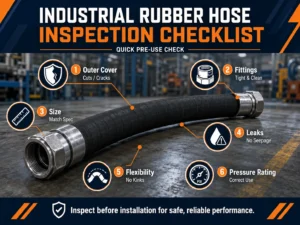
Use this checklist for periodic in-service inspection of all installed hoses. Recommended frequency: monthly for critical applications, quarterly for general-purpose applications.
Hose Body
- Outer cover free from cracks, cuts, abrasion penetrating to reinforcement
- No blisters, bubbles, or swelling along any section
- No kinks or permanent deformation from previous bending
- No discolouration indicating chemical attack or heat damage
- Markings still legible — if not, hose should be tagged for identification
End Connections
- No leakage at ferrule or fitting body
- Ferrule tight, no movement or rotation relative to hose
- No corrosion of ferrule or fitting visible
- Threads on male fittings undamaged and clean
- Hose swivel (if applicable) moves freely without drag
Routing and Support
- Minimum bend radius not being exceeded anywhere along the installed route
- Hose not in contact with hot surfaces, sharp edges, or rotating components
- Clamps and supports in place and secure
- Hose has adequate free length — not in tension
System Performance
- No pressure drop or flow restriction consistent with hose blockage
- No unusual noise from hose during operation
- System pressure within hose working pressure rating
Action Required
- Hoses with any single critical defect (leakage, bulging, cracking to reinforcement, coupling movement): Remove from service immediately
- Hoses with minor surface crazing or cover damage not penetrating reinforcement: Tag, monitor, and schedule replacement within 30 days
- Hoses approaching manufacturer’s maximum service life: Schedule proactive replacement
Why Leading Industries Trust Rubber Hose India LLP
Rubber Hose India LLP has established itself as a trusted name among industrial hose buyers in India by consistently prioritising product integrity over volume.
Controlled Manufacturing Processes Every production batch is manufactured against a defined process specification, with controls at compounding, extrusion, braiding or spiralling, vulcanisation, and assembly. Process deviations are identified and resolved before product leaves the plant.
In-House Testing The company maintains in-house testing capability for hydraulic proof testing, dimensional verification, and compound physical properties. Test certificates are generated from actual test data, not from templates.
Traceable Quality Documentation Every hose supplied by Rubber Hose India LLP can be traced to its raw material batch, production date, inspection results, and test records. This traceability is essential for regulated industries and incident investigation.
Application Engineering Support The team at Rubber Hose India LLP works with plant engineers to select the correct hose specification for each application — not just the nearest stock item. Custom hose solutions for non-standard pressures, temperatures, media, or physical configurations are available.
Industry Applications Rubber Hose India LLP supplies hose solutions across a broad range of sectors: chemical and petrochemical processing, steel and heavy manufacturing, construction equipment, mining, food and beverage, pharmaceutical, and general industrial applications.
Also, Read: Rubber Hose Failure Causes: The Complete Engineering Guide
Conclusion
The cost of low quality rubber hose is never the price on the invoice. It is the unplanned shutdown at 2 AM, the hydraulic fluid injection injury that sends a worker to hospital, the chemical spill that triggers a regulatory investigation, and the long-term reputational damage that follows a preventable industrial accident.
Quality industrial hoses are engineered to a specification, manufactured under controlled conditions, tested against defined standards, and supplied with traceable documentation. They cost more upfront. They cost far less over a plant’s lifetime.
The guidance in this article — from identifying poor quality rubber hose signs to conducting a proper industrial hose quality check, from fake rubber hose identification to making sound industrial hose buying decisions — is designed to give you the knowledge to make the right choice every time.
Inspect before you install. Verify before you buy. Replace before you fail.
For reliable and tested industrial hose solutions, consult the experts at Rubber Hose India LLP and choose hoses engineered for safety, durability, and performance.
Frequently Asked Questions
What are common rubber hose defects?
The most common defects include delamination between layers, under-cured or over-cured rubber compound, insufficient reinforcement coverage, uneven bore diameter, poorly crimped end fittings, and missing or incorrect standard markings. These defects may not be visible externally but become apparent under service conditions.
Why do industrial hoses fail?
Hose failures result from a combination of factors: incorrect material selection for the service fluid or temperature, inadequate pressure rating, installation errors (overbending, tension, abrasion contact), exceeding the design service life, and — most preventably — use of low quality or counterfeit hose that was never capable of meeting the service requirements.
How often should industrial hoses be inspected?
Critical applications (high pressure, high temperature, toxic or flammable media) should be inspected monthly. General-purpose applications should be inspected quarterly. All hoses should receive a pre-installation inspection against the checklist in this guide, and any hose that shows critical failure signs should be removed from service immediately regardless of inspection interval.
What causes hose bursts?
Hose bursts are caused by pressure exceeding the hose's actual (not rated) burst capability, which happens when the hose is operated above its rated working pressure, when the reinforcement has been damaged by kinking, abrasion, or fatigue, when the hose is used outside its rated temperature range (causing compound degradation), or when the hose is a counterfeit product with no genuine pressure-containing capability.
Are fake rubber hoses dangerous?
Extremely. Counterfeit hoses are often made from recycled rubber with no reinforcement specification and no pressure testing. They may appear acceptable under low-pressure conditions but fail catastrophically under normal working pressure. A single counterfeit hose in a hydraulic or steam system is a serious injury risk.
What should buyers check before purchasing industrial hoses?
Verify the supplier's manufacturing credentials, request test certificates and material certificates for the batch being purchased, confirm standard compliance (IS, ISO, SAE, EN as applicable) through the certification body, compare the full technical specification against your application requirements, and evaluate the supplier's after-sales and technical support capability.
Which rubber material lasts longest in industrial service?
There is no single answer — the best material depends entirely on the application. For petroleum service, nitrile (NBR) provides the best resistance. For steam and high-temperature water, EPDM is the standard choice. For extreme temperature ranges with food or pharmaceutical requirements, silicone excels. Selecting the correct material for the application determines service life; the wrong material, however well-made, will fail prematurely.
Can I repair a damaged rubber hose instead of replacing it?
In most cases, no. Hose repair products (tape, clamps) are temporary emergency measures only and should never be used as a long-term solution, particularly in high-pressure, high-temperature, or chemical service. A damaged hose should be replaced with a correctly specified new assembly.
What is the shelf life of a rubber hose in storage?
Shelf life varies by compound but is typically 2–5 years from the date of manufacture under correct storage conditions: cool, dark, dry environment, away from ozone sources (electric motors, welding equipment), with the hose stored straight or in large-radius coils, not in tight bends. Always check the manufacture date on the hose markings before installation.
What standards should industrial rubber hoses conform to in India?
Depending on application: IS 446 (water hoses), IS 444 (steam hoses), IS 447 (petroleum hoses), BIS/ISI standards for specific applications, ISO 1307 (general purpose hoses), ISO 1436 (hydraulic hoses), SAE J517 (hydraulic hose), and EN standards for specific European-specification equipment. Always verify that the standard claimed on the hose matches your application requirement.
How can I verify that a hose manufacturer is legitimate?
Check their BIS licence for IS-certified products, verify ISO certification through the relevant accreditation body, ask for a facility visit, request references from similar industries, and evaluate the technical depth of their sales and support team. Legitimate manufacturers welcome scrutiny; illegitimate ones avoid it.