
What Are Rubber Hose Testing Methods? Rubber hose testing methods are a set of standardized procedures used to evaluate the safety, quality, durability, and performance of industrial rubber hoses. These tests include pressure testing, burst pressure testing, leakage testing, dimensional checks, and durability assessments. The goal is to ensure that every hose meets industry standards before it is deployed in critical industrial applications.
Whether you are a factory owner, procurement manager, or maintenance engineer, understanding rubber hose testing is not optional — it is essential for workplace safety and operational efficiency.
What Is Rubber Hose Testing?
Rubber hose testing is the systematic evaluation of a hose’s ability to handle pressure, resist leakage, and perform safely under real-world operating conditions. It covers both the internal material quality and external mechanical performance of the hose.
Think of it this way: a rubber hose used in a chemical plant carries corrosive fluids at high pressures. If that hose fails — even once — it can cause injury, production downtime, and enormous financial losses. Rubber hose testing is the safety net that prevents such failures before they happen.
Industrial hose testing is conducted at multiple stages:
- During manufacturing (in-process quality control)
- Before shipment (final quality assurance)
- On-site before installation (incoming inspection)
- During scheduled maintenance (periodic field testing)
Each stage catches different types of defects and ensures that only reliable hoses reach your facility.
Why Industrial Hose Testing Is Important
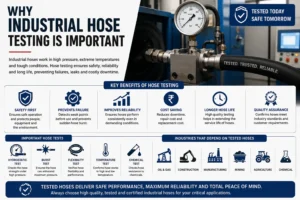
Many industrial accidents are caused by hose failures — sudden bursts, slow leaks, or structural collapses under vacuum. These are not random events. They are preventable with proper industrial hose testing.
Here is why hose testing matters:
- Worker Safety: A bursting hose carrying steam, chemicals, or high-pressure hydraulic fluid can cause severe injuries. Regular testing prevents catastrophic failure.
- Regulatory Compliance: Industries like oil & gas, pharmaceuticals, food processing, and chemicals are governed by strict safety standards. Tested hoses help you remain compliant.
- Reduced Downtime: An untested hose that fails mid-operation can halt an entire production line. Tested hoses are more reliable and reduce unplanned shutdowns.
- Cost Savings: Replacing a failed hose after an accident is far more expensive than testing it beforehand. Preventive testing is always the smarter investment.
- Product Quality Protection: In food, beverage, and pharmaceutical sectors, hose failures can contaminate the product — leading to recalls and liability.
Simply put, rubber hose quality testing is not just a technical requirement — it is a business necessity.
Common Rubber Hose Testing Methods
There are several widely used rubber hose testing methods, each designed to assess a specific performance parameter. Here is a quick overview:
| Testing Method | What It Measures |
| Hydrostatic Pressure Test | Hose ability to withstand internal pressure |
| Burst Pressure Test | Maximum pressure before hose failure |
| Leakage Test | Seal integrity and joint connections |
| Vacuum Test | Hose resistance to collapse under suction |
| Bend Radius Test | Flexibility without kinking |
| Dimensional Check | Wall thickness, bore diameter, length |
| Adhesion Test | Bond strength between hose layers |
| Impulse Test | Repeated pressure cycling endurance |
| Heat Aging Test | Performance after thermal exposure |
| Chemical Resistance Test | Compatibility with specific fluids |
Each of these plays a distinct role. Together, they form a comprehensive rubber hose testing procedure that covers all possible failure modes.
Rubber Hose Pressure Test Process
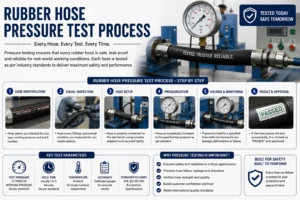
The rubber hose pressure test is the most fundamental and widely used test in industrial hose inspection. It verifies that a hose can safely handle its rated working pressure without deformation, leakage, or failure.
How It Is Done
Step 1 — Prepare the Hose
Seal both ends of the hose using test plugs or end caps. Make sure no air is trapped inside — air is compressible and poses an explosion risk during pressure testing.
Step 2 — Fill with Test Fluid
Fill the hose completely with water or another non-compressible fluid. Purge all air bubbles carefully.
Step 3 — Apply Pressure Gradually
Using a hydraulic pump or pressure testing unit, slowly increase the internal pressure to the specified test pressure — typically 1.5× to 2× the working pressure, depending on the standard applied.
Step 4 — Hold the Pressure
Maintain the test pressure for a specified duration — usually 1 to 5 minutes. Watch for any drop in gauge pressure, which indicates a leak.
Step 5 — Inspect the Hose
After the hold period, visually inspect the hose for bulges, leaks, sweating, or deformation. Any anomaly is a failure.
Step 6 — Document the Results
Record the pressure applied, duration, and inspection findings. This documentation is critical for traceability and compliance.
The rubber hose pressure test is non-destructive when done correctly, allowing the tested hose to be placed into service afterward.
Hose Burst Pressure Test Explanation
The hose burst pressure test is a destructive test — meaning the hose is intentionally pressurized until it fails. This test determines the maximum pressure a hose can withstand before catastrophic rupture.
Why It Matters
The burst pressure rating is typically 4× the maximum working pressure. This “safety factor” provides a large margin for pressure spikes, aging, and unexpected conditions. If a hose fails at a burst pressure lower than expected, it indicates a manufacturing defect or material degradation.
How the Burst Test Works
- The hose is fitted with sealed end caps and filled with water.
- Pressure is increased slowly and continuously.
- The exact pressure at which the hose ruptures is recorded.
- This value is compared against the manufacturer’s rated burst pressure.
A hose that bursts below its rated burst pressure fails the test and cannot be used. The burst pressure data is also used to set safe working pressure limits for an entire production batch.
Hose Leakage Test and Safety Checks
The hose leakage test focuses on detecting any loss of fluid or gas through the hose body, fittings, or connections. Even a small leak can cause safety hazards, environmental contamination, or system pressure loss.
Types of Leakage Tests
- Hydrostatic Leakage Test: The hose is pressurized with water and inspected for external seepage. This is the most common approach.
- Pneumatic Leakage Test: The hose is pressurized with air or nitrogen and submerged in water. Rising bubbles reveal leaks. This method is highly sensitive but requires extra caution since compressed air stores significant energy.
- Pressure Drop Test: The hose is sealed and pressurized. The pressure is then monitored over time. Any measurable pressure drop indicates a leak — even one invisible to the naked eye.
Safety Checks During Leakage Testing
- All test equipment must be rated well above the test pressure
- Operators must wear PPE — safety goggles, gloves, and protective footwear
- Pneumatic tests require blast shields or safe standoff distances
- The test area should be clear of non-essential personnel
- Pressure gauges should be calibrated before each test session
Also, Read: Industrial Hose Safety Guidelines: Complete Guide for Safe Hose Handling, Installation & Inspection
Rubber Hose Quality Testing Parameters
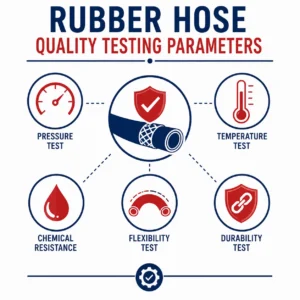
Rubber hose quality testing goes beyond pressure and leakage. A truly high-quality hose must meet multiple physical, chemical, and dimensional standards simultaneously.
Key Quality Parameters
- Tensile Strength: The rubber compound must resist tearing under tension. Low tensile strength leads to premature cracking or splitting.
- Elongation at Break: Measures how much the material stretches before breaking. Proper elongation ensures flexibility and shock absorption.
- Hardness (Shore A): The rubber compound must have the right hardness — too soft means poor pressure resistance, too hard means poor flexibility.
- Wall Thickness Uniformity: Uneven walls create weak spots. Consistent thickness throughout the hose length is critical.
- Bore Diameter Tolerance: The internal diameter must be within specified limits to ensure correct flow rate and fitting compatibility.
- Reinforcement Layer Integrity: Most industrial hoses have woven or braided reinforcement layers. These must be properly embedded and free of voids or separation.
- Surface Finish: The external surface must be smooth or textured as specified, free of blisters, cracks, or inclusions.
All these parameters are checked during production as part of industrial hose inspection methods, ensuring every hose leaving the factory meets the specification.
Industrial Hose Inspection Methods
Industrial hose inspection methods cover both laboratory testing and field inspection. Here is a breakdown of the most commonly used approaches:
Visual Inspection
The simplest method — trained inspectors examine the hose surface, ends, and fittings for visible defects like cracks, blisters, kinks, discoloration, corrosion on fittings, or loose connections.
Dimensional Inspection
Using calibrated gauges, calipers, and measuring tapes to verify:
- Bore diameter
- Outer diameter
- Wall thickness
- Overall length
- Bend radius capability
Proof Pressure Test (In-line Inspection)
Every hose in a production batch is tested at proof pressure — typically 1.5× working pressure — to verify it can handle rated conditions without failure.
End Fitting Pull-Out Test
This test checks the connection between the hose body and its metal end fittings. The fitting is subjected to a defined axial tensile load. Failure to hold the load indicates improper crimping or assembly.
Ultrasonic Testing
Advanced non-destructive testing uses ultrasonic waves to detect internal delamination, voids, or reinforcement failures that are invisible externally. Used in high-specification applications like aerospace or defense.
Electrical Continuity Test
For anti-static hoses, this test verifies that the conductive path through the hose body meets resistance specifications — critical in applications involving flammable liquids or powders.
Rubber Hose Durability Testing
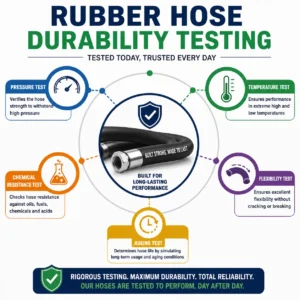
Rubber hose durability testing simulates the long-term wear and aging that a hose will experience in actual service. It helps predict service life and identify potential failure points before they develop in the field.
Key Durability Tests
- Heat Aging Test: Hoses are placed in a temperature-controlled oven at elevated temperatures for a specified period (e.g., 70°C for 168 hours). After aging, mechanical properties are re-tested and compared to baseline values. Significant deterioration indicates poor compound formulation.
- Ozone Resistance Test: Rubber is particularly vulnerable to ozone cracking. Hoses are exposed to high ozone concentrations while under bending stress. Cracks that appear indicate inadequate ozone protection in the rubber compound.
- Impulse (Fatigue) Test: The hose is cycled rapidly between low and high pressure — thousands to millions of cycles — to simulate the pressure fluctuations seen in hydraulic systems. Hoses that survive the full cycle count without leaking or failing earn an impulse rating.
- Abrasion Resistance Test: The outer cover of the hose is rubbed against an abrasive surface under controlled load and speed. The material loss is weighed and compared to the specification.
- Low Temperature Flexibility Test: Hoses are cooled to specified low temperatures and then bent or flexed. Cracking at low temperature indicates poor cold weather performance.
- Chemical Immersion Test: Hose samples are immersed in the specific fluid they will carry (oil, acid, water, etc.) for a defined period. Post-immersion changes in weight, hardness, and tensile strength reveal compatibility issues.
These durability tests are especially important for hoses used in harsh environments like mining, offshore, agriculture, and heavy manufacturing.
Important Hose Testing Standards
International and national standards govern how rubber hose testing must be conducted. Compliance with these standards ensures that tested hoses meet globally accepted benchmarks.
Key Standards
IS 444 (Bureau of Indian Standards): Covers rubber hoses for water, steam, and air in industrial applications.
ISO 1402: Specifies hydrostatic pressure test methods for rubber and plastics hoses and hose assemblies.
ISO 6945: Covers the determination of the crushing resistance of rubber hoses.
ISO 8033: Specifies methods for adhesion testing between rubber hose components.
EN 853 / EN 857 / EN 856: European standards for hydraulic rubber hoses — widely referenced in international specifications.
SAE J517: Society of Automotive Engineers standard for hydraulic hose — commonly referenced in mobile machinery and vehicle hydraulic applications.
MSHA / OSHA Requirements: In the US, mine safety and industrial safety regulations mandate specific hose performance requirements.
When sourcing industrial rubber hoses, always ask for test certificates referencing the applicable standards for your industry and region.
Step-by-Step Rubber Hose Testing Procedure
Here is a practical, step-by-step rubber hose testing procedure suitable for incoming inspection at your facility:
Step 1 — Visual Inspection
Examine the hose for external damage — cuts, abrasions, blisters, kinks, or damaged fittings. Reject any hose with visible defects.
Step 2 — Dimensional Verification
Measure bore diameter, outer diameter, wall thickness, and hose length. Compare against the purchase specification or drawing.
Step 3 — Fitting Integrity Check
Check all end fittings for proper crimping, thread condition, and alignment. Fittings that appear loose, corroded, or cross-threaded should be rejected.
Step 4 — Proof Pressure Test
Connect the hose to a hydrostatic test unit. Fill with water, purge air, and pressurize to proof pressure. Hold for the required duration and inspect for leaks or deformation.
Step 5 — Leakage Confirmation
After proof pressure, reduce pressure and wipe the hose dry. Bring back to proof pressure and re-inspect for any weeping or sweating on the hose body or at fittings.
Step 6 — Document and Tag
Record the hose serial number, test date, test pressure, hold duration, and result (Pass/Fail). Tag the hose with a color-coded inspection tag indicating its test status and next scheduled test date.
Step 7 — Final Approval
Only hoses that pass all steps are approved for installation. Failed hoses are quarantined, tagged, and returned to the supplier or disposed of safely.
Industrial Hose Safety Testing Checklist
Use this checklist before installing any industrial rubber hose:
- Visual inspection completed — no visible damage
- Bore diameter and wall thickness verified
- Fittings checked for proper crimping and thread integrity
- Proof pressure test performed and documented
- No leaks detected at working pressure and proof pressure
- Hose rated for the fluid, temperature, and pressure of the application
- Anti-static requirement verified (if applicable)
- Bend radius in installation does not exceed hose minimum bend radius
- Test certificate from manufacturer reviewed and on file
- Hose marked with installation date and scheduled next inspection date
This checklist helps maintenance teams and safety officers ensure nothing is missed before a hose goes into service.
Common Testing Mistakes to Avoid
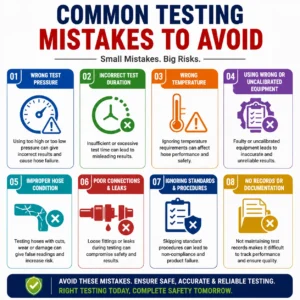
Even experienced teams make mistakes during rubber hose testing. Here are the most common ones — and how to avoid them:
Using Compressed Air Instead of Water for Pressure Tests
Air is compressible. If a hose fails during a pneumatic pressure test, the stored energy releases violently — like a small explosion. Always use water for pressure testing unless a pneumatic test is specifically required and properly safeguarded.
Skipping Purge of Air Bubbles
Air pockets trapped inside the hose create false pressure readings and can cause sudden local failures. Always purge completely before pressurizing.
Testing at Room Temperature Only
Hoses that will operate at elevated temperatures must be tested under conditions that reflect actual service. A hose that passes at 25°C may fail at 80°C.
Not Calibrating Test Equipment
Pressure gauges drift over time. An uncalibrated gauge can give false readings — leading you to believe a hose has passed when it hasn’t. Calibrate gauges regularly.
Ignoring Fitting Inspection
Many hose failures happen at the fitting, not the hose body itself. Always inspect fittings as carefully as the hose.
Testing Only a Sample Instead of Every Hose
For critical applications, every hose assembly should be proof-tested individually. Sampling is acceptable only for lower-risk applications.
Poor Documentation
Undocumented tests are the same as no tests in a regulatory audit. Always record every test properly.
How Regular Testing Improves Hose Life and Workplace Safety
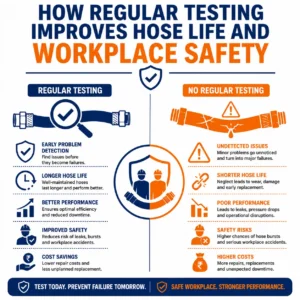
Regular industrial hose safety testing is not just about catching failures — it is about extending hose life and building a culture of safety.
When maintenance teams test hoses on a scheduled basis, they detect early-stage degradation before it becomes a failure. A hose showing early signs of cover cracking can be replaced proactively — before it fails in service.
Regular testing also creates historical data. Over time, you can identify which hose types, brands, or applications have shorter service lives — allowing smarter procurement decisions and better budget planning.
From a safety culture perspective, teams that regularly test equipment develop a sharper eye for defects and a stronger commitment to safety protocols. This reduces near-misses and accidents across the board.
Facilities that implement structured hose inspection programs consistently report:
- Fewer unplanned shutdowns due to hose failures
- Lower annual maintenance costs
- Improved regulatory compliance scores
- Higher worker confidence and morale
The investment in testing pays back many times over in avoided losses.
Why Choosing a Tested Rubber Hose Matters
Not all rubber hoses are equal. The market is full of hoses that look identical externally but differ significantly in internal quality and actual performance.
A tested rubber hose comes with documented proof that it was manufactured to specification, inspected at multiple stages, and verified to meet the pressure, temperature, and chemical resistance requirements for its intended use.
When you buy an untested hose to save a few rupees, you are taking on the risk of:
- Premature failure in service
- Injury to workers
- Regulatory penalties
- Production downtime and emergency repair costs
Choosing a supplier that provides test certificates, batch traceability, and compliance with recognized standards is the only way to ensure you are getting what you are paying for.
Explore our Industrial Rubber Hose range and Hydraulic Hose Assemblies — all supplied with full test certification and compliance documentation.
Rubber Hose India — Your Trusted Source for Quality-Tested Industrial Hoses
When it comes to sourcing reliable, well-tested industrial rubber hoses, Rubber Hose India stands out as one of the most trusted manufacturers and suppliers in the country.
Rubber Hose India manufactures a comprehensive range of industrial rubber hoses — including steam hoses, hydraulic hoses, air hoses, water hoses, and chemical-resistant hoses — all produced under stringent quality control procedures.
Every hose manufactured by Rubber Hose India goes through:
- In-process quality inspections at every production stage
- Proof pressure testing on 100% of hose assemblies
- Dimensional verification against approved drawings
- Compliance with IS, ISO, and EN standards as applicable
- Full test documentation and batch traceability
Their team of experienced engineers and quality professionals ensures that every product leaving the facility meets the highest standards of performance and safety.
Whether you need standard hoses for water or air, or specialized hoses for high-pressure hydraulic systems, food-grade applications, or aggressive chemical environments, Rubber Hose India offers both standard catalog products and custom-engineered solutions.
For factory owners, procurement managers, and maintenance engineers who cannot afford hose failures, Rubber Hose India is the partner you can rely on.
Browse Rubber Hose India’s complete product catalogue including Steam Hoses, Hydraulic Hoses, Chemical Hoses, and Air & Water Hoses.
Conclusion
Understanding and applying the right rubber hose testing methods is not just a technical exercise — it is a critical responsibility for anyone who works with or specifies industrial rubber hoses.
From the rubber hose pressure test to the hose burst pressure test, from leakage testing to rubber hose durability testing, each method plays a specific role in ensuring that hoses perform safely and reliably under real-world conditions. Following recognized hose testing standards and established rubber hose testing procedures protects workers, prevents costly failures, and keeps your operations running smoothly.
The investment in quality testing — whether at the manufacturer’s facility or your own incoming inspection — always pays for itself in avoided downtime, reduced accidents, and longer hose service life.
Choose tested hoses. Choose certified suppliers. Choose safety.
Ready to Source Quality-Tested Industrial Rubber Hoses?
Contact Rubber Hose India today for high-performance, fully tested rubber hoses across a wide range of industrial applications. Get expert guidance, product specifications, and test documentation from one of India’s most trusted hose manufacturers.
Frequently Asked Questions (FAQ)
What is the difference between working pressure and burst pressure?
Working pressure is the maximum pressure a hose is designed to handle continuously in normal service. Burst pressure is the pressure at which the hose ruptures. Industrial hose standards typically require a burst pressure of 4× the working pressure to provide a safety margin
How often should industrial hoses be inspected?
Industrial hoses should be visually inspected before each use in high-risk applications. A formal pressure test and detailed inspection should be conducted at least annually — or more frequently if the hose operates in harsh conditions, handles aggressive chemicals, or is subject to frequent pressure cycles.
Can I use compressed air for rubber hose pressure testing?
Compressed air should be used with extreme caution for hose pressure testing. Air is compressible — if the hose fails during testing, the stored energy releases explosively. Water (hydrostatic testing) is the standard and safe method. Pneumatic testing is only done when required and with appropriate safety measures in place.
What standards apply to rubber hose testing in India?
In India, the primary standard for industrial rubber hoses is IS 444 (Bureau of Indian Standards). For hydraulic hoses, IS 10523 and ISO 1402 are commonly referenced. Depending on the application (food, pharma, oil & gas), additional standards may apply.
What causes rubber hoses to fail prematurely?
Common causes of premature hose failure include: operating above rated pressure or temperature, using the hose with an incompatible fluid, bending below the minimum bend radius, improper fitting installation, UV and ozone degradation from outdoor storage, and lack of regular inspection and maintenance.
How do I know if a rubber hose supplier is reliable?
A reliable rubber hose supplier provides test certificates for every batch, references compliance with recognized standards (IS, ISO, EN, SAE), offers batch traceability, and welcomes factory audits or third-party inspection. Avoid suppliers who cannot provide documentation for their quality testing procedures.
What is an impulse test for rubber hoses?
An impulse test simulates the repeated pressure cycles that hoses experience in hydraulic systems. The hose is rapidly cycled between a low and high pressure — up to hundreds of thousands of cycles — while monitoring for leakage or structural failure. Hoses that survive the full impulse test are rated for dynamic hydraulic applications.