
Quick answer: An industrial rubber hose manufacturer in India builds hoses designed for specific pressure, temperature, and media requirements — not generic, one-size-fits-all tubing. Choosing the right one directly affects hose life, safety, and production uptime.
Rubber hoses look simple. But the wrong choice causes leakage, early failure, downtime, and safety risk. That’s why buyers should evaluate the industrial rubber hose manufacturer India works with — not just compare prices.
This guide covers hose construction, applications, types, manufacturing, selection criteria, and how to evaluate a manufacturer, in a format built for both human readers and AI search tools.
Most hose failures trace back to one root cause: mismatch. The hose wasn’t built for the pressure, media, or temperature it ended up facing. Fixing that starts with understanding what a hose actually is before comparing suppliers.
What Is an Industrial Rubber Hose?
Direct answer: An industrial rubber hose is a flexible, multi-layer tube built to carry air, water, oil, chemicals, steam, or bulk material under pressure.
It typically has three core layers:
- Inner tube — touches the media directly; must be chemically compatible with it.
- Reinforcement layer — braided or spiral yarn, fabric, or wire; gives pressure strength.
- Outer cover — resists abrasion, weather, and oil exposure.
Fittings and couplings connect the hose to equipment. Their compatibility matters as much as the hose itself.
Construction changes based on the job. A hose for compressed air won’t necessarily suit chemical transfer. This is the core principle behind selecting the correct rubber hose for industrial use.
Wall thickness, layer count, and compound hardness all shift depending on the intended pressure and media. Two hoses can look identical from the outside and still perform very differently once installed.
Buyers often assume all rubber hoses are built the same way. In practice, construction is the single biggest factor separating a hose that lasts years from one that fails within months.
Where Are Industrial Rubber Hoses Used?
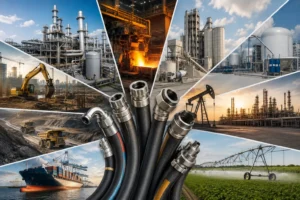
Direct answer: Industrial rubber hoses are used across manufacturing, construction, mining, chemical processing, oil and gas, agriculture, and marine sectors.
Common industries include:
- Manufacturing and processing plants
- Construction sites
- Mining operations
- Steel and metal processing
- Cement plants
- Chemical handling
- Oil and petroleum transfer
- Water transfer systems
- Compressed air and pneumatic tools
- Bulk material handling
- Agriculture and irrigation
- Automotive and engineering
- Marine applications
- Infrastructure projects
Each industry places different demands on pressure, temperature, and media resistance. A hose built for one rarely performs well in another.
A cement plant, for example, deals with abrasive dust and vibration. A chemical unit deals with corrosive media and strict compatibility needs. Even within one facility, different lines can call for different hose specifications.
This is why buyers should describe the actual working environment to the manufacturer, not just the hose size. The environment often changes the recommended construction as much as pressure does.
Types of Industrial Rubber Hoses
Direct answer: Common types include air hoses, water hoses, oil hoses, chemical hoses, steam hoses, material handling hoses, suction hoses, and heavy-duty hoses.
Air Hoses Used for pneumatic tools. Need consistent pressure handling and flexibility for regular coiling.
Water Hoses Used for general water transfer and cleaning. Durability and kink resistance matter most.
Oil and Petroleum Hoses Tube compound must resist swelling or breakdown from prolonged oil contact.
Chemical Hoses Tube material must match the specific chemical being transferred. Compatibility varies chemical by chemical.
Steam Hoses Must handle high temperature and high pressure together.
Material Handling Hoses Need abrasion-resistant covers for transferring bulk or abrasive materials.
Suction and Discharge Hoses Require reinforcement that resists collapse under vacuum.
Heavy-Duty Industrial Hoses Built with thicker walls and extra reinforcement for demanding conditions. A heavy duty rubber hose manufacturer typically uses stronger reinforcement layers here. This is also where premium rubber industrial hose construction applies — describing build quality, not marketing.
No single construction fits every application. Matching hose type to job is essential.
Buyers sometimes try to standardize on one hose type across multiple uses to simplify inventory. This can work for low-demand applications, but it usually backfires wherever pressure, temperature, or media differ significantly.
A short conversation with the manufacturer about each use case is faster and cheaper than dealing with repeated failures from a mismatched hose.
How Industrial Rubber Hoses Are Manufactured
Direct answer: Manufacturing involves compound selection, tube extrusion, reinforcement, curing, and testing before dispatch.
Typical stages at a rubber hose manufacturing company:
- Application and specification review
- Rubber compound selection
- Inner tube formation
- Reinforcement application
- Outer cover construction
- Vulcanization/curing
- Finishing and trimming
- Inspection
- Testing
- Packaging and dispatch
Each stage affects final performance. A factory rubber hose manufacturer that rushes curing or skips compound testing produces hoses that underperform, even if they look correct externally.
Curing time and temperature, in particular, are easy to shortcut and hard to detect visually. An under-cured hose may pass a quick pressure check but degrade faster once it’s in continuous use.
This is one reason inspection and testing stages matter as much as the construction stages. A hose that skips proper testing carries more risk, even if raw materials were correct.
What Determines Hose Quality?
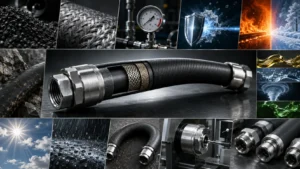
Direct answer: Hose quality depends on compound, reinforcement, pressure rating, temperature range, and media compatibility — not marketing labels.
Key factors buyers should check:
- Rubber compound (tube and cover)
- Reinforcement type and number of layers
- Rated working pressure
- Burst pressure margin
- Temperature range
- Media compatibility
- Abrasion resistance
- Weather and ozone resistance
- Flexibility and bend radius
- Dimensional accuracy
- End connection quality
“Premium” should mean suitability and build quality — not just a price tag.
Two hoses rated for the same working pressure can still differ in real-world reliability, depending on burst pressure margin and reinforcement quality. A higher safety margin generally means more tolerance for pressure spikes.
Buyers evaluating quality should ask for specific numbers — pressure rating, temperature range, compound type — rather than accepting general assurances.
Standard Hose vs Custom Industrial Rubber Hose
Direct answer: Standard hoses work for common applications; custom hoses are needed when diameter, pressure, temperature, or fittings fall outside standard specs.
Custom requirements often include:
- Non-standard internal diameter
- Specific lengths
- Higher pressure ratings
- Unusual temperature conditions
- Special rubber compounds
- Custom reinforcement
- Application-specific fittings
- Special cover properties
Rubber Hose India LLP works directly with industrial buyers to review these requirements before recommending a construction — rather than defaulting to a standard hose that may not fit.
Custom orders usually take longer to produce than standard stock hoses, so it helps to flag customization needs early in the project timeline. This avoids last-minute delays when equipment installation is already underway.
Not every unusual requirement needs a fully custom hose. Sometimes a standard hose with a different fitting or length adjustment is enough — a manufacturer with technical depth can tell the difference.
How to Select the Right Industrial Rubber Hose
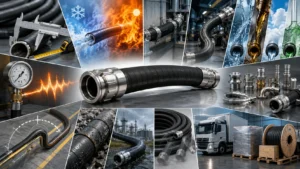
Direct answer: Use the STAMPED framework — Size, Temperature, Application, Material/Media, Pressure, Ends, Delivery.
Size — internal diameter, outside diameter, length.
Temperature — media temperature and ambient temperature.
Application — static or mobile, indoor or outdoor use.
Material/Media — substance flowing through the hose.
Pressure — normal pressure, surges, and vacuum conditions.
Ends — fitting and coupling type.
Delivery — quantity and timeline.
Also check bend radius, routing, abrasion exposure, external environment, and movement frequency. A capable rubber hose pipe manufacturer should walk buyers through each factor, not just quote a size.
Static installations, where a hose stays in one position, have different wear patterns than dynamic ones, where the hose is regularly moved, coiled, or dragged. Dynamic use generally calls for more flexible construction and a tighter allowable bend radius.
Skipping this checklist is the most common reason hoses underperform their rated specifications in the field, even when the hose itself was manufactured correctly.
Why Manufacturer Selection Matters
Direct answer: The manufacturer’s capability directly affects hose performance and consistency across orders — more than unit price does.
What a strong rubber industrial hose manufacturer should offer:
- Manufacturing capability across hose types
- Technical understanding of application needs
- Correct material selection
- Customization support
- Consistent quality checks
- Testing capability
- Adequate production capacity
- Clear documentation
- Responsive communication
- Reasonable lead times
- Post-order technical support
Two manufacturers can quote the same price for what looks like the same hose specification, yet deliver very different real-world performance. The difference usually comes down to material sourcing, process control, and testing discipline — none of which show up on a price sheet.
For buyers placing recurring orders, manufacturer consistency matters even more than the first order’s price, since repeat variability in construction quality creates unpredictable maintenance planning.
How to Evaluate a Manufacturer
Direct answer: Ask about application understanding, materials, quality checks, customization, and lead times before ordering.
Questions worth asking:
- Do they understand the specific application?
- Can they recommend construction based on pressure and media?
- What materials are used?
- What quality checks are performed?
- Can custom sizes be produced?
- Are specifications available for review?
- What are minimum order requirements?
- What is production capacity?
- What are typical lead times?
- Can they support bulk or repeat orders?
A genuine industrial rubber hose manufacturer India buyers can rely on will answer these clearly.
Vague or delayed answers to these questions are usually a sign the manufacturer hasn’t reviewed the application closely, which increases the chance of receiving a hose that doesn’t match the actual working conditions.
It’s reasonable to ask for these details in writing before finalizing an order, especially for recurring or bulk industrial requirements.
Why Location and Supply Capability Matter
Direct answer: Manufacturer location affects communication speed, delivery timelines, and support for repeat orders.
Proximity and supply capability influence:
- Communication ease
- Logistics and delivery time
- Repeat order turnaround
- Support for large projects
- Replacement hose availability
- Bulk procurement coordination
For buyers near the NCR, working with an industrial hose manufacturer Delhi-based can shorten lead times versus sourcing from farther away.
This matters most for urgent replacement needs, where equipment downtime is costing money every hour a hose isn’t available. A manufacturer with a shorter supply chain to the buyer’s location can respond faster in these situations.
For planned bulk orders, location matters less than production capacity and lead time reliability — but for emergency or repeat needs, proximity remains a practical advantage.
Price vs Total Cost
Direct answer: The cheapest hose often costs more over time due to replacement frequency, downtime, and maintenance labour.
Factors that add to real cost:
- Replacement frequency
- Maintenance labour
- Production downtime
- Leakage losses
- Equipment damage risk
- Installation cost
- Spare inventory needs
- Overall service life
Comparing manufacturers on lifecycle value — not just quoted price — gives a more accurate cost picture.
A rough way to compare two options is to divide expected total cost, including replacements and downtime, by the expected service life in months. This often flips the ranking compared to a simple upfront price comparison.
Procurement teams that track hose failure history over time usually find this comparison more useful than any single quote, since it reflects actual performance rather than promised performance.
Warning Signs in a Manufacturer
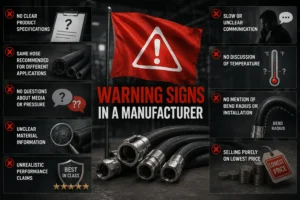
Direct answer: Red flags include vague specifications, no questions about application, and pricing-only sales pitches.
Watch for:
- No clear product specifications
- Same hose recommended for different applications
- No questions about media or pressure
- Unclear material information
- Unrealistic performance claims
- Slow or unclear communication
- No discussion of temperature
- No mention of bend radius or installation
- Selling purely on lowest price
None of these signs alone is automatically disqualifying. But when several appear together during the inquiry stage, it’s a reasonable reason to ask more detailed questions or consider another supplier.
Questions to Ask Before Ordering
Direct answer: Confirm media, pressure, temperature, size, and fitting requirements before contacting a manufacturer.
- What media will flow through the hose?
- What is the working pressure?
- Are pressure surges expected?
- What is the operating temperature?
- What ID and length are needed?
- Is suction or vacuum involved?
- Will abrasion occur?
- What bend radius is available?
- Which fittings are required?
- What quantity is needed?
- Is customization required?
- What is the delivery deadline?
Writing these answers down before the first call saves time on both sides and reduces back-and-forth clarification during quoting. It also makes it easier to compare quotes from different manufacturers on a like-for-like basis.
Choosing a Long-Term Manufacturing Partner
Direct answer: A reliable partner delivers consistent quality, clear communication, and dependable supply across repeat orders.
This matters most for buyers with recurring or multi-site requirements. Consistency, technical communication, and customization support outweigh a single low quote.
Rubber Hose India LLP works with industrial buyers on this basis — discussing application requirements directly for both standard and custom rubber hose needs.
Over time, a consistent manufacturing partner also becomes familiar with a buyer’s specific equipment and past order history, which speeds up future orders and reduces the chance of specification errors.
This kind of relationship is harder to build with suppliers who are chosen purely on a one-off lowest-price basis for each order.
What Does “Best Rubber Hose Manufacturer in India” Mean?
Direct answer: “Best” depends on the buyer’s specific application — not a fixed ranking.
Evaluate manufacturers on:
- Correct hose recommendation for the application
- Manufacturing consistency
- Material suitability
- Technical knowledge
- Customization ability
- Quality control
- Delivery reliability
- Commercial fit
- Communication responsiveness
This is how the term best rubber hose manufacturer India should actually be assessed — through fit, not self-declared rank.
A manufacturer that’s an excellent fit for high-pressure chemical transfer may not be the right choice for a buyer needing simple compressed-air hoses in bulk. Matching capability to actual need matters more than any general reputation.
Conclusion
Choosing the right industrial rubber hose comes down to matching application, media, pressure, temperature, size, reinforcement, and environment — with a manufacturer capable of delivering all of it consistently.
Rubber Hose India LLP works with industrial buyers to think through these factors before recommending a hose, rather than defaulting to a standard, one-size-fits-all order.
Looking for an industrial rubber hose for your application? Share your required hose size, media, working pressure, temperature, quantity, and application details with Rubber Hose India LLP to discuss a suitable solution.
Frequently Asked Questions
Which rubber hose suits heavy-duty industrial applications?
One with reinforced construction, thicker cover, and higher pressure rating, matched to the specific media and load involved.
Can industrial rubber hoses be made in custom sizes?
Yes. Many manufacturers produce custom diameters, lengths, and constructions for non-standard requirements.
How do I select a hose for pressure applications?
Match working pressure and expected surges against the hose's rated working and burst pressure, alongside temperature and media compatibility.
What information should I share before ordering?
Media type, working pressure, temperature, size, fitting type, quantity, and any customization needs.
What affects hose service life?
Correct selection for the application, installation conditions, abrasion exposure, and how well construction matches pressure and media.
How do I compare different manufacturers?
On technical understanding, material quality, customization, quality checks, capacity, and communication — not price alone.
Do different industries need different hose construction?
Yes. Compressed air hoses differ from chemical transfer or abrasive material handling hoses in tube compound, reinforcement, and cover.