
Industrial fluid transfer systems depend heavily on the quality, construction, and suitability of the hose used in the application. Whether a facility is transferring water, handling suction operations, discharging liquids, supporting pumps, or moving compatible chemicals, the wrong hose can result in leakage, reduced flow, premature failure, and unnecessary downtime.
This is why selecting the right PVC industrial hose manufacturer and, more importantly, the right hose specification should be treated as a technical procurement decision rather than a price-only purchase.
PVC hoses are widely used across agriculture, construction, manufacturing, water management, pumping systems, and general industrial applications because they can provide a practical combination of flexibility, low weight, corrosion resistance, and economical operation.
However, not every PVC hose is suitable for every application. A hose designed for low-pressure delivery may not be suitable for suction. A flexible hose used for water transfer may not be compatible with a particular chemical. Likewise, selecting an incorrect diameter, pressure rating, reinforcement, or temperature range can significantly reduce service life.
For industrial buyers, understanding these differences is the first step toward choosing a reliable PVC hose pipe manufacturer India supplier and obtaining the correct product for the application.
What Is a PVC Industrial Hose?
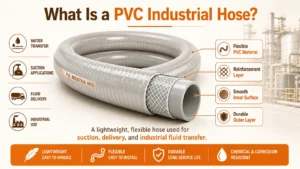
A PVC industrial hose is a flexible hose primarily made using polyvinyl chloride compounds and designed to transfer liquids, air, powders, or other compatible media depending on its construction.
Unlike a simple unreinforced plastic tube, industrial PVC hoses may incorporate textile reinforcement, rigid PVC spirals, helixes, or multiple material layers to provide the mechanical strength required for different operating conditions.
PVC hoses can be designed for applications such as positive-pressure delivery, suction, discharge, water transfer, air movement, ventilation, irrigation, and general industrial fluid handling.
The actual performance of a hose depends on several factors, including its material formulation, reinforcement, wall thickness, internal diameter, pressure rating, temperature capability, and compatibility with the transferred medium.
For this reason, an experienced industrial PVC hose manufacturer or industrial hose supplier should evaluate the intended application before recommending a hose solely on the basis of size.
Why Are PVC Hoses Widely Used in Industrial Applications?
PVC has become a common hose material because it can offer several operational benefits where the application is compatible with its properties.
PVC hoses are generally lightweight compared with many heavy-duty rubber hose constructions. This can make handling, installation, routing, transportation, and replacement easier, particularly where operators regularly reposition hoses.
PVC is also inherently resistant to corrosion and can be formulated for different levels of flexibility and resistance to environmental exposure.
Depending on the hose design, reinforcement, and grade, a PVC industrial hose may offer good flexibility, smooth internal flow characteristics, resistance to various mild chemicals, and sufficient strength for common suction and delivery operations.
These characteristics make PVC hoses popular in applications such as water transfer, irrigation, pumps, construction dewatering, industrial drainage, ventilation, air transfer, and compatible liquid handling.
The key consideration is that the hose must always be selected according to its actual technical rating rather than assuming that all PVC hoses provide identical performance.
Types of PVC Industrial Hoses
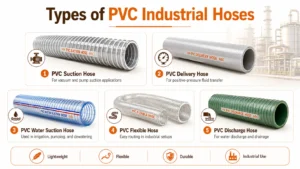
Different applications create different mechanical demands on a hose. A suction line, for example, experiences different stresses from a hose carrying liquid under positive pressure.
Understanding the major hose categories makes it easier for procurement teams to communicate their requirements to a PVC industrial hose manufacturer or supplier.
PVC Suction Hose
PVC suction hoses are designed for applications where a pump creates negative pressure or vacuum inside the hose.
One of the major risks in a suction application is hose collapse. For this reason, suction hoses commonly use structural reinforcement such as a rigid PVC spiral or helix to help the hose maintain its internal shape while operating under vacuum.
A buyer evaluating a PVC suction hose manufacturer should therefore look beyond hose diameter. Vacuum rating, reinforcement construction, bend radius, wall strength, media compatibility, and operating temperature are equally important.
PVC suction hoses can be used for applications such as water pumping, irrigation, drainage, construction dewatering, tank transfer, agricultural operations, and other compatible fluid-handling duties.
A smooth internal bore can also help reduce unnecessary flow restriction.
PVC Delivery Hose
Delivery hoses operate primarily under positive pressure, carrying media from one point to another.
A PVC delivery hose manufacturer may offer different constructions depending on working pressure, hose diameter, application, and required flexibility.
Typical applications can include water delivery, pump discharge, industrial washdown, irrigation, general fluid transfer, and other compatible delivery systems.
For industrial buyers, the important distinction is that suction capability should never automatically be assumed simply because a hose is capable of handling positive delivery pressure.
Pressure resistance and vacuum resistance are separate performance requirements.
PVC Water Suction Hose
Water suction is one of the most common applications for spiral-reinforced PVC hoses.
A PVC water suction hose manufacturer solution may be used with pumps in agriculture, irrigation, construction, dewatering, drainage, water transfer, and various industrial installations.
Because the hose operates on the suction side of a pump, structural stability is particularly important. A hose that is too soft for the vacuum created by the pump may flatten, restrict flow, or collapse completely.
Buyers should verify the required internal diameter, vacuum rating, operating temperature, bend radius, water conditions, and pump characteristics before selecting a water suction hose.
The connection between the hose and pump should also be correctly sized and properly secured to minimize air leakage into the suction line.
PVC Flexible Hose
Flexibility is a valuable property where hoses must move around machinery, bends, confined areas, portable equipment, or changing operating positions.
A PVC flexible hose manufacturer can produce or supply different constructions depending on whether the hose is intended for air, water, liquids, ventilation, suction, or general-purpose service.
However, maximum flexibility is not always desirable.
A highly flexible hose may require additional reinforcement if it is expected to withstand significant pressure or vacuum. Therefore, the best construction is usually a balance between flexibility and structural strength.
Bend radius should also be considered carefully. Repeatedly forcing a hose into a tighter bend than its design allows may create kinks, stress points, flow restrictions, or premature damage.
PVC Discharge Hose
PVC discharge hoses are used to move compatible fluids away from pumps, tanks, equipment, drainage systems, or process areas.
A suitable PVC discharge hose manufacturer solution may support applications such as water removal, drainage, industrial pumping, irrigation, construction sites, and general liquid transfer.
Discharge applications should be evaluated according to maximum system pressure, expected flow, hose length, temperature, media compatibility, external abrasion, and connection requirements.
Even relatively simple water discharge applications can experience pressure fluctuations caused by pump starts, shutdowns, valves, routing, or other system conditions.
PVC Suction Hose vs PVC Delivery Hose
Although suction and delivery hoses may appear similar, they serve different mechanical functions.
| Parameter | PVC Suction Hose | PVC Delivery Hose |
| Main Function | Draws media toward a pump | Carries media away from a source or pump |
| Internal Condition | Negative pressure/vacuum | Positive pressure |
| Major Risk | Hose collapse | Excess pressure or rupture |
| Reinforcement | Often spiral or helix reinforced | Depends on required pressure and application |
| Important Rating | Vacuum capability | Working pressure |
| Typical Use | Pump suction, water intake, dewatering | Water delivery, discharge, fluid transfer |
| Selection Priority | Collapse resistance and vacuum rating | Pressure resistance and flow capacity |
| Flexibility | Must balance flexibility with structural stability | Depends on pressure and routing requirements |
Some hose constructions are designed for both suction and delivery. In such cases, both the vacuum and pressure ratings should be checked before installation.
Rubber Hose India LLP’s current product information, for example, lists a heavy-duty suction and discharge hose constructed from soft PVC with a rigid PVC spiral and identifies applications involving water, slurry, chemicals, and oils, subject to suitability for the specific medium.
Common Applications of Industrial PVC Hoses
The correct PVC hose construction can support a wide variety of industrial operations.
Common areas include agriculture and irrigation, water pumping, construction dewatering, drainage, manufacturing facilities, tank transfer, ventilation, dust extraction, compatible chemical transfer, air movement, industrial cleaning, and general fluid delivery.
The suitability of the hose should always be verified for the specific medium and operating conditions.
For example, stating that a PVC hose has “chemical resistance” does not mean it is compatible with every chemical at every concentration and temperature. Chemical compatibility should be checked for the actual substance being transferred.
The same principle applies to food, pharmaceutical, oil, slurry, or abrasive-material applications. The hose grade and construction must be specifically suitable for the intended service.
How to Select the Correct PVC Industrial Hose
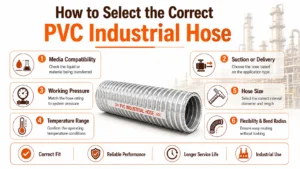
Choosing the right hose requires more than providing its internal diameter.
Industrial buyers should provide the supplier with enough operating information to determine whether the hose is suitable for the application.
1. Identify the Transferred Media
Start by identifying exactly what will pass through the hose.
Water is relatively straightforward, but chemicals, oils, slurry, powder, air, gases, food-related substances, and other materials may require specific compounds or hose constructions.
The compatibility of the inner hose material with the transferred media is critical because unsuitable media can cause softening, swelling, hardening, cracking, contamination, or premature deterioration.
2. Determine Whether the Application Is Suction or Delivery
This is one of the most important questions.
If the hose is connected to the suction side of a pump, it requires adequate vacuum resistance.
If it is on the discharge side, the required working pressure becomes especially important.
Where the same hose performs both suction and delivery functions, both ratings must be verified.
3. Check the Required Working Pressure
Working pressure is the pressure that the hose is designed to handle under defined operating conditions.
Buyers should consider the normal operating pressure as well as potential pressure surges.
A hose should not be selected simply because its stated pressure rating appears close to normal operating pressure without considering actual system conditions.
4. Understand Burst Pressure
Burst pressure and working pressure are not interchangeable.
Burst pressure generally represents a failure threshold under specified testing conditions, whereas working pressure is the relevant rating for normal operation.
A hose must therefore never be operated continuously at or near its burst pressure.
5. Confirm Vacuum Requirements
For suction service, determine the vacuum conditions created by the pump and system.
A strong spiral reinforcement can help resist collapse, but the actual vacuum rating specified for the hose should still be checked.
This is particularly important for larger diameters and demanding pumping systems.
6. Verify Operating Temperature
Both the media temperature and surrounding environmental temperature can affect PVC hose performance.
Material properties can change at elevated or very low temperatures, so the hose manufacturer’s specified temperature range should be respected.
7. Select the Correct Internal Diameter
Internal diameter influences flow rate, velocity, pressure loss, and connection compatibility.
A hose that is too small may create excessive flow restriction, while unnecessary oversizing can increase cost, weight, and handling difficulty.
The hose ID should be matched to the pump, system requirement, and fittings rather than selected by approximation.
8. Consider Bend Radius and Routing
Routing a hose too tightly can create kinks and concentrated mechanical stress.
Before ordering, inspect the installation layout and determine whether the hose will run straight, around machinery, through confined areas, or around repeated bends.
A good PVC flexible hose manufacturer specification should provide sufficient flexibility without compromising structural strength.
9. Evaluate Reinforcement
Reinforcement is one of the defining elements of industrial hose construction.
Depending on the application, PVC hoses may use braided textile reinforcement, rigid spirals, helixes, or other constructions.
Reinforcement selection affects working pressure, vacuum resistance, dimensional stability, flexibility, and overall durability.
10. Check Fittings and Coupling Compatibility
A reliable hose can still perform poorly if paired with unsuitable fittings or incorrectly installed couplings.
The hose ID, OD, wall construction, fitting type, clamping method, pressure requirement, and application should all be considered as a complete assembly.
PVC Hose Selection Checklist for Procurement Teams
Before requesting a quotation from a PVC hose pipe manufacturer India supplier, buyers can use the following checklist:
| Requirement | Information to Confirm |
| Media | What liquid, air, powder, slurry, or chemical will pass through the hose? |
| Function | Suction, delivery, discharge, or both? |
| Internal Diameter | Required hose ID and connection size |
| Working Pressure | Normal maximum operating pressure |
| Pressure Surges | Whether temporary pressure spikes may occur |
| Vacuum | Maximum expected suction/vacuum |
| Temperature | Media and ambient temperature |
| Hose Length | Required length per hose or coil |
| Flexibility | Routing and minimum bend requirements |
| Reinforcement | Spiral, braided, or other construction |
| Environment | Indoor, outdoor, UV, abrasion, weather exposure |
| Connections | Coupling, clamp, fitting, or adapter requirement |
| Quantity | Trial quantity, routine requirement, or bulk purchase |
| Documentation | Technical specifications or test information required |
| Delivery | Required dispatch or installation schedule |
Providing this information early makes discussions with an industrial hose supplier significantly more efficient.
Quality Factors to Check When Buying PVC Industrial Hose
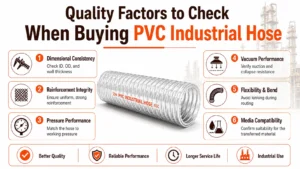
Industrial procurement should consider quality consistency, not just the appearance of a sample.
Dimensional Consistency
Internal diameter, outside diameter, wall thickness, and overall dimensions should remain consistent within the specified tolerance.
Variations can affect fittings, sealing, flow, and installation.
Reinforcement Integrity
The reinforcement should be uniformly incorporated into the hose structure according to the design.
Irregular reinforcement can create weak points and inconsistent mechanical performance.
Pressure Performance
For pressure applications, the hose should be suitable for the defined working pressure and system conditions.
Where relevant, pressure testing and product specifications help buyers evaluate suitability.
Vacuum Performance
For suction hoses, resistance to collapse is critical.
The reinforcement and hose construction should support the specified vacuum conditions.
Surface and Visual Inspection
Cracks, inconsistent wall thickness, exposed reinforcement, irregular surfaces, deformation, and other visible defects should be identified before installation.
Flexibility and Bend Behaviour
The hose should bend according to its intended design without excessive flattening, kinking, or structural distortion.
Media Compatibility
This factor deserves repeated emphasis because even a mechanically strong hose can fail if its material is incompatible with the transferred substance.
Understanding PVC Hose Construction
A typical industrial PVC hose can include an inner layer responsible for contact with the transferred medium, reinforcement for mechanical strength, and an outer layer that protects the structure from external conditions.
The exact configuration varies considerably among products.
For example, a transparent braided PVC hose may use textile reinforcement to increase pressure resistance, while a heavy-duty suction hose may use a rigid PVC helix to resist collapse.
Rubber Hose India LLP currently lists PVC hoses among its industrial hose and allied-product range, while its suction and delivery hose product page specifies a soft PVC construction reinforced with a rigid PVC spiral.
This demonstrates why buyers should evaluate individual hose construction rather than treating “PVC hose” as a single product category.
How PVC Industrial Hoses Are Manufactured
Manufacturing methods vary according to hose type and equipment, but a typical process starts with selecting and preparing the PVC compound according to the required physical properties.
The inner layer can then be formed through extrusion. Where reinforcement is required, textile yarn, spiral reinforcement, or another structural element is applied according to the hose design.
Additional PVC layers may then be extruded or bonded around the reinforcement.
The hose passes through controlled cooling and sizing stages to achieve the required dimensions. It can then undergo inspection and relevant testing before being cut or coiled for supply.
For an industrial PVC hose manufacturer, process control is important because small inconsistencies in dimensions, reinforcement placement, or material processing can influence product performance.
Industrial buyers should therefore evaluate technical specifications and quality controls alongside price.
How to Evaluate a PVC Industrial Hose Manufacturer or Supplier
Searching for the best PVC hose manufacturer India can produce many choices, but the word “best” should not be interpreted as a marketing claim.
The most suitable supplier is the one that can consistently meet the technical, commercial, and logistical requirements of the application.
Buyers should evaluate application knowledge, product range, technical specifications, quality-control procedures, availability of appropriate sizes, ability to support bulk requirements, delivery capability, and responsiveness to technical questions.
A supplier that asks about pressure, media, temperature, suction conditions, ID, and application before making a recommendation is generally providing more useful technical support than one that recommends a hose based only on size and price.
PVC Hose Manufacturer Delhi: What Should Industrial Buyers Consider?
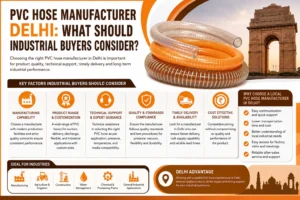
Delhi and the wider NCR region contain a large concentration of industrial buyers, engineering companies, distributors, maintenance teams, contractors, and manufacturing businesses.
Companies searching for a PVC hose manufacturer Delhi or industrial hose supplier may therefore value convenient product availability, technical support, rapid communication, and access to multiple hose types and fittings.
However, location should not replace technical evaluation.
Whether the supplier is in Delhi or another industrial region, buyers should check product suitability, specifications, reliability, and supply capacity.
Rubber Hose India LLP has its registered and sales office at Ajmeri Gate, Delhi, along with its works and corporate office in the Patparganj Industrial Area. Its website lists PVC hoses among the industrial hose products handled by the company.
For buyers in Delhi/NCR as well as those sourcing industrial hoses for projects elsewhere in India, access to a broad industrial hose portfolio can simplify procurement when an application requires hoses, fittings, couplings, or related products.
PVC Industrial Hose Manufacturer in India: Price vs Total Application Value
Price naturally matters in industrial procurement, particularly for recurring or bulk requirements.
But selecting the cheapest hose without considering operating conditions can increase the actual cost of ownership.
If a hose is under-specified, frequent replacement can increase maintenance hours, production interruptions, emergency purchasing, fluid loss, cleanup requirements, and labour costs.
Overspecifying a hose can also be inefficient because buyers may pay for performance characteristics that the application does not require.
The better approach is specification-based purchasing.
Procurement teams should aim to select a hose that provides the required performance margin for the real operating environment at a commercially reasonable cost.
Warning Signs of an Unreliable PVC Hose Supplier
Price alone should not determine supplier selection.
Industrial buyers should be cautious when a supplier cannot provide clear information about hose construction, working pressure, vacuum suitability, temperature range, dimensions, or intended applications.
Another warning sign is recommending the same hose for very different media or operating conditions without discussing compatibility.
Unclear product identification, inconsistent dimensions, poor communication regarding lead times, and reluctance to clarify technical requirements can also create procurement risk.
A capable supplier should be willing to understand the application before finalising the recommended hose specification.
Questions to Ask Before Ordering PVC Industrial Hose
Before issuing a purchase order, ask the supplier the following questions:
- Is this hose suitable for the exact media being transferred?
- Is the hose designed for suction, delivery, discharge, or combined service?
- What is the recommended working pressure?
- What vacuum condition can the hose handle?
- What temperature range applies to the product?
- What reinforcement construction is used?
- What are the hose ID, OD, and available sizes?
- What bend limitations should be considered?
- Which fittings or couplings are compatible?
- Are technical specifications available for the selected product?
- Is the hose suitable for outdoor or abrasive environments if required?
- What quantity and delivery schedule can be supported?
These questions make it easier to compare quotations from a PVC suction hose manufacturer, PVC delivery hose manufacturer, or general industrial hose supplier on a technically comparable basis.
Why Application-Based Hose Selection Matters
An industrial hose is part of a working system rather than an isolated component.
Its performance is influenced by the pump, fittings, operating pressure, temperature, media, routing, environment, installation method, and frequency of movement.
Consider a construction dewatering system. The suction side may require a reinforced hose capable of resisting vacuum, while the pump outlet requires a hose rated for discharge pressure.
Using the same generic lightweight hose in both positions without verifying its technical ratings can create problems.
Similarly, an irrigation system may need flexibility and long hose lengths, while a factory installation may place greater importance on abrasion resistance and routing around equipment.
This is why the conversation with a PVC industrial hose manufacturer or supplier should begin with the application rather than with the product catalogue.
Choosing the Right PVC Hose for Long-Term Performance
Correct hose selection should be followed by correct installation and maintenance.
Hoses should not be dragged unnecessarily over sharp surfaces, twisted during installation, forced below their recommended bend radius, exposed to incompatible media, or operated beyond their specified pressure and temperature range.
Connections should be inspected periodically, particularly in systems where vibration or repeated movement is present.
Operators should also monitor hoses for signs such as cracking, hardening, unusual softening, excessive abrasion, deformation, leakage, reinforcement damage, or deterioration near fittings.
Replacing a deteriorating hose during planned maintenance is generally preferable to waiting for an unexpected failure during operation.
Rubber Hose India LLP and Industrial PVC Hose Requirements
Rubber Hose India LLP has been operating since 1993 and describes its business activities as the sales and distribution of industrial hoses and allied products alongside manufacturing and supply of hydraulic hose assemblies. Its listed hose portfolio includes PVC hoses, hydraulic hoses, Teflon hoses, and SS flexible hoses.
For PVC applications specifically, the company’s product information includes suction and delivery hoses for applications involving water and other compatible media, with spiral-reinforced PVC construction among the available designs.
Industrial buyers can therefore discuss factors such as application, media, pressure, suction requirements, dimensions, fittings, and quantity before selecting the appropriate PVC hose solution.
Conclusion
Choosing the correct PVC industrial hose requires an understanding of much more than hose diameter and price.
Media compatibility, suction or delivery function, working pressure, vacuum, temperature, reinforcement, hose construction, flexibility, bend radius, environment, fittings, and operating conditions all influence performance.
A reliable PVC industrial hose manufacturer or supplier should help buyers match these technical requirements with the appropriate product rather than treating every PVC hose as interchangeable.
Whether you are evaluating a PVC suction hose manufacturer, PVC delivery hose manufacturer, PVC water suction hose manufacturer, PVC flexible hose manufacturer, PVC discharge hose manufacturer, or searching for a dependable PVC hose pipe manufacturer India supplier, specification-based procurement is the safest approach.
Industrial buyers searching for a PVC hose manufacturer Delhi can also discuss their application requirements with Rubber Hose India LLP to identify an appropriate PVC hose from its industrial hose range.
The objective should not simply be to locate the best PVC hose manufacturer India search result. It should be to select a hose solution that delivers the required performance, compatibility, safety, and service life for the actual operating environment.
Frequently Asked Questions About PVC Industrial Hoses
What is the difference between a PVC suction hose and a PVC delivery hose?
A suction hose is designed to withstand negative pressure or vacuum without collapsing, while a delivery hose primarily carries media under positive pressure. Suction hoses commonly require structural reinforcement such as a rigid helix. Some hoses are rated for both suction and delivery.
How do I choose the right PVC suction hose?
Start with the transferred media, internal diameter, vacuum requirement, temperature, pump capacity, hose length, bend radius, and reinforcement type. A suitable PVC suction hose manufacturer or industrial supplier should evaluate these parameters before recommending a product.
Can PVC hoses be used for water suction?
Yes, suitable reinforced PVC hoses are commonly used for water suction in pumping, irrigation, construction, drainage, and dewatering systems. Buyers should choose a product specifically rated for the required suction conditions rather than using a standard delivery hose.
What should I check before choosing a PVC hose pipe manufacturer in India?
Evaluate technical product information, application support, available hose constructions, dimensional consistency, pressure and vacuum ratings, media compatibility, quality controls, availability, commercial terms, and delivery capability.
Is a PVC flexible hose suitable for industrial applications?
Yes, depending on its construction and rating. A PVC flexible hose can be suitable for many industrial applications, but flexibility alone does not determine suitability. Pressure, vacuum, temperature, reinforcement, media, and environmental conditions must also be considered.
What is the difference between working pressure and burst pressure?
Working pressure represents the pressure range intended for normal operation under specified conditions. Burst pressure relates to the pressure at which the hose may fail during testing. Burst pressure should never be treated as the normal allowable operating pressure.
How do I find the best PVC hose manufacturer in India for my application?
Rather than relying only on advertising claims, compare suppliers based on application knowledge, product specifications, quality consistency, technical support, appropriate hose range, commercial reliability, and ability to meet delivery requirements.