
Hydraulic hoses serve as the critical lifelines of modern industrial machinery. They transfer high-pressure fluid power to actuate cylinders, drive motors, and control complex mechanical systems across manufacturing, construction, and processing plants.
Selecting an unsuitable hose or partnering with an unreliable hydraulic hose manufacturer in India can quickly lead to severe fluid leaks, unscheduled downtime, costly equipment damage, and high maintenance expenses.
For industrial procurement managers, plant engineers, and OEM buyers, sourcing hydraulic hoses is a technical decision. Evaluating a manufacturer requires a clear understanding of working pressure ratings, fluid compatibility, temperature limits, and assembly precision to ensure long-term system reliability.
What Is a Hydraulic Hose?
A hydraulic hose is a flexible, multi-layered pipe designed to convey fluid under high pressure within a hydraulic power system. Its performance depends entirely on the design and structural integrity of its three core layers:
- Inner Tube: The innermost layer directly contacts the hydraulic fluid. It must be chemically compatible with synthetic oils, water-based fluids, or petroleum-based liquids to prevent degradation, swelling, or hardening.
- Reinforcement Layer: Wrapped or braided around the inner tube, this layer provides the structural strength needed to withstand internal fluid pressure. It usually consists of synthetic yarn, high-tensile steel wire braid, or multi-spiral steel wire.
- Outer Cover: The external layer protects the reinforcement and inner tube from ambient environmental hazards, including mechanical abrasion, ozone exposure, ultraviolet light, direct heat, and chemical splashes.
Why Manufacturer Selection Matters
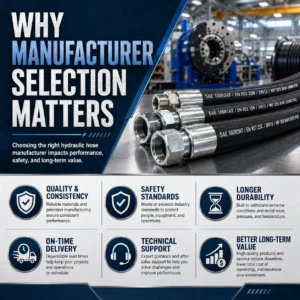
Selecting a competent manufacturer directly impacts machine performance, operator safety, and total operational costs. Partnering with a proven supplier provides clear advantages:
- Product Quality and Reliability: Consistent raw material selection and tight manufacturing tolerances prevent premature hose bursting or inner tube erosion.
- Pressure Performance: Standardised manufacturing ensures that the hose handles working pressures and pressure surges without structural failure.
- Safety: High-pressure hydraulic failures release fluid at velocity, creating hazard risks for personnel. Quality hoses lower these operational hazards.
- Equipment Uptime: Reliable components minimise fluid leaks and unscheduled system shutdowns, maintaining planned production schedules.
- Total Cost of Ownership: High-quality hoses last longer, reducing frequency of replacement and overall maintenance expenses.
- Custom Assemblies and Support: Established manufacturers supply tailored hose lengths, specific fitting combinations, and expert technical guidance for complex applications.
Types of Hydraulic Hoses
Yarn-Braided Hydraulic Hose
Yarn-braided hoses use synthetic textile fibers (such as nylon or polyester) woven over the inner tube to provide structural support.
- Construction: Synthetic rubber inner tube reinforced with one or more layers of high-strength textile braiding, covered by a synthetic rubber outer layer.
- Pressure Range: Suitable for low-to-medium pressure applications, return lines, and low-pressure fluid transfer.
- Flexibility: Offers high flexibility and a tight bend radius, making routing easy in confined spaces.
- Common Applications: Fuel lines, hydraulic return lines, air/water transfer, and low-pressure lubrication systems.
- Procurement Considerations: Contact a yarn braided hydraulic hose manufacturer when your system requires lightweight, highly flexible lines operating below high-pressure thresholds.
Wire-Braided Hydraulic Hose
Wire-braided hoses are the industry standard for medium-to-high pressure industrial fluid power applications.
- Construction: Features one or two layers of high-tensile steel wire braided criss-cross over the inner tube.
- Pressure Handling: Handles medium to high pressure depending on single-wire (1SN/1ST) or double-wire (2SN/2ST) construction.
- Flexibility: Balances pressure strength with flexibility for dynamic equipment routing.
- Common Applications: Excavators, hydraulic presses, agricultural machinery, and industrial power units.
- Procurement Considerations: Work with an experienced wire braided hydraulic hose manufacturer to verify proper wire braid tension and outer cover abrasion resistance.
Spiral-Wire Hydraulic Hose
Spiral-wire hoses are built for demanding applications that experience high working pressures and severe pressure surges.
- Construction: Constructed with multiple layers (four or six) of high-tensile steel wire wrapped in alternating spiral directions around the tube.
- Pressure and Impulse Handling: Designed for high-pressure and high-impulse conditions where standard braided wire might suffer metal fatigue.
- Difference from Wire-Braided Hoses: Wire braids criss-cross over each other, whereas spiral wires lie parallel in alternating layers. This layout allows spiral hoses to handle high pressure without wire friction failure.
- Common Applications: Heavy earthmoving machinery, mining drills, large hydraulic presses, and high-duty construction equipment.
Hydraulic Rubber Hose
Synthetic rubber compound selection determines how well a hose withstands specific environmental hazards and fluid chemistries.
- Rubber Compounds: Manufactured using synthetic rubbers such as Nitrile (NBR), Neoprene (CR), or Ethylene Propylene Diene Monomer (EPDM).
- Resistance Factors: Formulated for oil resistance, high temperature stability, ozone protection, and outer cover abrasion resistance.
- Procurement Considerations: Consult a hydraulic rubber hose manufacturer to match the internal compound with your exact hydraulic fluid chemistry.
How to Select the Correct Hydraulic Hose
Never select a hose based only on inner diameter or purchase cost. Use the STAMPED rule (Size, Temperature, Application, Media, Pressure, Ends, Delivery) and check these key technical factors:
1. Transferred Hydraulic Fluid
The inner tube material must match the fluid type (mineral oil, synthetic ester, water-glycol, or bio-oils). Incompatible fluids cause inner tube swelling, hardening, cracking, or chemical degradation.
2. Working Pressure and Surges
The hose working pressure rating must meet or exceed the system’s continuous operating pressure. Account for transient pressure surges and peak spike pressures to avoid premature hose failure.
3. Burst Pressure
Burst pressure is a laboratory test metric (typically $4\times$ the working pressure). Never select or operate a hose at its burst pressure limit; designing around continuous working pressure ensures safety margins.
4. Fluid and Ambient Temperatures
Both continuous fluid temperature and external ambient temperature affect hose service life. High fluid heat degrades inner tube elastomer, while ambient heat can break down the protective cover.
5. Internal Diameter and Flow Rate
Selecting an undersized internal diameter (ID) causes fluid velocity to jump, generating excessive friction loss, heat generation, and system power loss. An oversized hose increases installation space and overall weight.
6. Hose Length and Minimum Bend Radius
Hoses contract and expand under pressure. Provide enough length to avoid tension during machine movement. Do not exceed the specified minimum bend radius, as sharp bends kink the tube and stress the wire reinforcement.
7. Environmental Exposure and Electrical Conductivity
Consider exposure to mechanical abrasion, sunlight, ozone, chemicals, or direct heat sources. Determine whether the application requires a non-conductive hose (often required for utility bucket trucks and electrical work).
High-Pressure Hydraulic Hose Requirements
Selecting a high pressure hydraulic hose manufacturer requires close evaluation of manufacturing tolerances and quality control procedures. High-pressure lines operate under severe mechanical strain and demand high safety margins.
| Technical Parameter | Procurement Evaluation Requirement |
| Maximum Working Pressure | Must exceed system relief valve setting and peak dynamic pressure surges. |
| Impulse Resistance | Verify the hose withstands cyclic pressure impulse tests per ISO 6803 or SAE J517. |
| Reinforcement Construction | Confirm whether single-wire braid, double-wire braid, or multi-spiral wire is required. |
| Temperature Rating | Check that fluid and ambient rating matches the working environment (e.g., -40°C to +100°C). |
| Standard Compliance | Verify compliance with global standards (SAE 100R series, EN 853, EN 856, or ISO 1436). |
| Fitting Compatibility | Ensure end fittings and ferrules are engineered and certified for the exact hose profile. |
Hydraulic Hose Assemblies
A hydraulic hose by itself cannot operate in a fluid system; it requires crimped end fittings to create an leak-free assembly.
A complete hydraulic hose assembly includes:
- The Hydraulic Hose: Selected for fluid, pressure, and temperature.
- Outer Ferrules / Collars: Metal sleeves crimped over the outer cover to lock the fitting shank to the reinforcement.
- End Fittings: Threaded connectors (BSP, NPT, JIC, ORFS, Flange) that join the hose to pump ports, valves, or cylinders.
- Protective Sleeves: Spiral guards, fire sleeves, or textile wraps added to protect against external abrasion or high ambient heat.
Partnering with a reliable hydraulic hose assembly manufacturer ensures precision insertion depth, exact crimp diameter controls, and pressure testing. Incorrect crimp dimensions can cause fitting blow-offs under pressure or damage the inner tube lining, leading to internal fluid bypass.
Understanding “No-Leak” Hydraulic Hoses
Procurement specifications often ask for a no leak hydraulic hose manufacturer. However, no responsible manufacturer can promise zero leakage across every operating condition without proper system integration.
Selection
& Seals
To Specification
& Installation
Hydraulic connection leak risks are minimized by focusing on precise manufacturing and assembly techniques:
- Matched Hose and Fitting Systems: Using end fittings engineered specifically for the hose dimensions.
- Accurate Crimp Calculations: Calibrating crimp machine settings to achieve the exact outer crimp diameter without crushing the inner tube.
- Correct Thread and Seal Selection: Transitioning from tapered threads (like NPT) to O-ring face seal (ORFS) or ISO 6149 threads for high-pressure sealing.
- Proper Installation Torque: Following recommended tightening torques to protect thread profiles and O-rings from damage during assembly.
- Routine Inspection: Checking hose lines regularly for cover wear, fluid weeping near ferrules, or fitting misalignment.
Major Industrial Applications
Different industries operate under distinct mechanical strains, requiring specific hose designs and certifications:
Outer Wear
Heavy Pressure
Non-Leaking
Flame
- Construction Machinery: Excavators, backhoes, and wheel loaders require wire-braided and spiral hoses with abrasion-resistant covers to handle constant movement, high-impulse pressures, and stone impacts.
- Mining Equipment: Underground and surface mining drills need heavy-duty spiral steel wire hoses with flame-resistant covers to withstand continuous vibration and extreme mechanical wear.
- Agricultural Machinery: Tractors and harvesters use compact wire-braided hoses that offer tight bend radiuses, fluid compatibility with bio-oils, and resistance to weather exposure.
- Machine Tools and Presses: Hydraulic presses demand high-pressure stability and tight crimping parameters to maintain precise working pressures without line flexing.
- Steel Plants and Foundries: High-ambient temperature areas require protective fire-sleeve protection over hydraulic lines to resist thermal degradation and metal splash hazards.
- Material Handling and Logistics: Forklifts and boom cranes rely on flexible, high-tensile hoses with minimal outer diameter profiles for smooth routing over pulleys and mast sheaves.0
How to Evaluate a Hydraulic Hose Manufacturer in India
When auditing a hydraulic hose manufacturer in India, evaluate technical capabilities, quality processes, and supply chain reliability using this buyer checklist:
Evaluate these essential criteria when selecting a supplier:
- Production Technology: Modern extrusion equipment ensures consistent wall thickness, concentricity, and uniform wire tension during braiding.
- Raw Material Integrity: High-purity synthetic elastomers and high-tensile steel wire prevent premature material breakdown under stress.
- Testing Facilities: Verify the manufacturer conducts batch proof-pressure testing, burst testing, and impulse testing to validate product safety margins.
- Customization Capability: Check if the supplier provides cut-to-length hoses, special end fitting combinations, or custom sleeve protection.
- Documentation and Traceability: Reliable suppliers provide technical data sheets, material test reports, and pressure test certificates upon request.
Questions to Ask a Manufacturer Before Placing an Order
To verify technical fit and prevent procurement errors, ask prospective suppliers these questions:
- What is the continuous working pressure and minimum burst pressure rating for this hose size?
- Which synthetic rubber compounds are used in the inner tube, and are they compatible with my hydraulic fluid type?
- What is the allowable operating fluid and ambient temperature range?
- Does this hose meet international standards such as SAE J517, EN 853, EN 856, or ISO 1436?
- Can you supply matched end fittings, ferrules, and custom crimped hydraulic hose assemblies?
- What quality control testing is performed on production batches before shipment?
- Can batch test certificates and technical data sheets be provided with the shipment?
- What is the minimum order quantity (MOQ) and production lead time for custom configurations?
Information Buyers Should Share for an Accurate Quotation
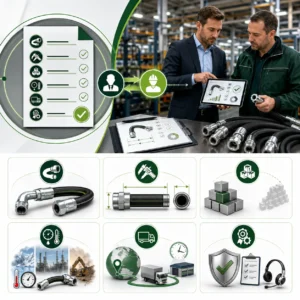
Providing complete application details speeds up quoting and ensures you receive the correct hose design. Include these key parameters in your enquiry:
- Machine or Application Type: Equipment model, duty cycle, and operating conditions.
- Fluid Medium: Synthetic oil, water-glycol, mineral oil, or specialized chemical fluids.
- Working and Peak Pressure: Operating pressure levels and dynamic impulse conditions.
- Operating Temperatures: Continuous fluid temperature and ambient environment exposure.
- Hose Dimensions: Required internal diameter (ID), outer diameter (OD) limits, and total assembly length.
- Fitting Details: Thread type (BSP, NPT, JIC, ORFS, Flange), angle (straight, 45°, 90°), and material specs.
- Quantity and Delivery: Order volume, batching requirements, target delivery date, and site location.
Common Procurement Mistakes to Avoid
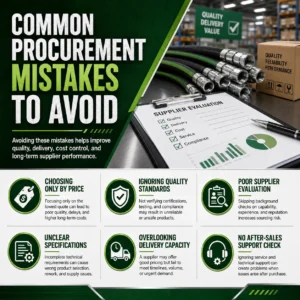
Avoiding typical procurement traps helps maintain system reliability and lower lifetime operating costs:
- Selecting Based Solely on Lowest Purchase Price: Cheaper hoses often use low-grade rubber compounds or uneven wire braiding, leading to short service life and frequent downtime.
- Ignoring System Pressure Surges: Choosing a hose based only on steady-state pressure leaves no margin for spike pressures, increasing burst risks.
- Mixing Hose and Fitting Brands Without Verification: Mismatched fittings and hoses cause improper crimp profiles, leading to fluid leaks or end-fitting pull-offs.
- Exceeding Minimum Bend Radius Limits: Bending a hose too sharply stresses internal wire reinforcements, causing premature failure at the bend point.
- Replacing Failed Hoses Without Analyzing Cause: Simply installing a new hose without diagnosing why the old one failed (e.g., heat, chemical decay, abrasion) leads to repeated line failures.
Hydraulic Hose Manufacturer in Delhi
Industrial buyers searching for a hydraulic hose manufacturer in Delhi or the Delhi NCR regional hub should focus on technical capabilities, material quality, and customer support over physical location alone.
Delhi NCR is a major distribution and industrial manufacturing hub with access to testing labs, logistics infrastructure, and customized engineering services.
When evaluating regional suppliers, verify their product line completeness (yarn, wire, spiral), crimping and testing capabilities, and ability to deliver verified test documentation with your order.
Why Choose Rubber Hose India LLP?
Rubber Hose India LLP supports plant engineers, procurement managers, and machinery manufacturers with industrial hose products designed for demanding operating environments.
Key product offerings and supply capabilities include:
- Hydraulic Rubber Hoses: Built with oil, fuel, and weather-resistant synthetic elastomers.
- Yarn-Braided Hydraulic Hoses: Flexible, lightweight options for low-to-medium pressure applications.
- Wire-Braided Hydraulic Hoses: Single and double-wire braided hoses for medium-to-high pressure equipment.
- Spiral-Wire Hydraulic Hoses: Heavy-duty, multi-spiral steel wire hoses for severe pressure applications.
- High-Pressure Hose Assemblies: Crimped hose assemblies fitted with matching end fittings, tested for reliable field performance.
- Custom Lengths and Configurations: Tailored hose solutions engineered to meet specific industrial machinery and OEM requirements.
By evaluating application parameters—including pressure limits, fluid compatibility, temperature ranges, and fitting profiles—Rubber Hose India LLP helps industrial buyers select reliable, cost-effective hose solutions.
Conclusion
Choosing the correct hydraulic hose manufacturer in India requires careful review of technical specifications, manufacturing standards, testing practices, and assembly capabilities. A hydraulic hose must be matched to system working pressures, fluid chemistries, temperature extremes, and mechanical routing requirements.
Evaluating working pressure ratings, reinforcement design, fitting integration, and material quality helps industrial buyers reduce system leaks, prevent costly machine downtime, and improve operating safety. Providing clear, detailed application parameters during enquiry ensures accurate product selection and reliable long-term performance.
Contact Rubber Hose India LLP today to discuss your technical specifications, request a product quotation, or consult on customized hydraulic hose assemblies for your industrial machinery.
Need Reliable Hydraulic Hose Solutions for Your Machinery?
Consult with our technical team to select the right hose grade, fitting combination, and pressure rating for your equipment.
- Submit Your Technical Enquiry: Share your application details, fluid type, and pressure parameters to receive an accurate quote.
- Explore Custom Assemblies: Order precision-crimped hydraulic hose assemblies engineered for high reliability.
FAQs
Which hydraulic hose is suitable for high pressure?
High-pressure applications require multi-layer steel wire braided hoses (such as SAE 100R2 / EN 853 2SN) or multi-spiral steel wire hoses (such as EN 856 4SP/4SH). Multi-spiral wire designs provide maximum strength and fatigue resistance under high impulse loads.
What is the difference between yarn-braided and wire-braided hydraulic hoses?
Yarn-braided hydraulic hoses use synthetic textile fibers for flexibility and lightweight construction, making them suitable for low-pressure return lines. Wire-braided hydraulic hoses use high-tensile steel wire to withstand medium-to-high working pressures in heavy fluid power systems.
What is a hydraulic hose assembly?
A hydraulic hose assembly is a complete unit consisting of a cut hydraulic hose fitted with crimped metal end connectors, ferrules, and optional protective sleeves. The assembly creates a leak-free fluid line ready to install directly into machinery.
Can hydraulic hose assemblies be customised?
Yes, hydraulic hose assemblies can be customized by specifying the exact hose length, internal diameter, reinforcement layer, end fitting thread styles (BSP, NPT, JIC, ORFS, Flange), fitting angles (straight, 45°, 90°), and protective sleeving.
How can hydraulic hose leakage be prevented?
Prevent leaks by matching hose and fitting specifications, maintaining exact crimp dimensions, selecting O-ring seals over tapered threads for high pressures, applying correct installation tightening torques, and replacing worn or damaged hoses during routine maintenance.
What information is required for a hydraulic hose quotation?
Provide the application type, fluid medium, continuous working pressure, operating fluid and ambient temperatures, internal diameter, required hose length, fitting thread standards, quantity, and any special testing requirements.
How do I determine the correct hydraulic hose size?
Determine hose size by checking system flow rate requirements and using a flow nomogram to select an internal diameter that maintains recommended fluid velocity. This prevents excessive friction loss, heat generation, and pressure drops.
What is the difference between working pressure and burst pressure?
Working pressure is the maximum continuous pressure the hose is rated to handle safely during normal operation. Burst pressure is the laboratory test pressure at which the hose structurally fails, typically rated at four times the working pressure.
Which industries use hydraulic hoses?
Hydraulic hoses are widely used in construction, mining, agriculture, machine tool manufacturing, steel manufacturing, material handling, oil and gas, marine operations, and mobile hydraulic equipment systems.