
Industrial rubber hoses are workhorses. They carry water, steam, chemicals, air, fuel, and hydraulic fluid across some of the most demanding environments in the world. But even the highest-quality hose will fail prematurely if it is stored incorrectly.
Many industrial facilities lose thousands of rupees every year due to preventable hose failures — failures caused not by operational stress, but by poor storage. A hose that sat in direct sunlight for six months, or was stacked under heavy equipment, or stored near an ozone-generating motor, can lose structural integrity before it ever sees a single day of active use.
This guide is designed for industrial buyers, warehouse managers, plant managers, maintenance engineers, procurement teams, and factory owners who want to protect their rubber hose investments. It covers everything from rubber hose storage conditions and shelf life to ageing prevention, maintenance during storage, and practical care tips.
Whether you manage a small workshop or a large industrial facility, following these hose storage best practices will help you extend service life, reduce safety risks, lower replacement costs, and ensure your hoses perform exactly as expected when you need them most.
What Is Rubber Hose Storage and Why Is It Important?
| Quick Answer
Rubber hose storage refers to the controlled process of preserving unused or spare rubber hoses in conditions that prevent physical damage, chemical degradation, and premature ageing. Proper storage directly determines how long a hose lasts and how safely it performs when put into service. |
Rubber hoses are used across industries including oil and gas, chemicals, pharmaceuticals, agriculture, construction, mining, food processing, and manufacturing. These hoses are manufactured from natural or synthetic rubber compounds — materials that are sensitive to heat, UV radiation, ozone, moisture, and mechanical stress.
When a hose is not in active use, it enters a storage phase. How it is stored during this period determines whether it arrives at the point of installation in peak condition or already damaged. Storage is not a passive activity — it is an active part of industrial hose lifecycle management.
Why Proper Storage Matters for Industrial Hoses
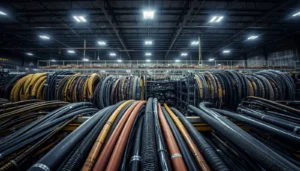
Improper rubber hose storage has real, measurable consequences:
- Safety Risks: A hose weakened during storage may fail under pressure, causing leaks, bursts, or workplace accidents.
- Productivity Loss: Unexpected hose failure causes unplanned downtime, halting production lines or critical operations.
- Higher Maintenance Costs: Replacing hoses that failed due to poor storage means avoidable expenditure on materials and labour.
- Equipment Damage: A leaking or burst hose can damage connected machinery, valves, and fittings.
- Regulatory Non-Compliance: In industries handling hazardous materials, a failed hose can trigger environmental incidents and regulatory penalties.
Proper storage is not just a logistical detail — it is a safety and financial imperative.
Industrial Hose Storage Guidelines Every Facility Should Follow
The following guidelines form the foundation of effective industrial hose storage:
- Clean Before Storage: Remove all residual media from the hose interior. Flush with clean water or an appropriate solvent, then dry completely.
- Store Indoors: Always store rubber hoses in covered, indoor facilities. Outdoor storage exposes hoses to UV radiation, temperature extremes, and moisture.
- Protect from UV Light: Ultraviolet radiation from sunlight breaks down rubber polymer chains. Use opaque bags, covers, or packaging to block UV exposure.
- Ensure Good Ventilation: The storage area must be well-ventilated to prevent moisture buildup, but airflow should not carry chemical fumes or ozone-heavy air.
- Keep Away from Chemicals: Do not store hoses near solvents, oils, acids, alkalis, or fuels. Chemical vapours can penetrate rubber and cause swelling or degradation.
- Avoid Mechanical Stress: Do not fold, kink, or crush rubber hoses during storage. Keep them in natural coiled shapes without sharp bends.
- Handle Carefully: When moving hoses, avoid dragging them on rough surfaces. Use proper handling equipment to prevent abrasion or impact damage.
Ideal Rubber Hose Storage Conditions
| Ideal Rubber Hose Storage Conditions
Rubber hoses should be stored indoors at a temperature between 10°C and 25°C, with relative humidity below 70%, away from direct sunlight, ozone sources, and chemical fumes. The storage area should be clean, dry, dark, and well-ventilated. |
Here are the specific environmental conditions recommended for rubber hose storage:
- Temperature: Maintain between 10°C and 25°C (50°F to 77°F). Avoid areas near furnaces, boilers, or air conditioning units that blow hot or cold air directly on hoses.
- Humidity: Keep relative humidity below 70%. High humidity accelerates oxidation and promotes mould or corrosion on metal fittings.
- Light: Store in a dark environment or use opaque wrapping. Both UV and visible light can initiate photochemical degradation in rubber.
- Ozone: Keep hoses far from electric motors, generators, welding equipment, and fluorescent lighting — all of which generate ozone. Ozone causes surface cracking in rubber compounds.
- Dust & Contaminants: Seal hose ends with end caps or plugs to prevent dust, insects, or moisture from entering the bore.
- Ventilation: Good air circulation prevents condensation, but avoid areas with strong industrial fumes or chemical vapours.
How to Store Rubber Hoses Correctly
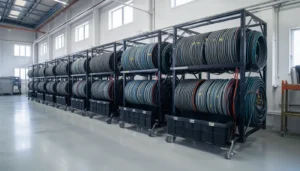
Follow these seven steps to store rubber hoses properly and extend their service life:
- Inspect Before Storage: Check the hose for cuts, abrasions, blisters, swelling, cracks, or damaged fittings. Do not store hoses that show signs of damage — tag them for evaluation or replacement.
- Clean the Hose: Flush the interior thoroughly with clean water or an appropriate cleaning agent. Wipe the exterior. Remove any residue of the media it was carrying.
- Dry Completely: Allow both the interior and exterior to dry completely before storage. Moisture trapped inside the hose or beneath fittings leads to corrosion and rubber degradation. Use compressed air if needed.
- Coil Without Sharp Bends: Coil hoses in large, natural loops. The coil radius should be at least 8–12 times the hose’s outer diameter. Avoid figure-eight bends, kinking, or folding.
- Store on Racks or Hangers: Place coiled hoses on purpose-built hose racks, pegs, or hangers. Do not store hoses directly on the floor, concrete surfaces, or under heavy objects. Racks allow air circulation and prevent compression.
- Label Properly: Attach labels showing the hose type, size, material, date of manufacture, date of storage entry, and any special application notes. This supports FIFO inventory management.
- Follow FIFO Inventory Method: First-In, First-Out ensures that older hoses are used before newer stock, preventing extended storage of early arrivals while newer stock is consumed first.
Recommended Hose Storage Temperature for Maximum Lifespan
| Recommended Storage Temperature
The ideal rubber hose storage temperature is between 10°C and 25°C (50°F and 77°F). Temperatures above 40°C accelerate oxidation and cause rubber to soften, while temperatures below –10°C can make rubber brittle and prone to cracking. |
Temperature is one of the single most critical factors in hose storage. Below is a reference table covering the full temperature range:
| Temperature Range | Condition | Impact on Hose |
| Below –10°C (14°F) | Extremely Cold | Rubber stiffens, cracks on flexing, fittings may loosen |
| –10°C to 10°C (14°F–50°F) | Cold | Reduced flexibility; handle with care; warm before use |
| 10°C to 25°C (50°F–77°F) | Ideal / Recommended | No degradation; maintains flexibility and performance |
| 25°C to 40°C (77°F–104°F) | Warm / Acceptable | Monitor; increase inspection frequency |
| Above 40°C (104°F) | Hot / Harmful | Accelerated oxidation, softening, loss of tensile strength |
| Above 60°C (140°F) | Extreme Heat | Rapid deterioration; rubber compounds break down quickly |
Seasonal storage care is important in India and other regions with extreme seasonal variation. During summer months, warehouse temperatures can exceed 40°C — necessitating insulation, air cooling, or climate-controlled storage. During winter, particularly in northern regions, ensure hoses are not stored in unheated sheds where temperatures drop significantly overnight.
Understanding Rubber Hose Shelf Life
| What Is Rubber Hose Shelf Life?
Rubber hose shelf life is the maximum period during which an uninstalled hose can be stored before it is no longer fit for safe use. Shelf life depends on rubber material, storage conditions, and the hose’s manufacturing quality. Typical shelf life ranges from 3 to 10 years under ideal conditions. |
Shelf life is not a fixed guarantee — it is a guide. A hose stored in poor conditions may deteriorate in 12 to 18 months, while the same hose stored in ideal conditions could remain serviceable for a decade.
| Hose Material | Estimated Shelf Life (Ideal Conditions) | Key Degradation Risk |
| Natural Rubber (NR) | 3–5 years | Ozone cracking, UV oxidation |
| Nitrile Rubber (NBR) | 5–7 years | Heat ageing, chemical swelling |
| EPDM Rubber | 7–10 years | UV (very resistant), ozone-resistant |
| Neoprene (CR) | 5–8 years | Oxidation, heat exposure |
| Silicone Rubber | 10+ years | Minimal; very heat and ozone resistant |
| PVC-lined Hoses | 3–5 years | Plasticizer migration, cold stiffening |
| SBR Rubber | 3–5 years | Ozone cracking, UV damage |
Signs that a stored hose should not be used:
- Visible cracks, crazing, or surface hardening
- Sticky or tacky exterior surface
- Swelling, delamination, or blistering
- Corrosion, rust, or looseness in metal fittings
- Unusual odour indicating chemical contamination
- Loss of flexibility — hose feels stiff or brittle
- Discolouration inconsistent with the rubber compound
Hose Storage Best Practices for Industrial Facilities
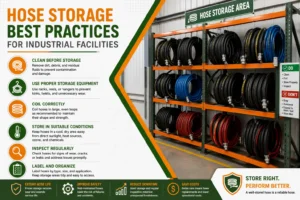
Beyond the fundamentals, the following best practices make a significant difference in large-scale industrial hose warehousing:
- Use Purpose-Built Hose Racks: Invest in dedicated steel or Aluminium hose racks with smooth rounded pegs that prevent sharp bends. Racks should be at a height that keeps hoses off the floor but within safe reach.
- Never Store on Concrete Floors: Concrete absorbs and radiates heat, retains moisture, and exposes hoses to alkaline pH — all of which accelerate rubber ageing. Always use racks or pallets.
- Protect Fittings: Fit protective end caps, plugs, or plastic covers on all hose ends and fittings. This prevents contamination and physical damage.
- Rotate Stock: Implement FIFO across all hose sizes and types. Use date labels on every hose and maintain a digital or physical inventory log.
- Schedule Regular Inspections: Conduct a physical inspection of all stored hoses every six months. Check for surface cracks, fitting integrity, and any signs of ageing.
- Maintain Safe Warehouse Layout: Keep hoses segregated by type, material, and application. Avoid mixing hoses designed for different media in the same storage area, as cross-contamination from residues is possible.
Industrial Hose Warehousing Best Practices
A well-designed warehouse significantly extends the life of rubber hose inventory:
- Warehouse Design: Choose a facility with insulated walls and roofing to minimize temperature fluctuations. Install windows with UV-blocking film or avoid windows in the storage zone entirely.
- Temperature & Humidity Control: In hot or humid regions, install HVAC or industrial-grade dehumidifiers to maintain the ideal environment.
- Ventilation: Mechanical ventilation systems with filtered air prevent ozone and chemical vapour accumulation while controlling humidity.
- Inventory Rotation: Use warehouse management software or manual FIFO boards to track hose age and ensure older stock moves first.
- Product Segregation: Store hoses by rubber type, size, and application. Petroleum-resistant hoses, food-grade hoses, and chemical hoses should be stored in clearly labelled separate sections.
- Packaging: Keep hoses in their original manufacturer packaging whenever possible. If repackaging, use opaque polyethylene bags or UV-resistant wrapping.
- Fire Safety: Rubber is flammable. Ensure the warehouse complies with fire safety regulations, with appropriate extinguisher types and evacuation procedures.
Rubber Hose Ageing Prevention Techniques
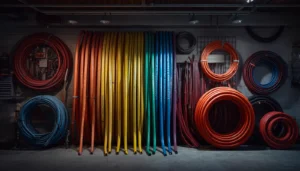
| How Can Rubber Hose Ageing Be Prevented?
Rubber hose ageing can be prevented by controlling storage temperature, blocking UV and ozone exposure, maintaining low humidity, avoiding chemical contact, inspecting hoses periodically, and coiling them correctly to prevent mechanical stress. |
Ageing in rubber hoses is caused by four primary mechanisms: oxidation, ozone attack, UV photodegradation, and thermal degradation. Preventing ageing means controlling all four simultaneously.
- UV Protection: Always wrap stored hoses in opaque, UV-blocking packaging or store them in a dark room. Even indirect sunlight through windows can initiate UV degradation over time.
- Ozone Protection: Keep hoses at least 5 metres away from any ozone-generating equipment. This includes electric motors (especially DC motors), mercury vapour lamps, and welding equipment. Ozone attacks rubber surfaces and causes deep cracking.
- Temperature Control: Maintain storage between 10°C and 25°C. Each 10°C rise in temperature roughly doubles the rate of rubber oxidation.
- Moisture Control: Use desiccants, dehumidifiers, or silica gel packs in sealed packaging. Moisture attacks both the rubber compound and metal fittings.
- Chemical Protection: Store hoses away from any chemicals including cleaning agents, fuels, and lubricants. Seal hose ends and use air-tight packaging where possible.
- Periodic Inspection: Inspect stored hoses at least every six months. Early detection of surface cracks or fitting corrosion prevents waste.
- Proper Coiling: Mechanical stress — from tight bends, kinks, or compression — accelerates rubber fatigue even during storage. Always maintain natural, large-radius coils.
Industrial Hose Maintenance During Storage
Maintenance during storage is often overlooked, yet it is a critical part of the hose lifecycle:
- Routine Inspections: Schedule visual inspections every 6 to 12 months. Check for surface cracking, crazing, colour changes, fitting corrosion, and flexibility.
- Cleaning During Long Storage: If a hose has been stored for more than 12 months, consider a fresh flush and inspection before use. Dust or condensation inside the bore is a risk in long-term storage.
- Pressure Testing Before Reuse: Any hose stored for more than two years — regardless of visual condition — should be pressure-tested before return to service. Test at 1.5x the rated working pressure and hold for the recommended duration.
- Fitting Checks: Inspect crimped or clamped fittings for corrosion, looseness, or deformation. Replace end caps if damaged.
- Documentation: Maintain a written or digital log for every hose unit in storage, recording manufacture date, entry date, inspections performed, and any observations.
- Replacement Planning: Based on shelf life data and inspection findings, proactively plan for hose replacement before failures occur. This supports maintenance budgeting and eliminates emergency procurement.
Practical Rubber Hose Care Tips for Longer Service Life
These actionable care tips apply whether a hose is in active use or in storage:
- Never use a rubber hose beyond its rated pressure or temperature specifications.
- Always drain and clean hoses before placing them in storage.
- Apply a thin coat of talc to the exterior of natural rubber hoses before long-term storage to prevent surface sticking.
- Use hose reel systems for large-diameter or long hoses — this prevents uneven stress distribution during storage.
- Avoid dragging hoses on abrasive surfaces even when repositioning in the warehouse.
- Store hoses away from heat sources including radiators, boilers, steam pipes, and process heaters.
- If hoses are stored near chemical processes, use sealed packaging and inspect more frequently — every 3 months.
- Work with a reliable manufacturer like Rubber Hose India LLP to source hoses made from quality rubber compounds that inherently offer better storage resilience and longer shelf life.
Common Storage Mistakes That Damage Rubber Hoses
Avoid these frequently observed errors in industrial hose storage:
- Direct Sunlight Exposure: Even a few weeks of UV exposure initiates surface cracking and reduces tensile strength significantly.
- Heat Exposure Near Boilers or Furnaces: Thermal degradation accelerates rubber oxidation, causing the hose to harden, become brittle, or soften and collapse.
- Over-Stacking: Stacking hoses or other equipment on top of stored hoses crushes their cross-section and creates permanent flat spots.
- Hanging by Fittings: Suspending hoses by their metal end fittings — rather than by their body — concentrates stress at the most vulnerable joint point, risking premature delamination.
- Storing Near Electric Motors: Motors generate ozone — a highly reactive form of oxygen that attacks rubber polymer chains and causes characteristic ozone cracking.
- Chemical Contamination: Accidental spills or vapour exposure from nearby chemical storage can penetrate the outer rubber cover and attack the reinforcement layer or inner tube.
- Poor Inventory Handling: Using newer hoses while older stock ages — a direct result of ignoring FIFO — means that inventory gradually becomes unusable while procurement costs keep rising.
Proper vs Improper Rubber Hose Storage — Comparison Table
Use this table as a quick reference for your warehouse audit:
| Storage Factor | Proper Storage | Improper Storage |
| Location | Indoors, cool, dry warehouse | Outdoors, rooftop, or open yard |
| Temperature | 10°C – 25°C (50°F – 77°F) | Above 40°C or below –10°C |
| Sunlight Exposure | Shielded from UV with opaque covers | Direct sunlight exposure |
| Humidity Control | Below 70% relative humidity | High humidity, wet environments |
| Coiling Method | Large-radius coils on racks; no kinks | Tight bends, folded, or kinked |
| Chemical Proximity | Segregated from solvents, acids, oils | Near chemicals, lubricants, fuels |
| Electrical Equipment | Away from motors and generators | Stored near electric motors or ozone sources |
| Labeling & FIFO | Labeled with date; FIFO rotation practiced | No labeling; random stock rotation |
| Fittings & End Caps | End caps fitted; fittings protected | Open ends exposed to dust and moisture |
| Inspection Frequency | Every 6–12 months during storage | No routine inspection |
| Shelf Life Outcome | Up to 5–10 years (material-dependent) | Premature failure in 1–2 years |
Industrial Rubber Hose Storage Checklist
Warehouse & Maintenance Team Checklist — use before placing hoses in storage and during periodic inspections:
Pre-Storage Checklist
- Hose inspected visually for cuts, cracks, blisters, or fitting damage
- Interior flushed clean of all residual media
- Interior and exterior completely dried
- Hose coiled in large natural-radius loops — no kinks or sharp bends
- End caps or protective plugs fitted on both ends
- Hose labelled with: material type, size, manufacture date, entry date
- Hose placed on rack — not on floor or concrete
- Stored in dark, dry, ventilated indoor area
- Storage temperature confirmed between 10°C and 25°C
- Humidity confirmed below 70% RH
- Hose segregated by type and application
- FIFO inventory position updated
Periodic Storage Inspection Checklist (Every 6–12 Months)
- Visual check for surface cracks, crazing, or colour change
- Flexibility test — hose should bend without cracking
- Fitting inspection — no corrosion, looseness, or deformation
- Interior check — clean and free of moisture or contamination
- Storage environment confirmed — temperature, humidity, no ozone sources
- Labels verified — dates legible and correct
- FIFO rotation verified — oldest stock positioned for next use
- Hoses approaching shelf life limit flagged for priority use or disposal
- Inspection recorded in maintenance log
Why Choose Rubber Hose India LLP for Quality Industrial Hoses
When it comes to industrial rubber hoses, the quality of the hose at the point of manufacture has a direct impact on how well it survives storage and how long it performs in service. Rubber Hose India LLP is a trusted manufacturer and supplier of industrial rubber hoses in India, serving industries including oil and gas, chemicals, agriculture, construction, food and beverage, pharmaceuticals, and general manufacturing.
What sets Rubber Hose India LLP apart:
- Quality Manufacturing: Hoses are manufactured using premium rubber compounds, high-tensile reinforcement layers, and precision-engineered fittings that provide durability from day one.
- Proper Material Selection: The team helps clients select the right hose material — NBR, EPDM, Neoprene, Natural Rubber, Silicone, or PVC — matched to the application’s temperature, pressure, and chemical requirements.
- Durable Hose Solutions: Every hose is designed and manufactured to meet or exceed relevant standards, ensuring consistent quality across batches.
- Technical Guidance: Rubber Hose India LLP provides expert guidance on hose selection, installation, maintenance, and storage — going beyond just selling a product.
- Industrial Application Support: From single-item requirements to bulk procurement, the team supports plant managers and procurement teams with product knowledge, documentation, and after-sales support.
Conclusion
Rubber hoses are precision-engineered products. They are designed to perform under pressure, temperature, and chemical exposure — but only if they are treated with equal care during the periods they spend in storage. A rubber hose that is stored correctly will arrive at the point of installation in peak condition, perform reliably through its rated service life, and contribute to a safer, more productive industrial facility.
The principles covered in this guide — from ideal storage conditions and shelf life management to ageing prevention and inspection protocols — are not complicated to implement. They require commitment, organization, and the right storage infrastructure. The return on that commitment is measured in fewer emergency replacements, fewer workplace incidents, lower maintenance costs, and longer hose service life.
Good storage is good manufacturing practice. It extends the value of every hose you purchase and reduces the total cost of your fluid handling infrastructure.
Ready to Source High-Quality Industrial Rubber Hoses?
| For high-quality industrial rubber hoses and expert guidance on hose storage, maintenance, and application selection, connect with Rubber Hose India LLP.
Your trusted industrial rubber hose manufacturer and supplier in India. |
Frequently Asked Questions
What are ideal rubber hose storage conditions?
Ideal conditions include a temperature of 10°C to 25°C, relative humidity below 70%, darkness or UV shielding, no ozone sources nearby, clean dust-free air, and no exposure to chemical fumes or oils.
What is the recommended hose storage temperature?
The recommended rubber hose storage temperature is 10°C to 25°C (50°F to 77°F). Temperatures above 40°C accelerate ageing, and temperatures below –10°C can cause rubber to become brittle and crack.
How long is rubber hose shelf life?
Shelf life varies by material. Natural rubber hoses typically last 3 to 5 years in ideal storage. EPDM rubber hoses can last up to 10 years, and silicone hoses even longer. Poor storage conditions can reduce shelf life to 12 to 18 months for any rubber type.
How can rubber hose ageing be prevented?
Ageing can be prevented by blocking UV and ozone exposure, maintaining storage temperature between 10°C and 25°C, controlling humidity below 70%, avoiding chemical contact, coiling hoses properly, and conducting periodic inspections to detect early degradation.
Can rubber hoses be stored outdoors?
Outdoor storage is strongly discouraged. Even short-term outdoor storage exposes hoses to UV radiation, moisture, temperature extremes, and ozone — all of which accelerate rubber degradation. In unavoidable circumstances, fully wrap hoses in UV-resistant sheeting and store off the ground on pallets.
Does sunlight damage rubber hoses?
Yes. Ultraviolet (UV) radiation from sunlight initiates photochemical reactions in rubber polymer chains, causing surface hardening, cracking, and loss of flexibility. Even indirect or diffused sunlight over extended periods can cause measurable degradation.
What are hose storage best practices?
Best practices include: cleaning and drying hoses before storage, coiling without kinks, storing on racks indoors, using end caps, labelling with dates, maintaining FIFO rotation, inspecting every 6 to 12 months, keeping storage temperature between 10°C and 25°C, and protecting from UV and ozone.
Why is FIFO important in industrial hose warehousing?
FIFO (First-In, First-Out) ensures older hoses are used before newer ones, preventing any unit from sitting in storage beyond its recommended shelf life. Without FIFO, newer hoses are consumed while older stock ages, leading to avoidable waste and safety risks from degraded hoses being deployed unexpectedly.
How often should stored hoses be inspected?
Stored hoses should be inspected at least every 6 to 12 months. In facilities with high humidity, temperature fluctuations, or nearby chemical processes, inspection frequency should be increased to every 3 months. Every inspection should be documented in a maintenance log.
What are common signs of stored hose damage?
Key warning signs include: visible surface cracks or crazing, hardness or brittleness, sticky or tacky surface, swelling or blistering, corrosion on fittings, loss of flexibility, unusual chemical odour, or interior discolouration. Any of these signs should prompt removal from inventory for evaluation.
How does industrial hose maintenance improve hose life?
Routine maintenance — including pre-storage cleaning, periodic inspections, pressure testing before reuse, fitting checks, and documentation — ensures that degradation is caught early, hoses are used within their safe service life, and replacements are planned proactively rather than reactively. This directly reduces emergency downtime and total cost of ownership.