
Industrial hoses are critical components in factories, processing plants, construction equipment, hydraulic systems, water-transfer operations, and many other industrial applications. However, selecting a hose is not simply a matter of choosing the correct diameter and placing an order.
The hose must be suitable for the transferred media, working pressure, temperature, installation conditions, movement, abrasion exposure, and expected service environment. The supplier also needs to understand these requirements and provide the right product for the job.
This is why choosing the right industrial hose supplier in India should be treated as a technical procurement decision rather than a price-only purchase.
Whether you are looking for a rubber hose supplier India, hydraulic hose solution, PVC hose, or a dependable hose supplier for factories, understanding what to evaluate can help reduce incorrect purchases, premature failures, downtime, and repeated replacement costs.
This guide explains the major industrial hose types, important selection parameters, common buying mistakes, and the factors industrial buyers should check before choosing a supplier.
What Does an Industrial Hose Supplier Provide?
An industrial hose supplier provides hoses designed to transfer liquids, gases, air, oils, water, chemicals, abrasive materials, or hydraulic fluids under specific operating conditions.
Unlike a general-purpose hose, an industrial hose may need to withstand pressure, suction, heat, oil exposure, abrasion, weather, repeated movement, or other demanding conditions.
A capable industrial hose supplier in India may support different applications through products such as:
- Industrial rubber hoses
- Hydraulic hoses
- PVC hoses
- Water suction and discharge hoses
- Air hoses
- Steam hoses
- Welding and gas-cutting hoses
- Thermoplastic hoses
- Hose assemblies
- Hose fittings and adapters
- Clamps and couplings
The exact hose should always be selected according to the application rather than product name alone.
Industrial Hoses vs Regular Hose Pipes
A regular hose pipe may be suitable for simple water-transfer or light-duty applications. Industrial hoses, however, are designed around more specific operating parameters.
These may include working pressure, reinforcement, temperature limits, chemical compatibility, vacuum capability, abrasion resistance, flexibility, and connection requirements.
For example, a hose suitable for water delivery should not automatically be assumed suitable for hydraulic oil, steam, suction, chemicals, or compressed air.
That is why an industrial buyer should provide complete application information before selecting a hose.
Types of Industrial Hoses Available for Different Applications
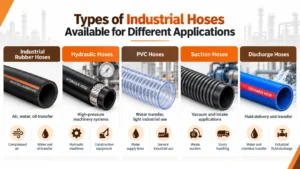
There is no single hose construction that is suitable for every industrial operation. Different applications create different mechanical, chemical, and environmental demands.
Understanding the basic hose categories makes supplier discussions much easier.
Industrial Rubber Hoses
Industrial rubber hoses are used across a wide range of manufacturing, engineering, construction, and material-transfer applications.
Depending on their construction, they may be designed for water, air, oil, steam, suction, discharge, welding gases, or other industrial media.
When evaluating a rubber hose supplier India, buyers should look beyond the word “rubber.” The actual tube compound, reinforcement, cover construction, pressure rating, temperature range, and media compatibility are more important.
A rubber hose designed for one application should not automatically be substituted for another simply because the size is the same.
Hydraulic Hoses
Hydraulic hoses transfer hydraulic fluid between pumps, valves, cylinders, motors, and other system components.
They normally operate under significantly higher pressures than many general industrial hoses.
A buyer searching for a hydraulic hose supplier India should provide details such as:
- Maximum working pressure
- Pressure surges or impulse conditions
- Hydraulic fluid type
- Operating temperature
- Hose internal diameter
- Required length
- Bend and movement conditions
- End fitting type
The hose, fitting, and assembly must work as a compatible system. Selecting only according to external appearance or hose diameter can create serious performance problems.
PVC Hoses
PVC hoses are commonly used for water transfer, suction and delivery, irrigation, ventilation, air movement, and various general industrial duties.
Different PVC constructions can include textile-braided hoses, spiral-reinforced suction hoses, ducting hoses, and other specialized designs.
When working with a PVC hose supplier India, check whether the hose construction is intended for pressure delivery, suction, or another specific duty.
A hose used on the suction side of a pump, for example, needs enough structural support to resist collapse under vacuum.
Suction and Discharge Hoses
Suction hoses need to resist negative pressure without collapsing. They usually use reinforcement designed to maintain hose shape under vacuum conditions.
Discharge hoses operate under positive pressure to move material away from a pump or system.
Some hoses can perform both functions, but buyers should confirm the actual pressure and vacuum ratings rather than assuming that every delivery hose is suitable for suction.
Application-Specific Hose Solutions
Some industrial applications create more demanding conditions than general fluid transfer.
A hose may need to handle:
- High temperatures
- Oils and fuels
- Abrasive materials
- Repeated flexing
- Outdoor exposure
- Chemicals
- High pressure
- Vacuum
- Steam
- Compressed air
The correct solution depends on the combination of these conditions.
Industries That Depend on Reliable Industrial Hose Suppliers
Industrial hoses are found across almost every sector where fluids, air, gases, or materials need to move between equipment.
Common users include:
- Manufacturing plants
- Engineering units
- Construction companies
- Mining operations
- Agricultural facilities
- Automotive workshops
- Hydraulic equipment operators
- Material-handling facilities
- Chemical processing units
- Water-management systems
- Infrastructure projects
- OEMs and machinery manufacturers
For a factory, hose reliability can directly influence maintenance requirements and equipment availability.
A dependable hose supplier for factories therefore needs to support more than occasional purchases. Buyers may also need consistent specifications, replacement availability, multiple hose types, compatible fittings, technical information, and dependable order fulfilment.
How to Choose the Right Industrial Hose Supplier in India
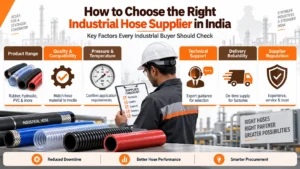
The right supplier is not necessarily the one offering the lowest quotation.
Industrial buyers should evaluate whether the supplier can consistently provide a hose that matches the technical and commercial needs of the application.
Check the Supplier’s Product Range
Factories often use several hose categories within the same facility.
One department may require hydraulic hoses, while another needs water suction hoses, air hoses, PVC hoses, or industrial rubber hoses.
Working with a supplier that can support multiple categories can simplify procurement and reduce the need to coordinate with several vendors.
However, product range alone is not enough. Technical suitability must still be verified for every application.
Verify Hose Material and Media Compatibility
The inner tube of the hose remains in direct contact with the transferred material.
If the hose material is incompatible with the media, it may soften, swell, crack, harden, or otherwise deteriorate prematurely.
Before ordering, clearly identify the material being transferred.
For chemicals, oils, fuels, or other aggressive media, provide the exact substance and relevant operating conditions whenever possible.
Never assume that a hose described as “chemical resistant” is suitable for every chemical.
Confirm Working Pressure
Working pressure is one of the most important selection parameters.
The selected hose needs to be rated for the actual system conditions, including expected pressure variations.
Buyers should not confuse working pressure with burst pressure. Burst pressure is not the pressure at which the hose is intended to operate continuously.
Where pressure surges occur, those conditions should also be discussed with the supplier.
Check Operating Temperature
Temperature affects hose materials and performance.
Consider both:
- Temperature of the material passing through the hose
- Ambient temperature around the hose
A hose operating near hot machinery, furnaces, boilers, engines, or outdoor heat may face environmental temperatures different from the fluid temperature.
Both conditions matter.
Confirm Hose Size
Internal diameter directly influences flow and system performance.
A hose that is too small may create excessive flow restriction, while unnecessarily large hose may make installation more difficult and increase cost.
Buyers should confirm:
- Internal diameter
- External diameter where installation clearance matters
- Required length
- Connection sizes
Do not select the hose only by measuring the outside diameter of an existing hose.
Check Minimum Bend Radius
Routing a hose through an excessively tight bend can place additional stress on the reinforcement and tube.
It may also restrict flow or lead to kinking.
Before installation, compare the available routing space with the hose manufacturer’s or supplier’s recommended bend limitations.
Evaluate Abrasion Exposure
Hoses used on machinery, workshop floors, mobile equipment, or construction sites can rub against surrounding surfaces.
Continuous abrasion can damage the cover and eventually expose the reinforcement.
Where movement or rubbing is unavoidable, buyers should discuss abrasion resistance and protective measures with their supplier.
Look at Quality Consistency
For repeat industrial requirements, consistency matters as much as the performance of a single hose.
Procurement teams should evaluate whether the supplier can provide suitable specifications consistently across repeat orders.
For hose assemblies, correct cutting, fitting selection, crimping, inspection, and testing can also be important parts of overall quality control.
Evaluate Technical Support
A good supplier should ask questions before recommending a hose.
If a supplier recommends a product based only on diameter and price without asking about media, pressure, temperature, suction requirements, or application conditions, important selection factors may be overlooked.
Technical discussion is particularly valuable for unfamiliar or critical applications.
Consider Availability and Delivery
A technically suitable hose has limited value if it cannot be supplied when the factory needs it.
Industrial buyers should therefore consider:
- Standard size availability
- Bulk quantity capability
- Replacement availability
- Lead time
- Dispatch reliability
- Availability of matching fittings
These factors become especially important when the hose supports critical production equipment.
Compare Value, Not Only Purchase Price
The cheapest hose is not always the lowest-cost solution.
A hose that fails prematurely can create additional costs through replacement labour, machine downtime, fluid loss, damaged components, and emergency procurement.
When searching for the best industrial hose supplier, evaluate the complete technical and supply value instead of judging suppliers only by the initial unit price.
Industrial Hose Supplier vs Industrial Hose Dealer: What’s the Difference?
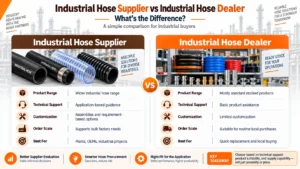
The terms supplier and dealer are often used interchangeably, but their capabilities can differ.
A dealer may primarily focus on selling available products, while a broader industrial hose supplier may also offer application guidance, hose assemblies, multiple hose categories, fittings, bulk supply, or technical support.
However, the business title itself does not prove capability.
Whether you are evaluating an industrial hose dealer Delhi or a supplier serving customers across India, check what the company can actually provide.
Useful questions include:
| Evaluation Factor | What the Buyer Should Check |
| Product Range | Are required hose categories available? |
| Technical Support | Can the supplier understand application conditions? |
| Pressure Options | Are appropriate pressure ratings available? |
| Fittings | Can compatible fittings or adapters be supplied? |
| Custom Requirements | Are required lengths or assemblies possible? |
| Quality Checks | How are hoses or assemblies inspected? |
| Availability | Are common sizes available when required? |
| Delivery | Can industrial order timelines be supported? |
The supplier’s actual capability matters more than the label used to describe the business.
Industrial Hose Suppliers Delhi: What Should Local Industrial Buyers Consider?
Delhi is an important commercial and industrial sourcing hub for engineering businesses, factories, contractors, maintenance teams, OEMs, and equipment operators.
Buyers comparing industrial hose suppliers Delhi may naturally value proximity because it can make communication, inspection, replacement purchases, and logistics more convenient.
However, location should not become the only selection criterion.
Check whether the supplier can provide the correct hose construction, pressure range, material compatibility, fittings, technical guidance, and quantity required for your operation.
Rubber Hose India LLP lists its registered and sales office at Ajmeri Gate, Delhi, and its works and corporate office in the Patparganj Industrial Area. Its website also lists industrial hoses, hydraulic hoses, PVC hoses, fittings, clamps, couplings, and related products within its range.
For industrial buyers in Delhi and NCR, access to multiple hose categories from one source can make procurement easier, particularly when a facility uses different hose types across different departments.
Still, every hose should be selected according to the actual application.
Searching for a “Hose Pipe Supplier Near Me”? Check These Factors First
Searching online for a hose pipe supplier near me is a practical way to find nearby vendors, especially when a replacement is required quickly.
But the closest supplier is not automatically the most suitable supplier.
Before placing an order, check:
- Does the supplier understand the application?
- Is the hose compatible with the media?
- Is the required working pressure supported?
- Is the temperature range suitable?
- Is the hose designed for suction if vacuum is involved?
- Is the correct size available?
- Are matching fittings available?
- Can the required quantity be supplied?
- What is the expected delivery time?
A nearby supplier offering the wrong hose can create more problems than a technically capable supplier located slightly farther away.
Use location to narrow your options, then use technical suitability to make the final decision.
Key Technical Information to Share With Your Hose Supplier
One of the easiest ways to improve hose selection is to provide complete application details from the beginning.
Instead of asking, “Do you have a 1-inch hose?”, provide information about what the hose will actually do.
1. Transferred Media
Tell the supplier exactly what will pass through the hose.
Examples include water, air, hydraulic oil, steam, fuel, slurry, or a specific chemical.
2. Working Pressure
Provide normal operating pressure and any known pressure surges.
Do not intentionally select a hose to operate close to or beyond its specified limitations.
3. Temperature
State both fluid temperature and surrounding environmental temperature where relevant.
4. Hose Size
Specify the required internal diameter and length.
If space is restricted, external diameter may also matter.
5. Suction or Delivery
Tell the supplier whether the hose will work under positive pressure, vacuum, or both.
This can significantly affect hose construction.
6. Bend and Movement
Explain whether the hose will remain stationary, flex repeatedly, move with machinery, or pass through a restricted routing area.
7. Abrasion Conditions
Mention if the hose will drag, rub, or contact rough surfaces.
8. Environmental Exposure
Outdoor hoses may encounter sunlight, weather, dust, moisture, oils, or temperature variations.
9. End Connections
Provide details about fittings, threads, flanges, couplings, or other connection points where applicable.
10. Required Quantity
Quantity matters for availability, production planning, packaging, and delivery.
Providing these details helps an industrial hose supplier in India recommend options based on actual operating conditions rather than assumptions.
A Simple Industrial Hose Selection Checklist
Before purchasing, ask the following:
| Parameter | Question to Confirm |
| Media | What will flow through the hose? |
| Pressure | What is the maximum working pressure? |
| Temperature | What are the fluid and ambient temperatures? |
| Size | What internal diameter and length are required? |
| Suction | Will the hose operate under vacuum? |
| Movement | Will it flex or remain stationary? |
| Bend | Is there enough space for proper routing? |
| Abrasion | Will the hose rub against equipment or surfaces? |
| Environment | Is there outdoor, oil, heat, or chemical exposure? |
| Connections | Which fittings or couplings are required? |
| Quantity | Is this a single replacement or bulk factory requirement? |
| Delivery | When does the hose need to reach the site? |
This information gives both buyer and supplier a much clearer starting point.
Common Mistakes Buyers Make When Purchasing Industrial Hoses
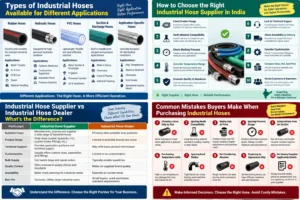
Many hose problems begin before the hose is installed.
Avoiding a few common procurement mistakes can significantly improve the chance of selecting the right product.
Choosing a Hose Only by Size
Two hoses with the same internal diameter can have completely different constructions and applications.
Size alone does not indicate pressure rating, material compatibility, reinforcement, temperature resistance, or suction capability.
Ignoring Media Compatibility
A mechanically strong hose can still fail if its inner tube is incompatible with the transferred material.
Always confirm media compatibility.
Buying Only on Price
A lower purchase price may look attractive, but premature replacement can make the overall cost much higher.
Consider service conditions and expected reliability as well as price.
Ignoring Pressure Surges
Systems do not always operate at perfectly stable pressure.
Where pressure spikes or pulsation occur, communicate those conditions to the supplier.
Using a Delivery Hose for Suction Without Verification
Vacuum can cause an unsuitable hose to flatten or collapse.
A hose used for suction should be specifically designed and rated for those conditions.
Ignoring Bend Radius
Forcing a hose into a tight bend can create kinks and additional structural stress.
Plan the routing before finalizing hose length and type.
Replacing a Hose Based Only on Appearance
Two hoses can look similar externally while having very different internal materials or reinforcement.
When replacing an existing hose, identify its specification and application rather than relying only on visual similarity.
What Makes a Reliable Hose Supplier for Factories?
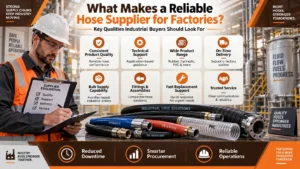
Factories usually need more than one successful delivery.
They need consistent supply that supports maintenance, production, planned shutdowns, emergency replacements, and repeat purchasing.
A reliable hose supplier for factories should therefore be evaluated on several factors.
Consistent Specifications
Repeat orders should continue to meet the required application parameters.
Multiple Hose Categories
Factories often use hydraulic, rubber, PVC, suction, discharge, air, and other hose types across different equipment.
Technical Understanding
The supplier should understand why media, pressure, temperature, reinforcement, and connections matter.
Replacement Availability
Critical equipment can remain idle if a suitable replacement hose cannot be sourced quickly.
Bulk Supply Capability
Procurement teams purchasing for multiple machines or departments may require larger quantities and scheduled supply.
Fittings and Accessories
Access to compatible fittings, adapters, clamps, or couplings can simplify procurement.
Communication
Accurate specifications and clear delivery commitments are especially important for industrial maintenance teams.
These factors can be more valuable over the long term than a small difference in purchase price.
Why Work With an Experienced Industrial Hose Supplier?
Industrial hose selection involves several variables that are easy to overlook.
An experienced supplier can help buyers narrow their options based on the real operating conditions instead of selecting products from size or appearance alone.
Benefits can include:
- Better application matching
- Easier identification of suitable hose construction
- Access to multiple hose types
- Better coordination of hoses and fittings
- Support for repeat industrial requirements
- Reduced risk of incorrect product selection
- More efficient procurement
The goal is not simply to find the best industrial hose supplier according to an online claim. The goal is to identify the supplier that best matches your technical requirements, quantities, service expectations, and delivery needs.
Industrial Hose Solutions from Rubber Hose India LLP
Rubber Hose India LLP states that its operations include sales and distribution of industrial hoses and allied products along with manufacturing and supply of hydraulic hose assemblies. Its listed range includes hydraulic hoses, PVC hoses, Teflon hoses, SS flexible hoses, hydraulic fittings, hose fittings, and related products.
Its current product catalogue also includes industrial rubber hose products such as water suction and discharge hoses, steam hoses and welding/gas-cutting hoses, along with hydraulic and PVC hose categories.
For buyers comparing a rubber hose supplier India, hydraulic hose supplier India, or PVC hose supplier India, having access to multiple hose categories can make sourcing more convenient.
The company also states that it manufactures low-, high-, and extremely high-pressure hydraulic hose assemblies and carries out hose assembly operations and quality checks at its Delhi facility.
As with any industrial hose purchase, the final product should be selected after confirming the application’s pressure, media, temperature, size, movement, suction, and connection requirements.
How Should You Compare a Rubber Hose Supplier in India?
When comparing suppliers, avoid evaluating rubber hoses as one broad category.
Ask what the specific hose is designed to transfer and what operating conditions it supports.
A useful supplier comparison should include:
- Hose application
- Tube material
- Reinforcement type
- Cover construction
- Working pressure
- Temperature range
- Available dimensions
- Required fittings
- Supply quantity
- Delivery requirement
Some search users may use phrases such as rubber hose India supplier when looking for manufacturers, dealers, or distributors. Regardless of the search wording, application suitability should remain the primary basis for supplier selection.
Questions to Ask Before Selecting an Industrial Hose Supplier
Before finalizing an order, procurement and maintenance teams can use the following questions.
Is this hose compatible with the material being transferred?
The supplier should know what media the hose will carry before confirming suitability.
Compatibility is especially important for oils, fuels, chemicals, steam, and other demanding media.
What working pressure can the hose handle?
Confirm the rated working pressure and compare it with actual system requirements.
Also communicate pressure surges or pulsating conditions where relevant.
What temperature range is suitable?
Ask about both fluid and environmental temperature limitations.
Temperature outside the recommended range can affect hose performance and service life.
Is the hose suitable for suction?
Do not assume every hose can withstand vacuum.
If the application involves suction, ask specifically about vacuum capability and reinforcement.
Which reinforcement does the hose use?
Depending on the hose category, reinforcement may contribute to pressure resistance, vacuum resistance, structural stability, or other performance characteristics.
The appropriate design depends on the application.
What hose size should be used?
Confirm internal diameter according to flow requirements and existing equipment connections.
Length and routing also need to be considered.
Are compatible fittings available?
The hose and fitting combination should match the intended system.
This is particularly important in hydraulic assemblies and higher-pressure applications.
Can the supplier support repeat or bulk industrial orders?
Factories should discuss recurring quantities, availability, lead times, and replacement requirements in advance.
What information does the supplier need before recommending a hose?
A technically focused supplier should normally want to understand the application.
If no questions are asked about media, pressure, temperature, size, or service conditions, buyers should confirm that the proposed hose is actually suitable.
Final Checklist for Choosing an Industrial Hose Supplier in India
Before approving a supplier, confirm the complete requirement rather than comparing quotations alone.
Your checklist should include:
- Correct hose category
- Correct media compatibility
- Suitable working pressure
- Appropriate temperature range
- Correct internal diameter
- Required hose length
- Suitable reinforcement
- Vacuum capability where required
- Acceptable bend characteristics
- Abrasion resistance where required
- Compatible fittings and connections
- Product availability
- Repeat supply capability
- Technical support
- Required quantity
- Delivery timeline
- Overall lifecycle value
The right industrial hose supplier in India should help you source a hose that fits the application, not simply sell whichever hose matches the requested diameter.
Conclusion: Choose the Hose by Application, Not Just by Price
Industrial hoses perform an important job between equipment, pumps, hydraulic components, tanks, machines, and processing systems. Selecting an unsuitable hose can lead to leakage, restricted flow, premature wear, unexpected replacement, and unnecessary downtime.
Start every purchase by defining the application.
Identify the transferred media, working pressure, temperature, hose size, suction requirements, movement, abrasion exposure, environmental conditions, fittings, and quantity.
Then compare suppliers based on their ability to meet those requirements.
Whether you are searching for an industrial hose supplier in India, industrial hose suppliers Delhi, an industrial hose dealer Delhi, a rubber hose supplier India, or a supplier for hydraulic and PVC requirements, technical suitability should always come before price alone.
For an industrial hose requirement, share your application, media, hose size, working pressure, temperature, required length, fittings, and quantity with Rubber Hose India LLP so the requirement can be evaluated against suitable hose options.
Frequently Asked Questions About Industrial Hose Suppliers
Which type of industrial hose is suitable for factory use?
There is no single hose type suitable for every factory application.
Factories may require hydraulic hoses, rubber water hoses, air hoses, PVC suction hoses, steam hoses, welding hoses, or other specialized products.
The correct hose depends on the transferred media, pressure, temperature, movement, environmental exposure, and installation conditions.
What information should I provide to a rubber hose supplier?
Provide the transferred media, working pressure, temperature, internal diameter, required length, movement conditions, suction requirement, abrasion exposure, fittings, quantity, and application details.
The more complete the information, the easier it is to narrow down a suitable hose.
How do I select a hydraulic hose supplier in India?
When evaluating a hydraulic hose supplier India, check whether the supplier can support the required pressure range, hose size, fluid compatibility, fittings, assembly requirements, and technical specifications.
For assembled hoses, also discuss length, fitting orientation, connection type, pressure conditions, and equipment application.
What should I check when choosing a PVC hose supplier?
When selecting a PVC hose supplier India, first determine whether you require suction, delivery, braided pressure hose, ducting, or another PVC construction.
Check pressure or vacuum capability, temperature, media compatibility, flexibility, reinforcement, size, and environmental conditions before ordering.
How can I find a reliable hose pipe supplier near me?
A “hose pipe supplier near me” search can help identify nearby businesses, but proximity should only be the first filter.
Compare potential suppliers based on hose specifications, application knowledge, product availability, fittings, quantity capability, and delivery reliability before making the final choice.
What is the difference between a hose supplier and a hose dealer?
There is no universal difference because companies may use both terms differently.
Some dealers primarily resell standard products, while suppliers may provide a broader range, application support, assemblies, fittings, or bulk supply. Always evaluate actual capabilities instead of relying on the business title.
How should I evaluate industrial hose suppliers Delhi?
When comparing industrial hose suppliers Delhi, consider technical knowledge, product range, stock availability, pressure options, fittings, bulk requirements, communication, and delivery capability.
Local access can be useful, but correct hose selection remains more important than supplier proximity.
What makes the best industrial hose supplier for a factory?
The best industrial hose supplier for a specific factory is the one that can consistently meet its technical, commercial, and logistical requirements.
Look for appropriate hose options, application guidance, compatible fittings, consistent supply, replacement availability, dependable communication, and suitable delivery timelines rather than relying only on price or marketing claims.