
UPVC full form is Unplasticized Polyvinyl Chloride. It is a rigid and durable plastic material widely used in plumbing, water supply, irrigation, and drainage systems.
UPVC pipes are popular because they are lightweight, corrosion-resistant, and easy to install. They are commonly used in residential, commercial, and agricultural projects.
But what makes UPVC different from regular PVC pipes? And where should you use UPVC instead of CPVC or flexible PVC hoses?
This guide explains the meaning, types, uses, advantages, and differences between these materials to help you choose the right piping solution.
What Is the Full Form of UPVC?

The full form of UPVC is Unplasticized Polyvinyl Chloride. It is a type of PVC manufactured without adding plasticizers to make the material flexible.
The word “unplasticized” means the material remains rigid rather than flexible. This makes UPVC suitable for applications where a strong and stable pipe structure is required.
UPVC is also written as uPVC or PVC-U in technical specifications.
UPVC Full Form and Meaning at a Glance
| Term | Meaning |
| UPVC Full Form | Unplasticized Polyvinyl Chloride |
| PVC Full Form | Polyvinyl Chloride |
| Material Type | Rigid thermoplastic |
| Flexibility | Rigid |
| Main Properties | Lightweight, corrosion-resistant, durable |
| Common Uses | Water supply, irrigation, drainage, plumbing |
| Hot Water Suitability | Not recommended for standard hot water lines |
UPVC is commonly used in piping systems because it provides a practical alternative to metal pipes in many applications.
However, the correct pipe type and pressure rating must be selected for safe performance.
What Is a UPVC Pipe?
A UPVC pipe is a rigid plastic pipe made from Unplasticized Polyvinyl Chloride. It is designed to transport water or support specific piping applications, depending on its construction and specifications.
Unlike flexible PVC hose pipes, UPVC pipes do not bend easily. They maintain their shape and are generally installed using suitable fittings and joints.
UPVC pipes are commonly used for cold water distribution, agricultural irrigation, and drainage systems.
They do not rust like iron pipes and are easier to handle due to their relatively low weight.
Key Properties of UPVC Pipes
- Corrosion Resistance: UPVC does not rust when exposed to water or moisture.
- Lightweight Construction: Easier to transport, handle, and install.
- Smooth Inner Surface: Helps maintain water flow and reduces friction.
- Rigid Structure: Suitable for fixed piping installations.
- Low Maintenance: Does not require regular painting or rust protection.
- Chemical Resistance: Resistant to many chemicals, depending on concentration and temperature.
These properties make UPVC a practical choice for several residential, agricultural, and commercial applications.
What Are the Different Types of UPVC Pipes?
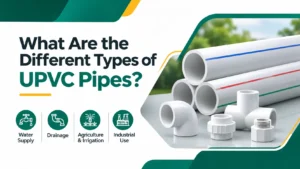
UPVC pipes are available in different designs based on their intended applications.
A pipe used for drinking water is not necessarily suitable for borewell casing or drainage. Each application requires the correct pipe specifications.
1. UPVC Pressure Pipes
UPVC pressure pipes are designed to carry water under a specified operating pressure.
They are commonly used in cold water distribution, agricultural irrigation, and other pressurized water systems.
Their pressure ratings vary according to pipe diameter, wall thickness, material specifications, and operating temperature.
2. UPVC Casing Pipes
UPVC casing pipes are used in borewells and tube wells to support the borehole structure.
They help protect the borehole and can prevent loose soil or surrounding material from entering the well.
Depending on the design, casing systems may include plain and screened sections.
3. UPVC Column Pipes
UPVC column pipes are designed for use with submersible pump systems.
They help carry water from underground pumps to the surface and are manufactured with connections suitable for the intended pumping conditions.
The correct column pipe must be selected based on pump depth, load, and operating requirements.
4. UPVC SWR Pipes
SWR stands for Soil, Waste, and Rainwater.
These pipes are used to carry wastewater and rainwater away from buildings through suitable drainage systems.
They are commonly installed in bathrooms, kitchens, rooftops, and building drainage networks.
Important: Standard SWR pipes are designed for drainage applications and should not be treated as pressure-water pipes.
What Are the Main Uses of UPVC Pipes?
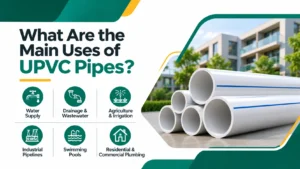
UPVC pipe uses include water supply, irrigation, plumbing, borewells, and drainage. The exact application depends on the type and rating of the pipe.
Here are some common applications.
1. Residential Water Supply
UPVC pipes are widely used for cold water supply in homes and residential buildings.
Their corrosion resistance and smooth inner surfaces make them useful for suitable water distribution systems.
For drinking water, buyers should select pipes specifically approved for potable water applications.
2. Agricultural Irrigation
Farmers use UPVC pipes to transport water from pumps, tanks, and other water sources to agricultural fields.
These pipes are suitable for many fixed irrigation networks where a rigid piping system is required.
The appropriate pressure class should be selected according to the irrigation system.
3. Plumbing Systems
UPVC pipes are used in cold water plumbing and certain building service applications.
Their low weight makes handling and installation easier compared with many traditional metal pipes.
However, UPVC pipes should not be used for hot water lines unless the specific product is rated for the required temperature.
4. Borewell Applications
Specially designed UPVC casing and column pipes are used in borewell installations.
Casing pipes support the borehole, while column pipes are used to carry pumped water upward.
Each type performs a different function and should be selected accordingly.
5. Drainage and Wastewater Systems
UPVC-based drainage pipes are commonly used to remove wastewater and rainwater from residential and commercial buildings.
Their smooth internal surfaces help wastewater flow through properly designed drainage systems.
For these applications, SWR pipes and compatible fittings are typically used.
What Are the Advantages of UPVC Pipes?
UPVC pipes offer several advantages when used in suitable conditions.
Their durability, low weight, and corrosion resistance make them a popular option for many piping projects.
1. Excellent Corrosion Resistance
UPVC pipes do not rust or corrode like conventional iron pipes.
This makes them useful in applications where pipes regularly come into contact with water and moisture.
2. Lightweight and Easy to Install
UPVC pipes are relatively light compared with metal pipes.
They are easier to transport, cut, handle, and install using appropriate tools and fittings.
This can reduce handling effort during installation.
3. Smooth Water Flow
The inner surface of a UPVC pipe is generally smooth.
This helps reduce friction losses and supports efficient water movement when the system is correctly designed.
4. Low Maintenance Requirements
UPVC pipes do not need regular painting or protection against rust.
Once installed correctly, they generally require limited routine maintenance.
However, joints, fittings, and operating conditions should still be checked when necessary.
5. Good Chemical Resistance
UPVC resists many commonly encountered chemicals.
This makes it suitable for selected industrial and water-handling applications.
Chemical compatibility should always be checked before using UPVC with concentrated chemicals or industrial fluids.
6. Long Service Life
UPVC pipes can provide many years of service when the correct product is selected and installed properly.
Their lifespan depends on water pressure, temperature, sunlight exposure, material quality, and installation conditions.
7. Cost-Effective Piping Solution
UPVC pipes are often an economical option for cold water supply and drainage applications.
Their relatively low weight, corrosion resistance, and maintenance needs can help reduce overall project costs.
Difference Between PVC and UPVC Pipes
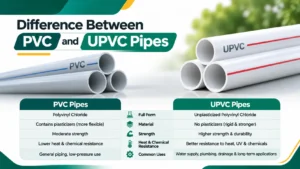
The main difference between PVC and UPVC is that UPVC is the rigid, unplasticized form of Polyvinyl Chloride.
PVC is a broad material family that includes both rigid and flexible formulations.
Flexible PVC products contain plasticizers that improve flexibility, while UPVC is manufactured without plasticizers added for that purpose.
PVC vs UPVC Comparison Table
| Feature | PVC | UPVC |
| Full Form | Polyvinyl Chloride | Unplasticized Polyvinyl Chloride |
| Material | Broad PVC family | Rigid PVC formulation |
| Flexibility | Can be rigid or flexible | Rigid |
| Plasticizers | May be added for flexibility | Not added to make it flexible |
| Common Applications | Pipes, hoses, cables, fittings | Water pipes, drainage, window frames |
| Corrosion Resistance | Generally good | Generally good |
| Installation | Depends on product type | Typically fixed piping |
Which Is Better: PVC or UPVC?
Neither material is better for every application.
UPVC is suitable for fixed piping systems where rigidity and corrosion resistance are important.
Flexible PVC hoses are more suitable when movement, bending, or frequent repositioning is required.
The best choice depends on the application rather than the material name alone.
UPVC vs CPVC Pipes: What Is the Difference?
UPVC and CPVC are both plastic piping materials, but they are designed for different operating conditions.
CPVC stands for Chlorinated Polyvinyl Chloride. Its chemical structure allows suitable CPVC pipe systems to withstand higher water temperatures than standard UPVC pipes.
This makes CPVC a common choice for hot and cold water plumbing.
UPVC vs CPVC Comparison Table
| Feature | UPVC | CPVC |
| Full Form | Unplasticized Polyvinyl Chloride | Chlorinated Polyvinyl Chloride |
| Structure | Rigid | Rigid |
| Cold Water | Suitable with correct rating | Suitable with correct rating |
| Hot Water | Generally not suitable | Suitable with correct rating |
| Common Uses | Irrigation, cold water, drainage | Hot and cold water plumbing |
| Cost | Often more economical | Usually more expensive |
| Temperature Resistance | Lower | Higher |
Which Is Better: UPVC or CPVC?
Choose UPVC for suitable cold water applications such as irrigation and fixed water distribution systems.
Choose CPVC when a plumbing system needs to handle hot water, provided the product meets the required temperature and pressure ratings.
For Indian installations, relevant BIS standards include IS 4985 for UPVC potable water pipes and IS 15778 for CPVC hot and cold water pipes.
How to Choose the Right UPVC Pipe
Choosing the right UPVC pipe involves more than checking its diameter.
Different piping systems require specific pressure ratings, wall thicknesses, jointing methods, and material specifications.
1. Identify the Application
First, determine whether the pipe will be used for water supply, irrigation, drainage, or borewell installation.
Each application may require a different UPVC pipe type.
2. Check the Pipe Size
Select the diameter according to the required water flow and system design.
A pipe that is too small can increase pressure losses, while an unnecessarily large pipe may increase installation costs.
3. Verify the Pressure Rating
Check the maximum operating pressure and choose a suitable pipe class.
Pressure ratings must account for operating temperature, potential pressure surges, and other system conditions.
4. Consider Water Temperature
Standard UPVC pipes are generally intended for cold water applications.
For hot water plumbing, consider a properly rated CPVC system instead.
5. Check Quality Standards
Look for the applicable Indian Standard, manufacturer information, pipe size, and pressure class.
For example, IS 4985:2021 covers UPVC pipes intended for potable water supplies.
Always verify that the pipe is suitable for its specific application.
6. Choose Compatible Fittings
Pipe joints are important for preventing leaks.
Use compatible fittings and the recommended joining method to maintain the reliability of the piping system.
UPVC Pipes vs Flexible PVC Hoses: Which Should You Choose?
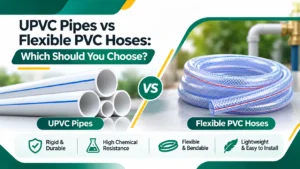
UPVC pipes and flexible PVC hoses are used for different purposes.
UPVC pipes are rigid and generally installed in fixed positions. Flexible PVC hoses can bend and are more suitable for applications that require movement.
UPVC Pipe vs PVC Hose Comparison
| Feature | UPVC Pipe | Flexible PVC Hose |
| Structure | Rigid | Flexible |
| Movement | Limited | Can bend and move |
| Installation | Fixed piping | Fixed or movable connections |
| Common Uses | Water supply, drainage, irrigation | Water transfer, suction, air handling |
| Connections | Pipe fittings and joints | Hose fittings, clamps, couplings |
| Selection Factors | Pressure class, size, temperature | Pressure, bend radius, fluid compatibility |
When Should You Use a UPVC Pipe?
Choose UPVC when you need a fixed piping system for suitable cold water, irrigation, or drainage applications.
It is useful where a rigid structure and stable pipe alignment are required.
When Should You Use a Flexible PVC Hose?
Choose a flexible PVC hose when your application requires bending, movement, or convenient connection to equipment.
These hoses are commonly used for water transfer, industrial operations, agricultural work, and suction or delivery systems.
For example, a factory may use rigid piping for a permanent water line and a flexible hose to connect that line to movable equipment.
At Rubber Hose India LLP, industrial buyers can explore flexible piping solutions, including PVC hoses, rubber hoses, and compatible accessories.
You can also read our guide on the types of PVC hose pipes to understand their uses and applications.
Common Mistakes to Avoid When Choosing UPVC Pipes
Selecting the wrong pipe can lead to leakage, poor performance, and expensive repairs.
Avoid these common mistakes when purchasing UPVC pipes.
- Ignoring Pressure Ratings: Not every UPVC pipe is designed for high-pressure water supply.
- Using UPVC for Hot Water: Standard UPVC pipes are not suitable for typical hot water plumbing.
- Choosing the Wrong Pipe Type: Drainage pipes and pressure pipes are designed for different purposes.
- Ignoring Pipe Markings: Always check specifications and applicable standards.
- Using Incompatible Fittings: Incorrect fittings can weaken joints and cause leaks.
- Selecting Pipes Only by Price: Consider material quality, application suitability, and long-term performance.
If you are comparing different manufacturers, read our guide to the top PVC pipe brands in India.
Conclusion
Understanding the UPVC full form, material properties, and applications can help you make better piping decisions.
UPVC pipes are a practical option for many cold water supply, irrigation, plumbing, and drainage systems. However, selecting the correct pipe type, size, and pressure rating is essential.
For applications that require movement or flexibility, PVC industrial hoses may be a more suitable alternative.
Looking for reliable industrial hose solutions?
Explore the range of PVC hoses, rubber hoses, fittings, and couplings available from Rubber Hose India LLP.
Contact the team to discuss your industrial hose requirements and find a solution suited to your application.
Frequently Asked Questions About UPVC Pipes
What is the difference between PVC and UPVC?
PVC is a broad plastic material family that can include rigid or flexible formulations. UPVC is the unplasticized, rigid form of PVC, commonly used for fixed piping systems.
Is UPVC pipe suitable for drinking water?
Yes, UPVC pipes can be used for drinking water when they are specifically manufactured and approved for potable water applications. In India, IS 4985:2021 is a relevant standard for UPVC potable water pipes.
Can UPVC pipes be used for hot water?
Standard UPVC pipes are generally not recommended for hot water plumbing. CPVC pipes are commonly preferred because suitable CPVC systems are designed for higher operating temperatures.
What are the main advantages of UPVC pipes?
The main advantages of UPVC pipes include corrosion resistance, lightweight construction, smooth water flow, low maintenance requirements, and durability when correctly installed.
Where are UPVC pipes commonly used?
UPVC pipes are commonly used in cold water distribution, irrigation systems, borewell applications, plumbing, and drainage. The correct pipe type must be selected for each application.
Which is better, UPVC or CPVC?
UPVC is generally suitable for cold water applications, while CPVC is commonly used for hot and cold water plumbing. The better choice depends on the required operating temperature, pressure, and application.