
Choosing between UPVC vs HDPE Pipe can be confusing, especially when both materials are widely used for water supply, irrigation, and underground piping systems.
UPVC pipes are rigid, lightweight, and commonly used for fixed water distribution. HDPE pipes are more flexible and suitable for underground pipelines, uneven ground, and applications requiring movement.
But which pipe is better for your project? The answer depends on pressure requirements, installation conditions, budget, and expected service life.
This guide explains the difference between UPVC and HDPE pipe, including strength, flexibility, price, lifespan, and applications, to help you make the right decision.
What Is a UPVC Pipe?
UPVC stands for Unplasticized Polyvinyl Chloride. It is a rigid plastic material commonly used in cold water supply, agricultural irrigation, plumbing, and other fixed piping systems.
Unlike flexible PVC hoses, UPVC pipes do not bend easily. Their rigid structure makes them suitable for straight pipelines and permanent installations.
UPVC pipes are lightweight, corrosion-resistant, and generally easy to install using compatible fittings and approved jointing methods.
Key Features of UPVC Pipes
- Rigid Structure: Suitable for fixed piping installations.
- Corrosion Resistance: Does not rust when exposed to water.
- Lightweight Material: Easy to transport and handle.
- Smooth Inner Surface: Helps reduce friction during water flow.
- Low Maintenance: Requires no regular rust protection.
- Cost-Effective: Often economical for conventional water distribution systems.
UPVC pipes are widely used in residential, commercial, and agricultural applications where flexible movement is not required.
Want to understand the material in detail? Read our guide on UPVC Full Form, Meaning, Uses and Advantages.
What Is an HDPE Pipe?
HDPE stands for High-Density Polyethylene. It is a strong, flexible thermoplastic material used in water supply, irrigation, industrial pipelines, and underground installations.
HDPE pipes can bend more easily than UPVC pipes, making them suitable for uneven ground and locations where some soil movement may occur.
They also offer excellent corrosion resistance and can be joined using heat-fusion methods, depending on the pipe system.
Key Features of HDPE Pipes
- High Flexibility: Can accommodate bends and gradual ground movement.
- Impact Resistance: Performs well under many demanding installation conditions.
- Corrosion Resistance: Does not rust or corrode like metal.
- Heat-Fusion Jointing: Creates strong, continuous pipe connections.
- Underground Suitability: Commonly used for buried water distribution.
- Chemical Resistance: Suitable for many fluids when compatibility is verified.
HDPE pipes are commonly selected for municipal water supply, agricultural pipelines, industrial water transfer, and underground distribution networks.
UPVC vs HDPE Pipe: Quick Comparison Table
The main difference between UPVC and HDPE pipes is their flexibility and installation requirements.
UPVC is rigid and suitable for fixed pipeline systems, while HDPE offers greater flexibility for underground and changing ground conditions.
| Features | UPVC Pipe | HDPE Pipe |
| Full Form | Unplasticized Polyvinyl Chloride | High-Density Polyethylene |
| Material Structure | Rigid | Flexible |
| Flexibility | Low | High |
| Impact Resistance | More sensitive to impact | Generally better impact resistance |
| Corrosion Resistance | Excellent | Excellent |
| Water Supply | Suitable | Suitable |
| Irrigation | Suitable | Suitable |
| Underground Installation | Suitable with proper design | Well suited to ground movement |
| Jointing Methods | Solvent cement or rubber-ring joints | Butt fusion, electrofusion, mechanical fittings |
| Temperature Suitability | Typically cold water | Typically cold water, subject to rating |
| Initial Cost | Often lower | May be higher |
| Lifespan | Can exceed 50 years | Can exceed 50 years |
| Maintenance | Low | Low |
| Best For | Fixed piping networks | Flexible and underground pipe networks |
Quick Answer: Choose UPVC for suitable fixed water distribution systems where rigid piping is practical. Choose HDPE when flexibility, long underground runs, or resistance to ground movement is important.
Neither material is automatically stronger or longer-lasting in every situation. Performance depends on the pipe grade, pressure rating, and installation quality.
Difference Between UPVC and HDPE Pipe: 7 Key Factors
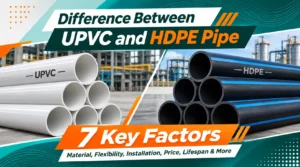
Understanding the difference between UPVC and HDPE pipe helps you choose the correct material for your project.
Although both are plastic pipes, their mechanical properties and installation methods are different.
1. Material Composition
UPVC pipes are made from rigid, unplasticized polyvinyl chloride.
HDPE pipes are manufactured from high-density polyethylene, which provides greater flexibility and toughness.
Both materials resist corrosion, but their responses to impact, bending, and temperature changes differ.
2. Strength and Durability
UPVC pipes offer good rigidity and dimensional stability, making them suitable for fixed water distribution networks.
HDPE pipes provide greater flexibility and impact resistance, which can be useful in challenging ground conditions.
However, pressure-handling capacity cannot be determined by material alone. It depends on the specific pipe design, wall thickness, and rating.
3. Flexibility
Flexibility is one of the biggest differences in an HDPE vs UPVC Pipe comparison.
UPVC pipes are rigid and generally require fittings to change direction.
HDPE pipes can accommodate gradual bends within the manufacturer’s minimum bend radius.
This makes HDPE useful for routes where a completely straight pipeline is difficult to install.
4. Installation Methods
UPVC pipes are commonly connected using solvent cement joints or elastomeric sealing-ring joints.
HDPE pipes may use butt fusion, electrofusion, or suitable mechanical connections.
Heat-fused HDPE joints can provide strong, continuous connections when properly installed.
However, fusion requires appropriate equipment, trained operators, and correct procedures.
5. Pressure Handling Capacity
Both UPVC and HDPE pipes are available in different pressure ratings.
UPVC pressure pipes are suitable for many cold water distribution systems, while HDPE pressure pipes are commonly used for underground and municipal water networks.
Neither material should be considered universally better for high pressure.
Always compare the actual pressure rating, operating temperature, pipe size, and expected pressure surges before selection.
6. Underground Performance
HDPE pipes are often preferred where soil movement, uneven terrain, or curved pipe routes are important considerations.
Their flexibility helps accommodate gradual changes in ground conditions.
UPVC pipes can also be installed underground successfully, provided bedding, jointing, backfilling, and installation requirements are followed.
7. Maintenance Requirements
Both materials resist rust and generally require less corrosion-related maintenance than many metal pipe systems.
UPVC pipelines require correctly installed joints and suitable protection against external loads.
HDPE systems also need proper installation, joint inspection, and pressure testing.
The overall maintenance requirement depends more on system design and installation quality than on the pipe material alone.
UPVC vs HDPE Pipe for Water Supply: Which Is Better?
When comparing UPVC vs HDPE Pipe for Water Supply, both materials can perform well in suitable conditions.
The right choice depends on whether the pipeline is installed in a residential building, agricultural field, underground network, or municipal water distribution system.
UPVC Pipes for Water Supply
UPVC pipes are commonly used for cold water distribution in residential and agricultural applications.
Their rigid structure and smooth internal surfaces support efficient water movement through fixed pipeline networks.
They are often preferred where installation conditions are straightforward and the system does not require significant flexibility.
HDPE Pipes for Water Supply
HDPE pipes are widely used for underground and long-distance water distribution networks.
Their flexibility makes them suitable for uneven routes and areas where minor ground movement may occur.
Heat-fused HDPE connections can also help reduce the number of mechanical joints in a pipeline.
Which Pipe Should You Choose for Water Supply?
UPVC is often a practical choice for conventional fixed cold water supply systems. HDPE is often preferred for underground networks requiring flexibility.
For drinking water applications, both materials must meet the relevant potable water requirements.
In India, IS 4985:2021 covers UPVC pipes for potable water supplies, while IS 4984:2016 covers polyethylene pipes for water supply.
UPVC vs HDPE Pipe for Irrigation: Which Is More Suitable?
Agricultural irrigation systems require pipes that can handle water pressure, outdoor conditions, and long-term operation.
Both UPVC and HDPE pipes are used in irrigation, but their suitability depends on the system layout and installation conditions.
Advantages of UPVC Pipes for Irrigation
UPVC pipes are commonly used for fixed agricultural water distribution systems.
Their rigid structure makes them useful for straight pipeline routes where pipes can be installed with suitable fittings.
They also offer corrosion resistance and can be economical for conventional irrigation networks.
Advantages of HDPE Pipes for Irrigation
HDPE pipes are useful for irrigation networks that require flexible pipe routing.
They can accommodate gradual bends and are suitable for buried distribution lines across uneven agricultural land.
HDPE is also commonly used for mainlines and submain lines in suitable drip and sprinkler irrigation systems.
UPVC vs HDPE Pipe for Irrigation: Comparison
| Irrigation Requirement | Suitable Choice |
| Straight, fixed pipelines | UPVC or HDPE |
| Uneven agricultural land | Often HDPE |
| Buried distribution lines | Both, depending on design |
| Flexible pipe routing | HDPE |
| Conventional fixed irrigation | Often UPVC |
| Long-distance water distribution | Both, depending on project needs |
Which is better for irrigation?
UPVC is often economical for fixed irrigation systems, while HDPE offers advantages where flexible routing and ground movement are important.
For pumps, portable equipment, and temporary water transfer, an appropriately rated flexible suction and delivery hose may be more convenient.
UPVC vs HDPE Pipe Price: Which Is More Affordable?
The UPVC vs HDPE Pipe Price comparison depends on pipe diameter, wall thickness, pressure rating, material grade, and manufacturer.
UPVC pipes often have a lower initial material cost in comparable conventional applications.
HDPE pipes may have a higher purchase price, and heat-fusion installation can require specialized equipment.
However, HDPE may offer installation advantages on projects with curved routes or long underground pipelines.
Factors Affecting UPVC and HDPE Pipe Prices
1. Pipe Diameter
Larger pipes generally require more material and have a higher purchase cost.
2. Pressure Rating
Higher-pressure pipe specifications may require increased wall thickness, influencing material usage and price.
3. Material Grade
HDPE grades such as PE80 and PE100 have different design characteristics. Actual cost depends on the product specification.
4. Installation Requirements
Trenching, fittings, jointing equipment, labour, and site conditions can significantly affect total expenses.
5. Transportation and Handling
Pipe length, weight, delivery location, and handling requirements also influence project costs.
Which Pipe Is More Cost-Effective?
UPVC may be more economical for simple, fixed water distribution systems.
HDPE may provide better overall value for projects where flexible routing or fusion-jointed pipeline construction reduces installation complexity.
Instead of comparing only the purchase price, consider the total installed cost, including fittings, labour, equipment, maintenance, and expected service life.
UPVC vs HDPE Pipe Lifespan: Which Lasts Longer?
The UPVC vs HDPE Pipe Lifespan comparison is important for homeowners, contractors, farmers, and infrastructure planners.
Both UPVC and HDPE piping systems can provide service lives of 50 years or more when properly designed, installed, and operated.
However, this is not a guaranteed lifespan for every product or installation.
UPVC Pipe Lifespan
UPVC pipes can provide decades of reliable service in suitable cold water applications.
Their durability depends on operating pressure, temperature, installation conditions, and material quality.
Excessive impact, incorrect installation, or unsuitable operating temperatures can reduce performance.
HDPE Pipe Lifespan
HDPE pipes are also designed for long-term service in appropriate water distribution systems.
Their flexibility and resistance to many forms of impact damage can benefit underground installations.
However, improper fusion, excessive pressure, high temperatures, or environmental stress can reduce service life.
Which Has a Longer Lifespan?
Neither UPVC nor HDPE has a universally longer lifespan.
Both materials can perform for decades when used within their specified limits.
The correct pipe selection, pressure rating, installation method, and maintenance practices are more important than choosing a material based only on an estimated lifespan.
UPVC vs HDPE Pipe for Underground Installation
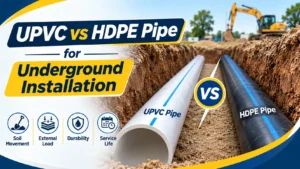
Underground pipelines face challenges such as soil pressure, ground movement, traffic loading, and changing installation conditions.
Both materials can be installed underground, but their mechanical properties influence the design.
When Is UPVC Suitable Underground?
UPVC is suitable for properly designed buried water distribution systems.
It generally requires appropriate trench preparation, bedding, backfilling, and jointing to manage external loads.
Rigid piping performs well when the installation supports the pipe and limits excessive movement.
When Is HDPE Suitable Underground?
HDPE is often advantageous for long underground pipelines and installations involving gradual bends.
Its flexibility can help accommodate certain ground movements and irregular routes.
However, suitable backfill, load calculations, joint quality, and installation methods remain essential.
Best Choice: HDPE is often preferred where flexibility is a major requirement. UPVC remains a practical option for conventional buried networks with suitable ground conditions.
UPVC vs HDPE vs Flexible PVC Hoses: What Is the Difference?
UPVC and HDPE pipes are commonly used in permanent water distribution systems.
Flexible PVC hoses serve a different purpose. They are useful when water or other suitable fluids must be transferred through movable or frequently repositioned connections.
At Rubber Hose India LLP, flexible industrial hose solutions are available for applications such as water transfer, suction, delivery, and industrial fluid handling.
UPVC vs HDPE vs PVC Hose Comparison
| Features | UPVC Pipe | HDPE Pipe | Flexible PVC Hose |
| Structure | Rigid | Flexible relative to UPVC | Highly flexible |
| Main Application | Fixed pipelines | Buried and distribution pipelines | Movable fluid transfer |
| Portability | Low | Depends on size | High |
| Jointing | Pipe joints | Fusion or mechanical joints | Hose fittings and couplings |
| Common Uses | Plumbing, irrigation | Water mains, irrigation | Water suction, delivery, industrial transfer |
| Installation | Mostly permanent | Mostly permanent | Permanent or temporary |
When Should You Use Flexible PVC Hoses?
Flexible PVC hoses are suitable when applications require movement, bending, or connections to portable equipment.
Examples include agricultural pumps, construction dewatering, industrial water transfer, and selected suction applications.
Unlike rigid pipes, flexible hoses can connect equipment without requiring an entirely fixed piping route.
For more information, explore our guide on the types of PVC hose pipes and their industrial applications.
How to Choose Between UPVC and HDPE Pipes
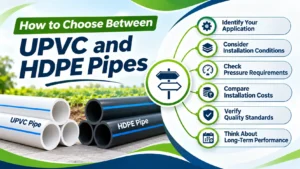
Choosing the right pipe requires evaluating the complete piping system rather than comparing only material names.
Follow these practical steps before purchasing.
1. Identify Your Application
Determine whether the pipe will be used for residential water supply, agricultural irrigation, underground distribution, or industrial water handling.
Different applications require different pipe specifications.
2. Consider Installation Conditions
Check whether the pipeline will be installed above ground, underground, or across uneven terrain.
UPVC is suitable for many fixed systems, while HDPE provides additional routing flexibility.
3. Check Pressure Requirements
Choose a pressure rating suitable for normal operating pressure, possible pressure surges, and temperature conditions.
Do not assume that all UPVC or HDPE pipes have the same pressure-handling capacity.
4. Compare Installation Costs
Include the cost of pipes, fittings, labour, machinery, and jointing equipment.
A lower purchase price does not always mean a lower overall project cost.
5. Verify Quality Standards
For water supply applications in India, check relevant BIS standards and manufacturer specifications.
Important standards include:
- IS 4985:2021: Unplasticized PVC pipes for potable water supplies.
- IS 4984:2016: Polyethylene pipes for water supply.
Also check pipe markings, dimensions, pressure class, and the suitability of fittings.
6. Think About Long-Term Performance
Consider expected service life, maintenance, exposure conditions, and the possibility of future repairs.
A well-designed system using correctly rated pipes will generally provide better results than choosing pipes based only on price.
Common Mistakes to Avoid When Buying UPVC or HDPE Pipes
Even a high-quality pipe can fail when selected or installed incorrectly.
Avoid these common purchasing and installation mistakes.
- Ignoring Pressure Ratings: Always select a pipe that can handle the required operating conditions.
- Choosing Only by Price: Compare overall installation cost and long-term performance.
- Using Incorrect Fittings: Compatible joints are essential for reliable connections.
- Ignoring Ground Conditions: Soil movement and external loads can affect buried pipelines.
- Overlooking Temperature Limits: Check the manufacturer’s operating temperature specifications.
- Skipping Quality Verification: Review relevant standards, markings, and technical documentation.
You can also explore our guide to the top PVC pipe brands in India to understand important factors when evaluating piping products.
Conclusion
Understanding the UPVC vs HDPE Pipe comparison helps you choose the right material for water supply, irrigation, and underground installations.
UPVC pipes are rigid, corrosion-resistant, and often economical for fixed piping systems. HDPE pipes provide greater flexibility and are commonly preferred for challenging underground routes.
Both materials can offer long service life when properly selected and installed.
For applications requiring flexible connections, suction, or portable water transfer, industrial PVC hoses may be a more suitable solution.
Looking for reliable industrial hose solutions in India?
Rubber Hose India LLP offers PVC hoses, rubber hoses, industrial hose assemblies, and related fittings for various industrial and agricultural requirements.
Explore our products or contact our team to find a suitable hose solution for your application.
Frequently Asked Questions About UPVC vs HDPE Pipes
Which is better, UPVC or HDPE pipe?
UPVC is often economical for fixed cold water systems. HDPE is often preferred where flexibility, gradual bends, or ground movement are important. The better option depends on the application.
Is HDPE stronger than UPVC?
HDPE generally offers greater flexibility and impact resistance. However, pressure strength depends on pipe grade, diameter, wall thickness, temperature, and pressure rating. Neither material is automatically stronger in every application.
Which pipe is better for water supply, UPVC or HDPE?
Both can be used for water supply when correctly rated. UPVC is commonly used in fixed distribution systems, while HDPE is widely used in underground and municipal water networks.
Which pipe is better for agricultural irrigation?
UPVC is often suitable for straight, fixed irrigation pipelines. HDPE is useful for uneven land, flexible routing, and underground irrigation networks. Both require appropriate pressure ratings.
Is UPVC cheaper than HDPE pipe?
UPVC often has a lower initial material cost in comparable conventional applications. However, final pricing depends on dimensions, pressure rating, material grade, fittings, installation method, and supplier.
What is the lifespan of UPVC and HDPE pipes?
Both UPVC and HDPE pipes can last 50 years or more under suitable conditions. Actual lifespan depends on installation quality, pressure, temperature, material specifications, and environmental exposure.
Can HDPE pipes be used underground?
Yes. HDPE pipes are widely used in underground water distribution systems. Their flexibility makes them useful in certain locations with uneven terrain or ground movement, provided the pipeline is correctly designed.
Can UPVC and HDPE pipes be joined together?
Yes, they can be connected using specifically designed transition fittings or compatible mechanical connections. Solvent cement intended for UPVC should not be used to join HDPE directly.
What is the difference between HDPE pipe and flexible PVC hose?
HDPE pipes are generally used in permanent distribution systems, while flexible PVC hoses are designed for applications requiring easy bending, movement, or portable connections.