
An industrial hose is not a generic commodity. It is an application-critical component that carries pressurized fluids, abrasive slurries, hot media or hazardous chemicals through a plant, project site or process line, and choosing the wrong industrial hose supplier can mean receiving a hose that looks correct on paper but does not actually match the job it needs to do.
A hose that appears suitable may still fail if it is not rated for the actual working pressure, pressure surges, transferred media, operating temperature, required flexibility, abrasion exposure, fitting compatibility or installation environment. These mismatches rarely show up during a quick visual check. They surface later, as leaks, cracks or sudden failures under load.
For procurement teams, plant maintenance managers, industrial engineers and project contractors, hose supplier selection is not only a purchasing decision. It is a technical decision with direct consequences for safety, uptime and cost. A dependable industrial hose supplier can help reduce failures, procurement delays, maintenance costs and unplanned production downtime.
This guide explains how buyers should evaluate quality, technical capability, documentation, customization and delivery reliability together, rather than looking at any single factor in isolation, before finalizing a supplier.
Why Industrial Hose Supplier Selection Matters
The supplier a buyer chooses has a direct effect on how a hose performs once it is installed. Two hoses can look identical in a catalogue photo and still behave very differently in service, because construction, compound quality and application fit determine actual performance.
Careful hose supplier selection influences several outcomes at once:
- Product suitability for the actual pressure, media and temperature involved
- Hose service life under real operating conditions
- Operational reliability of the line or machine the hose is fitted to
- Workplace safety, since hose failure under pressure can be hazardous
- Production continuity, because an unplanned hose failure stops a line
- Maintenance frequency and the labour hours spent on repeat replacements
- Replacement cost across the life of the equipment
- Inventory planning for spares and standard sizes
- Project delivery timelines for new installations
- Availability of technical support when something goes wrong
There is a meaningful difference between purchasing a hose and purchasing a correctly engineered hose solution. A hose is a physical product. A hose solution includes the right construction, the right fittings, the right documentation and the technical input needed to make sure the assembly matches the application. Buyers who evaluate an industrial hose supplier on this broader basis tend to avoid repeat failures.
Understand Your Application Before Contacting a Supplier
Before requesting a quotation, procurement teams should define the application clearly. A supplier can only recommend the correct hose when the buyer’s requirements are complete and accurate. Vague or incomplete information is one of the most common causes of incorrect hose selection.
The following framework covers the information an industrial hose supplier typically needs.
Size
- Internal diameter and outside diameter
- Required hose length
- Flow requirement for the application
Temperature
- Fluid temperature during normal operation
- Ambient temperature around the installation
- Nearby heat sources that could affect the hose
- Any temporary temperature peaks during start-up or cleaning
Application Type
- Suction or delivery service
- Pressure transfer
- Material handling
- Hydraulic use
- Chemical transfer
- Air, water, oil or slurry transfer
Media
- Chemical composition of the transferred fluid
- Oil type or water quality
- Presence of abrasive solids
- Food or pharmaceutical media requiring specific compatibility
Pressure
- Normal working pressure
- Maximum expected pressure
- Pressure spikes or surges
- Any vacuum requirement
Ends and Fittings
- Fitting type and thread type
- Coupling material
- Flange specification, if applicable
- Clamping or crimping requirement
Delivery
- Quantity required
- Project schedule
- Delivery location
- Whether the requirement is a planned order or an urgent replacement
Application Information Checklist: internal diameter, outside diameter, length, fluid temperature, ambient temperature, application type, transferred media, working pressure, surge pressure, fitting type, thread type, delivery timeline and quantity. Sharing this information upfront allows a reliable rubber hose supplier to recommend the correct construction on the first attempt.
This groundwork also makes it easier to compare industrial hose suppliers India buyers can approach for a given project, since every supplier is responding to the same requirements rather than a vague description.
Evaluate the Supplier’s Product Range
A capable industrial hose supplier should be able to manufacture or supply hoses across multiple categories, because plants rarely use only one type of hose. Typical categories include:
- Air and water hoses
- Oil and fuel hoses
- Chemical hoses
- Steam hoses
- Hydraulic hoses
- Material handling hoses
- Abrasion-resistant hoses
- Slurry hoses
- Cement and fly ash hoses
- Suction and discharge hoses
- Food-grade hoses
- Custom rubber hose assemblies
A wide catalogue is useful, but range alone does not make a supplier dependable. What matters more is whether the supplier can recommend the correct hose construction for a specific application rather than pointing buyers toward whatever is already in stock. Buyers comparing rubber hose manufacturers India should pay closer attention to this technical fit than to the size of the printed catalogue.
Check Application and Technical Knowledge
Technical consultation is one of the clearest signs of a trusted hose supplier. A supplier who understands hose application engineering will ask questions before recommending a product, not after.
A reliable supplier should ask about:
- Transferred media and its chemical properties
- Working pressure and surge pressure
- Operating temperature range
- Installation routing and available space
- Minimum bend radius needed for the layout
- Exposure to abrasion
- Static electricity build-up risk
- Vacuum conditions, if applicable
- Fitting compatibility with existing equipment
- Expected service conditions over the hose’s working life
Price-Only Supplier vs. Application-Focused Supplier
| Factor | Price-Only Supplier | Application-Focused Supplier |
|---|---|---|
| Questions asked | Few or none about the application | Detailed questions on pressure, media and temperature |
| Product recommendation | Based on lowest quote | Based on technical fit for the application |
| Documentation | Minimal or unavailable | Data sheets and relevant test information provided |
| Customization | Rarely offered | Available when the application requires it |
| Failure analysis | Not discussed | Willing to review cause of failure |
| After-sales assistance | Limited | Ongoing technical support |
| Long-term cost impact | Often higher due to repeat failures | Lower lifecycle cost through correct selection |
Verify Industrial Hose Quality Assurance
Industrial hose quality assurance is not a single step. It is a sequence of checks that should run from raw material to final packaging. Testing requirements vary depending on the hose type and the application it is built for, so buyers should not expect an identical checklist across every product.
Typical elements of industrial hose quality assurance include:
- Incoming raw material checks
- Rubber compound control
- Reinforcement consistency during construction
- Dimensional inspection of the finished hose
- Hose construction verification
- Pressure testing
- Leakage testing
- Visual inspection for surface defects
- Fitting inspection where assemblies are supplied
- Batch identification
- Final quality checks before dispatch
- Packaging inspection
Rather than assuming a hose has been tested, buyers should request the applicable test information and quality documents for the specific product being ordered. This is a reasonable request, and a supplier’s willingness to share this information is itself a useful indicator of reliability. A reliable rubber hose supplier documents these checks consistently, not only when a buyer specifically asks.
Ask for Technical Documentation
Proper documentation supports both industrial hose procurement and later maintenance work. Without it, plant teams often end up guessing at pressure ratings or ordering the wrong replacement when a hose eventually needs to be changed.
Documents to Request from a Supplier
| Document | Information Provided | Why Buyers Need It |
|---|---|---|
| Technical data sheet | Hose construction, dimensions, working pressure rating | Confirms the hose matches application requirements |
| Temperature and media guidance | Suitable temperature range and media compatibility | Prevents selection of an incompatible hose |
| Burst pressure information (where applicable) | Maximum pressure the hose can withstand before failure | Supports safety margin calculations |
| Minimum bend radius data | Tightest bend the hose can handle without damage | Avoids kinking and premature wear during installation |
| Fitting specification | Coupling type, thread and material details | Ensures fitting and hose form one compatible assembly |
| Inspection report / test certificate (where applicable) | Record of checks performed on the batch | Provides evidence supporting quality claims |
| Batch or product identification | Traceable batch or lot number | Enables reordering and failure investigation |
| Installation and storage guidance | Recommended handling, routing and storage conditions | Extends service life and prevents handling damage |
Check Manufacturing and Customization Capability
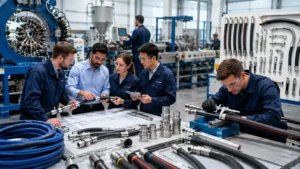
Standard hoses cover a large share of industrial requirements, but not all of them. Buyers may need a custom rubber hose manufacturer when the application falls outside standard sizes or standard construction.
Common reasons to consider a custom rubber hose manufacturer include:
- Non-standard hose size
- A special rubber compound for unusual chemical exposure
- A unique reinforcement construction for higher pressure or flexing
- Higher abrasion resistance for material handling duty
- Specific temperature resistance outside standard ranges
- Special vacuum requirements
- Custom hose length for a particular layout
- Flanged hose assemblies
- Special fittings not covered by standard catalogues
- Colour coding for identification across multiple lines
- Branding or identification markings
- Application-specific end connections
Customization should always be based on technical requirements, not appearance. A custom hose that looks different from a standard one is not automatically better suited to the job. Buyers should also expect that custom development may involve additional lead time, a minimum order quantity and a round of technical approval before production begins.
Evaluate Fittings and Hose Assembly Capability
A hose does not operate on its own. The hose, the fitting and the coupling function as one assembly, and a mismatch anywhere in that assembly can cause the whole unit to fail even if the hose itself is correctly rated.
Buyers should review a supplier’s fitting and assembly capability across:
- Fitting material and its compatibility with the transferred media
- End connection type and thread compatibility
- Flange dimensions
- Crimping or clamping method used to secure the fitting
- Overall assembly length and fitting alignment
- Leakage prevention at the coupling point
- Pressure suitability of the fitting itself
- Corrosion resistance of the fitting material
Mismatched fittings are a common and preventable cause of failure. A fitting that does not suit the hose construction or the operating pressure can lead to leakage, fitting pull-off, or premature failure of an otherwise adequate hose.
Compare Supplier Experience Across Industries
Experience in relevant application areas helps a supplier understand the operating challenges a buyer’s plant actually faces. Industries commonly served by industrial hose suppliers in India include steel plants, cement plants, mining, construction, chemical processing, oil and gas, engineering, power plants, material handling, agriculture, food processing and general manufacturing units.
Buyers should be cautious of suppliers claiming experience in a specific industry without being able to describe it in practical terms. Instead of asking for confidential customer names, buyers can ask general application questions, such as which hose constructions are typically used for a particular duty or what abrasion or temperature challenges are common in that industry. A supplier’s answers usually reveal genuine experience quickly.
Buyers searching for the best hose company in India should evaluate suppliers against their own application requirements rather than relying on general claims of scale or experience. The best supplier for a chemical transfer line is not necessarily the best supplier for an abrasive slurry line, since the technical demands are different. Among the industrial hose suppliers India lists across trade directories, the ones worth shortlisting are the ones willing to discuss these differences openly.
Review Production Capacity and Delivery Reliability
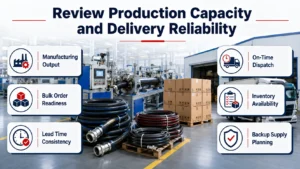
Delivery performance matters as much as product quality, because planned maintenance schedules and project timelines depend on hoses arriving when they are needed. A technically excellent hose that arrives late can still cause the downtime it was meant to prevent.
There are many rubber hose manufacturers India has to offer, but production capacity and lead times vary widely between them and should be verified directly.
Buyers should review a supplier’s:
- Standard product availability
- Production capacity for both standard and custom orders
- Raw material availability and supply consistency
- Typical lead time for different hose categories
- Minimum order quantity, particularly for custom products
- Ability to support urgent replacement needs
- Custom hose manufacturing timeline
- Packaging and transport protection
- Dispatch communication and order tracking
- Capability to supply multiple plant locations
Delayed hose delivery has a direct cost. It can extend machine downtime, force emergency procurement at short notice, and disrupt project schedules that were built around an assumed delivery date.
Compare Total Cost, Not Only Purchase Price
The lowest quotation is not always the lowest industrial hose lifecycle cost. A full cost comparison should include the hose purchase price, fitting cost, installation labour, inspection cost, replacement frequency, downtime, fluid loss, equipment damage, emergency transport and production delay.
The illustrative example below compares two hypothetical scenarios over the same operating period. The figures are examples only and are not based on any actual product or customer.
Illustrative Lifecycle Cost Comparison (Example Only)
| Cost Factor | Low-Price Hose (Frequent Replacement) | Correctly Selected Hose (Longer Interval) |
|---|---|---|
| Initial purchase price | Lower | Slightly higher |
| Replacement frequency | Higher | Lower |
| Installation labour over time | Repeated | Reduced |
| Downtime incidents | More frequent | Less frequent |
| Emergency procurement need | Higher likelihood | Lower likelihood |
| Overall lifecycle cost | Can be higher despite lower price | Often lower over the full service period |
All figures above are illustrative examples only and are not based on any actual product, project or customer data. Actual costs depend on the specific application and operating conditions.
Assess After-Sales and Technical Support
A reliable rubber hose supplier does not disappear after the invoice is settled. Ongoing support is part of what separates a transactional vendor from a long-term technical partner.
Useful after-sales support can include:
- Assistance with product selection for new applications
- Installation guidance
- Documentation support when records need to be updated
- Hose failure analysis to identify the root cause
- Help identifying the correct replacement part
- Maintenance recommendations
- Storage guidance for spares
- Support for custom assemblies
- Input on procurement planning for recurring needs
After-sales support does not mean a guarantee that a hose will never fail. No supplier can promise that, since actual service life depends on operating conditions, installation quality and maintenance practices. What a good support structure does provide is a faster, more informed response when something does go wrong.
Look for Traceability and Identification
Clear hose identification makes maintenance and procurement work considerably easier. When a hose carries visible details on hose type, size, pressure rating, product code and manufacturing batch, plant teams can reorder the exact product without guesswork.
Useful traceability information includes:
- Hose type and size
- Pressure rating
- Product code
- Manufacturing batch
- Assembly date, where applicable
- Fitting details
- Installation location within the plant
- Inspection history
- Replacement history
This kind of batch traceability is particularly useful when investigating a failure, since it allows a maintenance team to check whether other hoses from the same batch are installed elsewhere and may need inspection.
Industrial Hose Supplier Evaluation Checklist
The checklist below consolidates the evaluation factors covered in this guide into a single reference for supplier evaluation during industrial hose procurement.
Product Capability
☐ Suitable product range for the required applications
☐ Application-specific hose selection, not a one-size-fits-all recommendation
☐ Fitting compatibility with existing equipment
☐ Custom hose capability where standard products do not fit
Quality
☐ Defined quality checks at each production stage
☐ Product inspection before dispatch
☐ Testing capability appropriate to the hose type
☐ Batch identification for traceability
☐ Availability of technical documentation
Commercial Capability
☐ Transparent quotation with itemized details
☐ Clear lead time for standard and custom orders
☐ Reasonable minimum order quantity
☐ Adequate packaging for transport protection
☐ Defined delivery terms
Technical Support
☐ Application consultation before order confirmation
☐ Installation guidance
☐ Willingness to conduct failure analysis
☐ Ongoing maintenance support
Reliability
☐ Prompt response time to queries
☐ Clear and consistent communication
☐ Consistent supply across repeat orders
☐ Dependable delivery commitment
☐ Capacity for long-term support
Supplier Comparison Scorecard
The scorecard below can be used internally by procurement teams to compare shortlisted industrial hose suppliers India on a consistent, weighted basis. Assign a weight to each factor based on what matters most for the specific project, then score each supplier accordingly. There is no single best hose company in India for every requirement; the right choice depends on how a buyer weighs product suitability, documentation, customization and delivery reliability against each other.
Supplier Comparison Scorecard
| Evaluation Factor | Weight | Supplier A | Supplier B | Supplier C |
|---|---|---|---|---|
| Product suitability | ||||
| Technical knowledge | ||||
| Quality assurance | ||||
| Documentation | ||||
| Customization capability | ||||
| Fitting capability | ||||
| Delivery timeline | ||||
| Commercial terms | ||||
| After-sales support | ||||
| Communication | ||||
| Total lifecycle value |
Questions to Ask an Industrial Hose Supplier
The following questions help procurement teams and plant engineers evaluate a supplier’s technical depth before placing an order.
- Which hose construction is suitable for our transferred media?
- What is the recommended working pressure for this application?
- Can the hose handle expected pressure surges?
- What temperature range is this hose suitable for?
- What is the minimum bend radius for this hose?
- Is the hose suitable for suction or vacuum service?
- Which fittings are compatible with this hose construction?
- What abrasion protection is recommended for our environment?
- Is customization available if our requirement is non-standard?
- What quality inspections are performed before dispatch?
- Can relevant technical documentation be provided for this product?
- What is the expected delivery timeline for this order?
- Is batch identification available on this hose?
- What storage conditions are recommended for spares?
- What information will you need if we ever have to investigate a hose failure?
Warning Signs of an Unreliable Hose Supplier
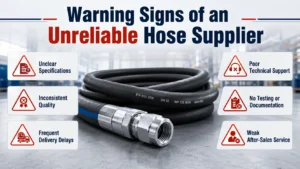
Certain patterns in how a supplier communicates can indicate a higher risk of receiving an incorrectly selected or poorly documented hose.
- Recommending a hose without asking any application questions
- Focusing the conversation only on price
- Unclear or missing pressure and temperature information
- Missing technical data sheets
- Offering fittings without checking compatibility
- No product identification on the hose
- Vague delivery commitments with no firm date
- Poor or slow communication
- Unsupported performance claims
- Suggesting one hose type for every industrial application
- Refusing to discuss the cause of a previous failure
- No clear quality inspection process to describe
One warning sign on its own may not prove that a supplier is unreliable. Multiple warning signs appearing together, however, are a reasonable basis for closer evaluation before placing an order. A willingness to discuss these points openly, rather than becoming defensive, is often what separates a trusted hose supplier from one simply trying to close a sale.
Benefits of a Long-Term Industrial Hose Partnership
Working with one dependable supplier over time, rather than switching between vendors for every order, tends to produce measurable operational benefits.
A long-term industrial hose partnership can support:
- Standardized hose selection across similar applications
- Faster repeat orders, since specifications are already on file
- Better inventory planning for spares
- Consistent fittings across the plant
- Improved maintenance records over time
- Reduced procurement time for recurring needs
- Easier identification of failure patterns
- Custom product development for evolving requirements
- Planned hose replacement instead of reactive emergency buying
- Lower lifecycle cost through consistent, correct selection
An industrial hose partnership should not replace ongoing scrutiny. Even with a trusted, long-standing supplier, periodic performance evaluation helps confirm that quality and service levels are being maintained. Procurement teams that keep an updated shortlist of industrial hose suppliers India can call on for repeat orders typically spend far less time on emergency sourcing when an unplanned need arises.
Common Industrial Hose Procurement Mistakes
Several recurring mistakes in industrial hose procurement lead to avoidable failures and cost. Buyers can use this list as a quick self-check before finalizing an order.
- Buying solely on price without checking technical fit
- Sending incomplete application details to the supplier
- Ignoring pressure surges when specifying working pressure
- Ignoring ambient temperature around the installation
- Selecting the wrong internal diameter for the required flow
- Using incompatible fittings with the hose construction
- Failing to verify minimum bend radius before installation
- Ordering without confirming a firm delivery time
- Skipping technical documentation to save time
- Reordering a failed hose without investigating why it failed
- Using one hose type across multiple incompatible applications
- Treating emergency purchases as a permanent procurement strategy
Also Read:
- How to Store Industrial Rubber Hoses Correctly
- How to Identify a Low-Quality Rubber Hose
- How to Reduce Hose Replacement Cost and Extend Rubber Hose Life
- A Buyer’s Guide to Buying Industrial Rubber Hose
Conclusion
Selecting the right industrial hose supplier is not a single-factor decision. It depends on how well a supplier combines application knowledge, product suitability, quality assurance, technical documentation, customization capability, fitting compatibility, delivery reliability and after-sales support.
Buyers who evaluate suppliers only on quoted price risk incorrect hose selection, premature failure, fluid leakage, safety concerns and repeated production downtime. A more complete evaluation, using the checklists and questions covered in this guide, helps procurement teams and plant engineers build a dependable, long-term industrial hose partnership rather than a series of one-time purchases.
Final hose suitability always depends on actual operating conditions at the installation site, so specifications should be verified before ordering and before installation. The best hose company in India for a given project is, ultimately, the one whose product range, quality assurance and support genuinely match that project’s technical requirements, not simply the one with the lowest quotation.
For application-based technical assistance, custom hose requirements or help selecting the right industrial rubber hose for your plant or project, contact Rubber Hose India LLP.
Frequently Asked Questions
What makes a trusted hose supplier?
A trusted hose supplier asks detailed application questions before recommending a product, provides technical documentation on request, maintains a defined quality inspection process, offers customization when needed, and supports buyers after the sale rather than only at the point of purchase.
How can I compare industrial hose suppliers in India?
Use a structured scorecard covering product suitability, technical knowledge, quality assurance, documentation, customization, fitting capability, delivery timeline, commercial terms and after-sales support. Weighting each factor by project priority makes comparisons across industrial hose suppliers in India more objective.
What documents should a rubber hose manufacturer provide?
Ask for a technical data sheet, working pressure and temperature range, media compatibility guidance, minimum bend radius, fitting specification, applicable inspection or test information, batch identification, and installation and storage guidance for the specific hose being ordered.
Why is media compatibility important in hose selection?
The transferred media determines which rubber compound and reinforcement construction can be used safely. An incompatible media can degrade the hose material, causing swelling, cracking or premature failure, even if the hose is otherwise correctly rated for the required pressure.
When is a custom rubber hose required?
A custom rubber hose manufacturer is typically needed for non-standard sizes, unusual chemical exposure, higher abrasion or temperature resistance, special vacuum requirements, non-standard lengths, or unique fittings and end connections that standard catalogue products do not cover.
How can buyers verify industrial hose quality?
Request the applicable test information and inspection documentation for the specific product, ask how batch identification and traceability are handled, and confirm what quality checks are performed at each stage of manufacturing, since requirements vary by hose type and application.
Should industrial hoses be purchased only on price?
No. Selecting a hose on price alone risks incorrect hose selection, premature failure, leakage, safety risks and production downtime. A full evaluation of technical fit, quality assurance and documentation typically results in lower total lifecycle cost than a price-only decision.
What should be included in an industrial hose quotation?
A complete quotation should specify hose construction, size, working pressure rating, temperature range, fitting details, quantity, lead time, minimum order quantity, packaging, and delivery terms, so the buyer can evaluate technical fit and commercial terms together.
Why are fittings important in a hose assembly?
The hose, fitting and coupling function as a single assembly. A fitting that is incompatible with the hose construction, media or pressure rating can cause leakage or pull-off, leading to assembly failure even when the hose itself is correctly specified.
How does supplier selection affect maintenance cost?
A supplier that recommends the correct hose construction and provides clear documentation reduces the frequency of unplanned replacements and failure investigations. This lowers maintenance labour, spare part costs and downtime compared to working with a price-only supplier.
What are the benefits of a long-term industrial hose partnership?
A long-term industrial hose partnership supports standardized selection, faster repeat ordering, better inventory planning, consistent fittings, improved maintenance records and planned replacement schedules, which together reduce lifecycle cost compared to switching suppliers for every order.