
When an industrial rubber hose fails on the shop floor, the cost rarely stops at the price tag of the replacement hose. A single failure can trigger production downtime, emergency procurement, product or fluid loss, cleanup work, and hours of maintenance labour spent tracing and fixing the problem. For plant managers and procurement teams trying to reduce hose replacement cost, the real challenge is not finding a cheaper hose — it is understanding the full cost of a hose failure and preventing it from happening in the first place.
Many facilities unknowingly pay more in the long run by choosing the lowest-priced hose without considering pressure rating, media compatibility, or installation conditions. A hose that fails after a few months creates repeated fitting costs, repeated labour costs, and repeated disruption. Industrial hose cost reduction is not about spending less on the first purchase. It is about reducing the number of times a hose needs to be touched, repaired, or replaced over its working life.
This article explains, in practical terms, how correct hose selection, proper installation, structured inspection, and preventive maintenance work together to extend rubber hose life and lower total industrial hose lifecycle cost. Reducing hose replacement cost requires a lifecycle-based maintenance approach rather than a one-time purchasing decision, and the sections below walk through each part of that approach in practical detail.
Why Do Industrial Rubber Hoses Fail Prematurely?
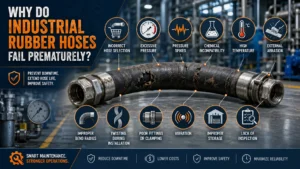
Premature hose failure is rarely caused by one factor alone. It is usually a combination of selection mistakes, installation errors, and neglected maintenance. Understanding each cause is the first step toward hose failure prevention and toward reducing industrial maintenance cost across a facility.
Incorrect Hose Selection
A hose chosen without matching it to the application’s pressure, temperature, and media requirements is likely to degrade quickly. Incorrect hose selection is one of the most common and most expensive mistakes in industrial hose maintenance, because it often leads to repeat replacement within weeks or months.
Excessive Working Pressure
Operating a hose above its rated working pressure stresses the reinforcement layer and the hose cover. Over time this leads to bulging, weeping, or sudden rupture, all of which increase hose downtime cost and safety exposure.
Pressure Spikes and Pulsation
Pumps, valves, and quick-closing equipment can create pressure spikes far above the system’s normal operating pressure. Repeated pulsation fatigues the hose reinforcement even when the average pressure appears acceptable, shortening hose service life significantly.
Incompatible Chemicals or Transferred Media
Every rubber compound has limits on the chemicals, oils, or slurries it can safely carry. When the transferred media is not compatible with the hose tube, the material swells, softens, or cracks from the inside, often before any external damage is visible.
High or Low Operating Temperature
Temperature resistance is application-specific. A hose rated for one temperature range but used outside it will harden, crack, or lose flexibility much faster than expected, directly increasing hose replacement frequency.
External Abrasion
Hoses dragged across floors, rubbed against machinery, or routed near sharp edges wear down from the outside. External abrasion is one of the most preventable causes of premature hose failure, yet it remains extremely common in busy industrial environments.
Improper Bend Radius
Every hose has a minimum bend radius. Forcing a hose into a tighter bend stresses the reinforcement at that point, creating a weak spot that fails long before the rest of the hose shows wear.
Hose Twisting During Installation
A hose installed with a twist is under constant torsional stress. This shortens service life and can loosen fittings over time, leading to fitting leakage that is often mistaken for a hose problem rather than an installation error.
Incorrect Fitting Selection
Fittings that do not match the hose size, pressure rating, or thread standard create stress points and leak paths. Incorrect fitting selection undermines even a correctly selected hose and adds recurring maintenance visits.
Poor Crimping or Clamping
An under-crimped or over-crimped fitting can slip, leak, or blow off under pressure. Poor crimping or clamping is a quality-control issue that often only becomes visible after the hose assembly is in service.
Excessive Vibration
Hoses mounted near vibrating equipment without adequate support experience constant micro-movement. Over time, this loosens fittings, wears the cover at contact points, and accelerates fatigue in the reinforcement.
Ageing and Weather Exposure
Ultraviolet light, ozone, and temperature swings degrade rubber compounds even when a hose is not in active use. Ageing is a background factor that reduces the remaining service life of every hose in a facility.
Improper Storage
Hoses stored coiled too tightly, exposed to sunlight, or stacked under heavy weight can degrade before they are ever installed. Improper storage effectively shortens the usable life of new inventory.
Lack of Inspection and Maintenance
Without a structured rubber hose inspection program, early warning signs go unnoticed until a hose fails in operation. Lack of maintenance turns preventable problems into unplanned downtime and emergency replacement.
Also, Read: Rubber Hose Failure Causes: The Complete Engineering Guide
Understand the Complete Industrial Hose Lifecycle Cost
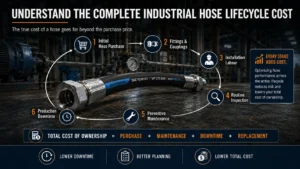
The purchase price of a hose is only one part of its true cost. Industrial hose lifecycle cost includes every expense connected to that hose from purchase to disposal, and it is this total figure that matters when a facility is trying to reduce hose replacement cost.
| Cost Component | What It Includes | How It Affects Total Cost |
|---|---|---|
| Initial hose purchase | Base price of the hose material | Lower price does not guarantee lower total cost |
| Fittings and couplings | Matching ends, adapters, ferrules | Wrong fittings increase leakage and rework |
| Installation labour | Technician time to fit and test the assembly | Repeated installation adds recurring labour cost |
| Routine inspection | Scheduled visual and physical checks | Reduces risk of unplanned failure |
| Preventive maintenance | Cleaning, protection, minor repairs | Extends service life and delays replacement |
| Production downtime | Lost output while a hose is repaired or replaced | Often the largest hidden cost of a failure |
| Product loss | Fluid, chemical, or material lost during failure | Adds material and cleanup cost |
| Equipment damage | Damage to nearby machinery from a burst hose | Can far exceed the cost of the hose itself |
| Emergency replacement | Rush procurement and after-hours labour | Costs more than planned replacement |
| Disposal cost | Handling and disposing of the failed hose | Small but recurring cost with frequent failures |
A slightly higher-quality hose that is correctly selected for the application can offer a lower total cost of ownership than a cheaper hose, simply because it needs to be touched less often. Consider a simple, illustrative example. A facility using a low-cost hose that needs replacement three times in a year will pay for three sets of fittings, three installation visits, and at least one or two unplanned downtime events. A facility using a properly selected hose that lasts the full year on one installation avoids most of those repeated costs. Actual figures will vary by application, but the pattern of repeated cost from repeated failure is consistent across industries.
Select the Correct Hose for Industrial Hose Cost Reduction
Correct hose selection is the single most effective step in hose failure prevention. Choosing the right hose the first time avoids the repeated cost cycle described above and forms the foundation of industrial hose cost reduction.
Type of Transferred Material
Identify whether the hose will carry water, air, steam, oil, chemicals, abrasive slurry, or food-grade material. Media compatibility determines the correct tube compound.
Working Pressure
Select a hose rated comfortably above the system’s normal operating pressure, with an appropriate safety margin as recommended by the manufacturer.
Pressure Surge
Account for pressure spikes caused by pumps or valves, not just the steady-state pressure, since surges are a common cause of early failure.
Operating Temperature
Match the hose’s temperature resistance to both the transferred media temperature and the surrounding ambient conditions.
Hose Size and Internal Diameter
An undersized hose restricts flow and increases pressure loss; an oversized hose adds unnecessary weight and cost.
Required Flexibility
Applications with frequent movement need a more flexible hose construction than fixed, static installations.
Minimum Bend Radius
Confirm that the intended routing does not require bending the hose tighter than its rated minimum bend radius.
Abrasion Resistance
Hoses routed along floors or near rough surfaces need a cover compound designed for higher abrasion resistance.
Reinforcement Type
Textile, wire braid, or spiral wire reinforcement each suit different pressure ranges and flexibility requirements.
Vacuum Requirement
Applications involving suction need a hose specifically rated to resist collapse under vacuum.
Static Electricity Control
Hoses carrying flammable or fine particulate media may require conductive or static-dissipating construction.
Environmental Exposure
Sunlight, ozone, chemicals, and outdoor weather all affect which hose cover material is appropriate.
Fitting and Coupling Compatibility
Confirm that the fittings match the hose in size, pressure rating, and thread or coupling standard before ordering.
A practical way to remember this selection process is the framework of Size, Temperature, Application, Media, Pressure, Ends, and Delivery requirements. Reviewing each of these factors before purchase supports better industrial hose selection and reduces the chance of an expensive mismatch.
Hose Selection Checklist for Procurement and Maintenance Teams
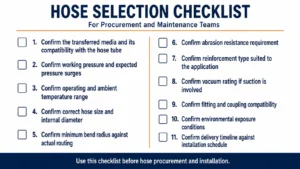
- Confirm the transferred media and its compatibility with the hose tube
- Confirm working pressure and expected pressure surges
- Confirm operating and ambient temperature range
- Confirm correct hose size and internal diameter
- Confirm minimum bend radius against actual routing
- Confirm abrasion resistance requirement
- Confirm reinforcement type suited to the application
- Confirm vacuum rating if suction is involved
- Confirm fitting and coupling compatibility
- Confirm environmental exposure conditions
- Confirm delivery timeline against installation schedule
Install Rubber Hoses Correctly to Extend Service Life
Even a correctly selected hose can fail early if it is installed incorrectly. Correct hose installation protects the investment made in proper selection and is essential to extend rubber hose life.
- Avoid twisting the hose during installation
- Do not exceed the minimum bend radius
- Keep the hose away from sharp edges and rough surfaces
- Provide sufficient hose length to allow for movement and expansion
- Avoid excessive tension on the hose or fittings
- Use suitable supports and clamps at regular intervals
- Prevent rubbing between adjacent hoses
- Protect the hose from nearby heat sources
- Check fitting alignment before tightening
- Avoid unnecessary adapters that add stress points
- Follow correct tightening practices per manufacturer torque guidance
- Test the completed assembly before putting it into full operation
Correct vs Incorrect Installation
| Installation Practice | Correct Approach | Incorrect Approach |
|---|---|---|
| Hose routing | Straight run with gentle bends | Twisted or kinked routing |
| Bend radius | Within manufacturer’s minimum rating | Tighter than minimum radius |
| Support | Clamped at regular intervals | Left unsupported and sagging |
| Fitting alignment | Fittings aligned before tightening | Forced alignment under tension |
| Length | Extra length for movement | Pulled tight with no slack |
| Heat exposure | Routed away from heat sources | Placed against hot surfaces |
| Testing | Pressure-tested before use | Put directly into full service |
Also, Read: Maximizing Industrial Rubber Hose Lifespan: A Complete Guide
Create a Rubber Hose Inspection Program
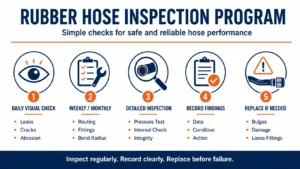
A structured rubber hose inspection program is one of the most cost-effective tools for hose failure prevention. Catching early warning signs during inspection is almost always cheaper than dealing with an unplanned failure.
Daily Visual Inspection
- Leakage at fittings or along the hose body
- Cracks in the outer cover
- Cuts or gouges
- Abrasion wear points
- Bulging or soft spots
- Flattening of the hose
- Kinks in the routing
- Loose fittings
- Unusual movement during operation
- Signs of heat damage
Weekly or Monthly Inspection
- Overall hose routing and support condition
- Clamp tightness and condition
- Bend radius compliance
- Fitting corrosion
- Exposed reinforcement
- Soft or hard spots along the hose
- Surface blistering
- Coupling movement
- Pressure-related deformation
Periodic Detailed Inspection
- Pressure testing where the application allows it
- Internal examination where possible
- Fitting integrity and torque check
- Electrical continuity checks where static control is required
- Review of maintenance history
- Review of expected replacement date
- Review of any changes in application conditions
Inspection frequency should depend on application severity, working pressure, temperature, transferred media, environment, and operating hours. A hose in a high-pressure, high-temperature, continuous-duty application needs more frequent inspection than a low-pressure, intermittent-use hose.
Common Warning Signs That a Rubber Hose Needs Replacement
Recognising warning signs early supports both hose failure prevention and hose replacement planning, and it is one of the simplest ways to reduce hose replacement cost without any change in purchasing. When these signs appear, the safer choice is usually replacement rather than continued use or field repair.
| Warning Sign | Possible Cause | Recommended Action |
|---|---|---|
| Deep cracks | Ageing, weather exposure | Replace the hose |
| Exposed reinforcement | Abrasion or ageing cover | Replace the hose |
| Persistent leakage | Fitting failure or internal damage | Inspect and replace |
| Bulges or blisters | Reinforcement damage or pressure spikes | Replace immediately |
| Permanent flattening | Excessive load or improper storage | Replace the hose |
| Severe abrasion | Lack of protection at contact points | Replace the hose |
| Hardened hose cover | Ageing or heat exposure | Replace the hose |
| Soft or swollen sections | Media incompatibility | Replace the hose |
| Damaged fittings | Poor crimping or handling damage | Replace the assembly |
| Movement near couplings | Loose crimp or worn ferrule | Inspect and replace |
| Chemical degradation | Incorrect media compatibility | Replace the hose |
| Heat burns | Proximity to heat source | Replace and reroute |
| Repeated pressure loss | Internal wear or fitting leakage | Inspect and replace |
| Unusual vibration | Loose support or internal damage | Inspect and replace |
A damaged hose should not be repaired when replacement would be the safer option, particularly in high-pressure or safety-critical applications. Actual condition and application risk should always guide the final decision.
Practical Rubber Hose Maintenance Tips
Simple, consistent habits deliver some of the largest hose maintenance cost savings available to a facility, often at very little added expense. The following rubber hose maintenance tips support day-to-day hose maintenance cost savings across a facility:
- Clean hoses after use to remove residue and contaminants
- Remove chemical residue promptly to prevent internal degradation
- Keep fittings clean and free of corrosion
- Avoid dragging hoses across floors or rough surfaces
- Use abrasion sleeves in high-wear areas
- Install heat protection near hot surfaces or equipment
- Control working pressure within the hose’s rated range
- Reduce pressure spikes with appropriate system design
- Maintain pumps and valves that influence hose pressure
- Prevent excessive vibration through proper mounting
- Use bend restrictors where tight routing cannot be avoided
- Inspect hoses before restarting equipment after a shutdown
- Store hoses correctly when not in use
- Record service history for every critical hose assembly
- Train operators on correct handling and early warning signs
- Replace damaged assemblies promptly rather than deferring action
Each of these practices reduces the likelihood of an unplanned failure, which is the largest driver of hose maintenance cost savings over time. Preventive hose maintenance is consistently less expensive than reactive, emergency-driven maintenance, and applying these rubber hose maintenance tips consistently, rather than occasionally, is what turns them into measurable hose maintenance cost savings.
Also, Read: Complete Rubber Hose Maintenance Guide for Industrial Use
Protect Hoses from Abrasion, Heat and Mechanical Damage
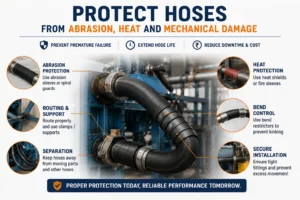
External damage is one of the most preventable causes of premature hose failure. Practical protection methods include:
- Protective sleeves for general abrasion resistance
- Spiral guards for hoses routed near sharp edges
- Hose covers for additional surface protection
- Fire-resistant sleeves near heat sources or open flame
- Clamps and supports to prevent sagging and rubbing
- Routing guides to keep hoses away from foot traffic and machinery
- Wear indicators that show when a protective layer needs renewal
- Hose bridges where hoses cross walkways or vehicle paths
- Bend restrictors at connection points prone to tight bending
- Separation from moving machinery to avoid entanglement or rubbing
Applying these protections at the time of installation is far less expensive than repairing damage caused by their absence.
Store Rubber Hoses Correctly
Rubber hose storage practices affect service life even before a hose is installed. Poor storage can reduce hose life before a hose is ever put into use, undermining the value of an otherwise correct purchase.
- Store hoses in a cool, dry and ventilated location
- Protect hoses from direct sunlight
- Keep hoses away from ozone-generating equipment such as electric motors
- Avoid contact with oils, solvents and chemicals during storage
- Do not stack heavy materials on top of stored hoses
- Avoid sharp bends when coiling hoses for storage
- Cap open hose ends to prevent contamination
- Keep hose assemblies clean before storage
- Use first-in, first-out inventory management for hose stock
- Maintain identification labels on stored hose assemblies
- Record purchase and storage dates for each batch
Develop a Preventive Hose Replacement Plan
A clear hose replacement plan is one of the most direct ways to reduce hose replacement cost, because it replaces guesswork with a structured decision process. Hose replacement planning can follow several approaches, each with different cost implications:
- Reactive replacement — replacing a hose only after it fails, which typically carries the highest hose downtime cost
- Time-based replacement — replacing hoses at fixed intervals regardless of condition
- Condition-based replacement — replacing hoses based on inspection findings and observed wear
- Risk-based replacement — prioritising replacement based on application criticality and failure consequences
An effective preventive replacement schedule considers application severity, working pressure, temperature, media compatibility, operating hours, previous failures, inspection results, manufacturer guidance, downtime consequences, and safety criticality. Hoses should not be replaced solely according to age without also considering actual condition and application risk, since a well-maintained hose in a mild application may safely outlast a stricter fixed schedule, while a hose in a severe application may need earlier attention.
Maintain a Hose Service Record
Keeping a maintenance record for every critical hose assembly supports both hose replacement planning and long-term industrial hose cost reduction, since past data is what makes future hose replacement planning accurate instead of reactive. A useful record should include:
| Field | Purpose |
|---|---|
| Hose identification number | Unique tracking reference |
| Hose type | Confirms specification on file |
| Size | Confirms diameter and length |
| Application | Records where the hose is used |
| Working pressure | Tracks operating conditions |
| Temperature | Tracks thermal exposure |
| Transferred media | Confirms compatibility requirements |
| Installation date | Basis for service life tracking |
| Inspection dates | Confirms inspection program compliance |
| Repair or replacement history | Identifies repeat failure patterns |
| Observed damage | Supports failure cause analysis |
| Expected replacement period | Supports planning and budgeting |
| Responsible technician | Establishes accountability |
Train Operators and Maintenance Teams
Operator behaviour has a direct influence on hose service life. Training should cover:
- Correct hose handling during connection and disconnection
- Identifying early warning signs of hose damage
- Preventing hose twisting during use and storage
- Avoiding overpressure conditions
- Safe equipment shutdown procedures
- Reporting leaks immediately rather than deferring
- Cleaning hoses after use
- Following scheduled inspection routines
- Understanding replacement criteria and when to escalate
Well-trained teams support hose failure prevention and reduce the frequency of emergency maintenance calls, which are typically the most expensive form of hose-related maintenance.
Industrial Hose Best Practices Checklist
Bringing the recommendations above together into a single reference makes it easier for teams to follow industrial hose best practices consistently, rather than relying on memory during a busy shift.
Before Installation
- Confirm hose specification matches application requirements
- Verify fitting compatibility
- Inspect the hose for storage or transit damage
During Installation
- Avoid twisting and tight bends
- Provide adequate support and clearance
- Check fitting alignment and tightening torque
During Operation
- Monitor working pressure and temperature
- Watch for unusual vibration or movement
- Keep hoses clear of moving machinery
During Inspection
- Follow the daily, weekly, and periodic inspection schedule
- Document all findings
- Flag any warning signs for review
During Storage
- Store in a cool, dry, ventilated area
- Cap hose ends and avoid sharp bends
- Label and date all stored assemblies
Before Replacement
- Review inspection and maintenance history
- Investigate the root cause of any failure
- Confirm the replacement hose matches updated application needs
How Better Hose Management Reduces Industrial Maintenance Cost
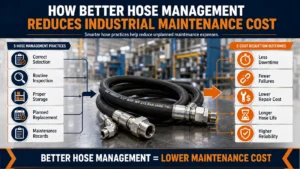
Facilities looking to reduce industrial maintenance cost often find that hose management is one of the easiest areas to improve, because most of the underlying causes are preventable. Structured hose management reduces industrial maintenance cost by lowering several recurring expenses at once, including unplanned downtime, emergency purchases, labour hours, fluid loss, equipment damage, repeat failures, inventory waste, and safety exposure.
Standardising hose selection, inspection, and documentation across multiple machines or facilities also improves maintenance efficiency. When maintenance teams work from a consistent hose maintenance record and a shared rubber hose inspection program, they can plan replacements ahead of failure rather than reacting to it. Even a short set of rubber hose maintenance tips, applied consistently across every machine, tends to produce more reliable hose maintenance cost savings than an occasional, unplanned effort. This shift from reactive to planned maintenance is often the single largest contributor to reduce hose replacement cost across an entire operation, and it is one of the most reliable ways to reduce industrial maintenance cost facility-wide over multiple budget cycles.
Mistakes to Avoid When Trying to Reduce Hose Costs
- Purchasing only based on price without checking specification
- Using one hose type for every application regardless of differences in pressure or media
- Ignoring pressure surges when selecting a hose rating
- Reusing damaged fittings on new hose assemblies
- Delaying replacement after the first sign of leakage
- Installing hoses without checking the minimum bend radius
- Skipping maintenance records for critical hose assemblies
- Storing hoses outdoors without protection
- Using temporary repairs as a permanent solution
- Replacing hoses without investigating the cause of the original failure
Repeated failure analysis is essential for long-term industrial hose cost reduction. Without understanding why a hose failed, the same expensive mistake is likely to repeat with the replacement hose. Avoiding these mistakes is as much a part of industrial hose best practices as any single maintenance task, and doing so consistently is one of the more overlooked ways to reduce industrial maintenance cost.
Conclusion
Reducing hose replacement cost is not achieved through a single purchasing decision, but through a combination of correct hose selection, proper installation, routine inspection, operator training, preventive maintenance, correct storage, failure documentation, and planned replacement. Each of these practices addresses a different part of the industrial hose lifecycle cost, and together they reduce the unplanned downtime and repeated labour that drive up maintenance spending.
Facilities that treat hose management as an ongoing program rather than a reactive task consistently see fewer emergency replacements and lower total maintenance cost over time. Actual hose service life will always vary according to application conditions, so recommendations here should be applied alongside manufacturer specifications and applicable safety procedures.
As an industrial rubber hose manufacturer, Rubber Hose India LLP works with plant managers, maintenance engineers, and procurement teams to select the right hose for their pressure, temperature, media, and application requirements. Contact Rubber Hose India LLP to discuss a hose selection and maintenance approach suited to your facility.
Frequently Asked Questions
How can I extend rubber hose life?
To extend rubber hose life, match the hose to its working pressure, temperature, and transferred media, install it without twisting or tight bends, protect it from abrasion and heat, and inspect it regularly. Correct storage before installation also plays an important role in overall service life.
How often should an industrial rubber hose be inspected?
Inspection frequency depends on the application. High-pressure, high-temperature, or continuous-duty hoses typically need daily visual checks along with periodic detailed inspection, while lower-severity applications may need less frequent review. Manufacturer guidance and past failure history should also inform the schedule.
What is the most common cause of industrial hose failure?
Common causes include incorrect hose selection, excessive working pressure, external abrasion, improper bend radius, and lack of routine inspection. Often, failure results from a combination of these factors rather than a single isolated cause.
When should a rubber hose be replaced?
A hose should be replaced when it shows deep cracks, exposed reinforcement, persistent leakage, bulges, permanent flattening, or damaged fittings. In safety-critical or high-pressure applications, replacement is generally the safer choice once any of these warning signs appear.
Can a damaged industrial hose be repaired?
Some minor issues may be addressed through refitting or reassembly, but hoses with internal damage, deep cracks, or exposed reinforcement should typically be replaced rather than repaired, since a repaired hose carries higher risk of repeat failure.
How does correct hose selection reduce maintenance costs?
Correct hose selection reduces maintenance costs by preventing the repeated cycle of premature failure, emergency replacement, and repeated labour that occurs when a hose is mismatched to its pressure, temperature, or media requirements.
What is included in industrial hose lifecycle cost?
Industrial hose lifecycle cost includes the initial purchase, fittings, installation labour, routine inspection, preventive maintenance, downtime, product loss, equipment damage, emergency replacement, and disposal. Purchase price alone does not reflect this total cost.
How should unused rubber hoses be stored?
Unused hoses should be stored in a cool, dry, ventilated location, away from direct sunlight, ozone-generating equipment, and chemicals. Ends should be capped, sharp bends avoided, and stock rotated using a first-in, first-out approach.
What should be included in a rubber hose inspection program?
A rubber hose inspection program should include daily visual checks for leaks and damage, weekly or monthly checks of routing and fittings, and periodic detailed inspection covering pressure testing and maintenance history review, adjusted to application severity.
Is preventive hose replacement cost-effective?
Preventive, condition-based replacement is generally more cost-effective than reactive replacement, since it avoids the higher downtime, labour, and emergency procurement costs associated with unplanned failure, while still allowing hoses in good condition to remain in service.
How can abrasion damage to industrial hoses be prevented?
Abrasion damage can be reduced with protective sleeves, spiral guards, proper routing away from sharp edges and moving machinery, and adequate support and clamping. Regular inspection helps catch early wear before it develops into a full failure.