
Every hydraulic hose assembly depends on one small detail that is easy to overlook: the thread. Whether you are connecting a hose end fitting to a cylinder port or selecting an adapter for a pump, thread type and size decide whether the joint holds pressure or fails under it.
This is exactly where the confusion between UNC vs UNF threads comes in. Both belong to the same unified inch thread family, yet they behave differently once installed. A wrong thread selection can lead to leakage, a loose connection, cross-threading during assembly, vibration-related failure over time, and unplanned equipment downtime — all of which are costly on a factory floor or a construction site.
This guide explains UNC and UNF threads in plain language, compares them directly, gives you a working thread chart, and connects the topic to real-world hydraulic hose fittings, hose end fittings, and adapter selection.
What Are UNC and UNF Threads?
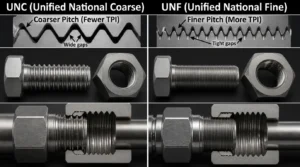
UNC and UNF are both part of the unified inch screw thread system, standardised under ASME B1.1. This standard defines thread form, series, class, allowance, tolerance, and designation for inch-based fasteners and fittings used across the USA and in equipment manufactured to US thread specifications.
UNC stands for Unified National Coarse and UNF stands for Unified National Fine. Both use the same 60-degree flank angle and are parallel (straight) threads, but they differ in pitch — the distance between adjacent threads — and in threads per inch (TPI).
If you are unsure whether your fitting needs a UNC or a UNF thread, our team at hydraulic hose manufacturer in India can help you match the correct thread standard to your hose assembly before you place an order.
What Is UNC?
UNC thread meaning is straightforward: it is a coarse-pitch thread with fewer threads per inch compared to UNF for the same nominal diameter. This coarse pitch offers several practical advantages:
- Faster assembly, since fewer turns are needed to fully engage the thread
- Lower risk of cross-threading during installation, useful in field conditions or repeated assembly/disassembly
- Strong general-purpose fastening for everyday industrial applications
- Better tolerance to minor thread damage, dirt, or paint buildup
Because of these traits, UNC threads are widely used across general industrial machinery, structural fastening, and equipment where speed of assembly and durability matter more than fine adjustment.
What Is UNF?
So, what is UNF? UNF thread meaning refers to a fine-pitch thread with a higher number of threads per inch for the same nominal diameter as its UNC counterpart. This finer pitch changes how the thread performs:
- Better holding strength in vibration-prone applications, since more threads are engaged per unit length
- Higher precision, making it suitable for fine adjustment and close-tolerance assemblies
- Increased tensile strength in thin-walled parts, since a shallower thread depth removes less material
- Common in equipment where loosening from vibration is a bigger risk than assembly speed
UNF fittings are typically chosen where the equipment is exposed to continuous vibration, such as engine-mounted components, precision instruments, and certain hydraulic or pneumatic connections.
UNC vs UNF Threads: Quick Difference Table
Here is a side-by-side UNC vs UNF thread difference table covering the parameters that matter most for selection:
| Parameter | UNC Threads | UNF Threads | Suitability |
|---|---|---|---|
| Full Form | Unified National Coarse | Unified National Fine | Both are part of the unified thread standard. |
| Thread Pitch | Coarse thread pitch | Fine thread pitch | UNC is suitable for faster assembly, while UNF offers greater precision. |
| Threads Per Inch (TPI) | Fewer threads per inch | More threads per inch | UNF has a higher TPI than UNC for the same nominal diameter. |
| Assembly Speed | Faster to assemble | Slower but more precise | UNC is preferred where quick installation and removal are required. |
| Strength Per Thread | Lower engagement per thread but strong overall | Higher thread engagement | UNF is suitable for applications requiring finer load distribution. |
| Vibration Resistance | Moderate resistance | Better resistance to loosening | UNF is generally preferred for vibration-prone equipment and assemblies. |
| Cross-Threading Risk | Lower risk | Slightly higher risk if forced | UNF threads require careful alignment during installation. |
| Common Use | General industrial fastening | Precision and high-vibration assemblies | Selection depends on the equipment design and operating conditions. |
UNC vs UNF Thread Chart
A practical UNC thread chart and unf thread chart side by side makes it easier to identify the right designation quickly. Below is a unified thread size chart for some of the most commonly used sizes:
| Nominal Size | UNC Designation | UNF Designation |
|---|---|---|
| 1/4 inch | 1/4-20 UNC | 1/4-28 UNF |
| 5/16 inch | 5/16-18 UNC | 5/16-24 UNF |
| 3/8 inch | 3/8-16 UNC | 3/8-24 UNF |
| 1/2 inch | 1/2-13 UNC | 1/2-20 UNF |
Reading this UNC vs UNF thread chart: the first number is the nominal diameter, and the second number is the threads per inch (TPI). A higher TPI value always indicates a finer thread, which is why UNF designations carry a larger second number than their UNC equivalent at the same nominal size.
UNC and UNF Threads in Hydraulic Hose Fittings
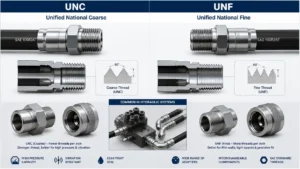
Thread standards directly affect hydraulic hose fittings, hose end fittings, and adapters. UNC fittings and UNF fittings can appear on mounting bolts, gauge ports, adapter bodies, and certain equipment connection points, especially on machinery and components manufactured to US thread standards.
Before installing or replacing a hose assembly, it is important to confirm whether the mating connection uses a unified inch thread (UNC/UNF) or another thread standard. Mismatched threads are one of the most common causes of on-site leakage and repeat maintenance calls.
Our hose end fittings range is manufactured and sourced to match multiple thread standards, so that your hose assembly connects correctly the first time, without forcing an incompatible fit.
Because thread compatibility is central to a leak-free hydraulic connection, industrial hose fittings and threaded hose fittings should always be checked against the port thread before crimping or assembly, not after.
UNC vs UNF vs Other Thread Types
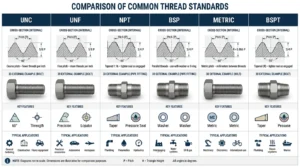
UNC and UNF are not the only thread standards used in hydraulic systems. Depending on the equipment’s country of origin and application, you may also encounter:
- BSP (British Standard Pipe) — common across the UK, Europe, and Asia, including much of the Indian industrial market
- NPT (National Pipe Thread) — a tapered thread standard widely used in North America
- JIC (Joint Industry Council) — a 37-degree flare fitting standard, widely used on hydraulic hose ends
- ORFS (O-Ring Face Seal) — a flat-face, O-ring sealed connection used in high-pressure hydraulic circuits
- Metric threads — sized in millimetres rather than inches, common on newer machinery
Here is a quick comparison of these hydraulic fitting thread types:
| Thread Standard | Typical Region / Use | Notes |
|---|---|---|
| UNC / UNF | USA-origin equipment and general fasteners | Inch-based unified thread standard governed by ASME B1.1. |
| BSP | UK, Europe, and Asia, including India | Available in parallel or tapered inch threads and commonly used in hydraulic systems. |
| NPT | North America | Tapered thread design that creates a seal through thread interference. |
| JIC | Global hydraulic systems | Uses a 37-degree flare fitting and is widely used on hydraulic hose ends. |
| ORFS | High-pressure hydraulic systems | O-ring face seal with a flat-face design that helps prevent leakage. |
| Metric | Europe, Asia, and most modern machinery | Thread diameter and pitch are defined in millimetres rather than inches. |
It is common for a single hydraulic system to combine multiple thread standards, which is why our hydraulic hose fittings and adapters are available across UNC, UNF, BSP, JIC, ORFS, and metric configurations to suit different equipment and country-of-origin requirements.
How to Identify UNC or UNF Threads
A simple, practical way to confirm whether a fitting is UNC or UNF:
- Step 1: Measure the nominal outer diameter of the male thread (or the bore for a female thread)
- Step 2: Use a thread pitch gauge to count the threads per inch (TPI)
- Step 3: Compare the diameter and TPI reading against a UNC vs UNF thread chart
- Step 4: Confirm whether the connection is male or female, and note the fitting type (straight, flared, O-ring face, or flanged)
- Step 5: Cross-check against the equipment manual or existing fitting if one is available, before ordering a replacement
This thread identification guide helps avoid guesswork, especially when replacing a damaged fitting where the original marking may be worn off.
Common Mistakes While Selecting Threads
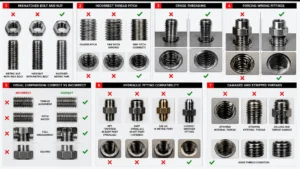
- Mixing UNC and UNF threads on the same nominal size, assuming they are interchangeable
- Forcing a fitting into place when the thread does not turn smoothly by hand
- Ignoring TPI and relying on diameter alone to judge a match
- Confusing inch thread standards with metric threads, which look similar but do not match
- Reusing damaged or worn fittings instead of replacing them
- Not checking the sealing type (thread seal, O-ring, or flare) before assembly
Which Is Better: UNC or UNF Threads?
There is no single best option between UNC or UNF threads — the right choice depends on the application, not a general ranking.
- UNC is a strong choice for general-purpose fastening and faster assembly, particularly where field conditions or repeated disassembly are common
- UNF is better suited to tighter fit requirements, fine adjustment, and vibration-prone applications where thread loosening is a concern
In practice, thread selection should follow the fitting design, working pressure, vibration exposure, equipment type, and the thread standard already specified by the original equipment manufacturer.
Buyer Guide for Hydraulic Hose Fittings
Before ordering hose fittings or adapters, buyers, purchase managers, and maintenance teams should verify the following:
| Checkpoint | Why It Matters |
|---|---|
| Thread Type and Size | Wrong thread size or type causes leaks and cross-threading. |
| Pressure Rating | The fitting must match the working and burst pressure of the system. |
| Material ( Carbon steel, stainless steel, or brass ) | Affects corrosion resistance, strength, durability, and service life. |
| Application Environment | Vibration, temperature, and chemical exposure influence fitting choice. |
| Compatibility With Existing Hose Assembly | Prevents mismatched connections between the hose and equipment. |
| Sealing Method ( Thread seal or O-ring face seal ) | Determines how the connection prevents leakage under pressure. |
If you need help confirming a thread type or sourcing the correct adapter, our industrial rubber hose manufacturer in India team can verify specifications against your existing hose assembly before dispatch.
Conclusion
UNC and UNF threads are two variants of the same unified inch thread standard, differing mainly in pitch, threads per inch, and the applications they suit best. UNC offers speed and strong general-purpose fastening, while UNF offers precision and better resistance to vibration-related loosening. Neither is universally superior — the right thread depends on your equipment, pressure requirements, and operating environment.
For hydraulic hose assemblies, hose end fittings, and adapters, getting the thread right the first time prevents leaks, downtime, and repeat maintenance. Rubber Hose India LLP manufactures and supplies hydraulic hose assemblies, hose end fittings, and industrial hose solutions across multiple thread standards, including UNC, UNF, BSP, JIC, and ORFS, to match your exact equipment requirements.
Frequently Asked Questions
What is UNF thread used for?
UNF threads are commonly used where fine adjustment, higher clamping load per thread, and resistance to vibration-induced loosening are needed, such as in precision assemblies and some fitting connections.
What does UNC thread mean?
UNC stands for Unified National Coarse, a standard coarse-pitch inch thread series defined under ASME B1.1, widely used for general-purpose industrial fastening.
Are UNC and UNF threads interchangeable?
No. UNC and UNF threads of the same nominal size have different pitches and threads per inch, so a UNC nut will not properly fit a UNF bolt of the same diameter, and forcing the fit can damage the threads.
How do I identify UNC or UNF threads?
Measure the nominal diameter, count the threads per inch using a pitch gauge or thread gauge, and compare the reading against a UNC/UNF thread chart to confirm the exact designation.
What is the full form of UNC and UNF?
UNC stands for Unified National Coarse and UNF stands for Unified National Fine. Both are part of the unified inch screw thread system.
Which is stronger, UNC or UNF?
UNC threads generally offer strong overall holding capacity and are less prone to cross-threading, while UNF threads offer higher strength per individual thread and better resistance to vibration loosening. Neither is universally stronger; the right choice depends on the application.
Are UNC and UNF used in hydraulic fittings?
Some hydraulic hose fittings and adapters use UNC or UNF threaded connections, though many industrial hydraulic systems in India also use BSP, JIC, ORFS, or metric threads depending on the equipment and country of origin.
What is an UNF thread chart?
A UNF thread chart lists standard nominal sizes alongside their corresponding threads per inch, helping buyers, engineers, and maintenance teams quickly identify and match the correct fine-thread fitting.
How do I choose the right thread for hose fittings?
Check the existing fitting's thread type, size, and TPI, confirm the pressure rating and application environment, and match it against the hose assembly manufacturer's specification before ordering a replacement or adapter.