
Industrial facilities depend on fluid conveyance systems to maintain continuous operations. At the heart of these systems are rubber hoses, engineered to withstand extreme pressures, harsh chemicals, and constant movement. When these critical components fail, the consequences range from temporary operational delays to catastrophic safety hazards.
Understanding rubber hose failure causes is not just a maintenance task. It is a fundamental requirement for plant engineers, safety officers, and facility managers. When an industrial hose ruptures or leaks, it compromises the entire system.
This comprehensive guide explores the molecular, mechanical, and operational reasons behind these failures.
You will learn how to identify warning signs, implement robust industrial hose inspection protocols, and establish foolproof hose failure prevention methods to keep your systems running safely.
What Constitutes Industrial Hose Failure?
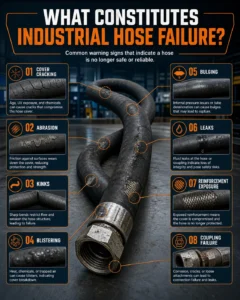
Industrial hose failure occurs when a flexible hose assembly loses its structural integrity. This loss prevents the hose from containing and transporting its designated medium safely. Failures rarely happen without a distinct underlying cause. They manifest in several ways, from catastrophic hose burst reasons to slow, insidious hose leakage issues.
When we examine industrial hose failure, we look at three distinct layers: the inner tube, the reinforcement layer, and the outer cover. A failure in any of these layers eventually compromises the whole assembly.
For instance, if the outer cover suffers abrasion, the reinforcement wire becomes exposed to moisture and rusts. Once the reinforcement weakens, the internal pressure pushes through the compromised area, resulting in a blowout.
The impact of these failures is significant. Beyond the immediate cost of replacing the hose, facilities face unscheduled downtime, environmental cleanup costs for spilled fluids, and severe safety risks to personnel working nearby.
Recognizing the exact rubber hose damage empowers your team to shift from reactive repairs to proactive asset management.
Deep Dive into Rubber Hose Failure Causes
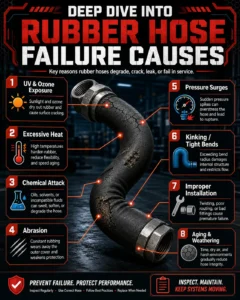
What causes a heavy-duty industrial hose to break down? The answers lie in the intersection of operational demands, environmental stressors, and physical handling. Here is a granular look at the primary rubber hose failure causes.
Pressure Related Hose Failure
Every hose assembly carries a specific maximum working pressure rating. This rating dictates the highest internal pressure the hose can safely handle during continuous operation. Exceeding this limit is a primary driver of pressure related hose failure.
However, continuous high pressure is not the only culprit. Pressure surges, often called the “water hammer” effect, cause devastating internal damage. When a valve closes rapidly, the moving fluid comes to a sudden halt. This creates a shockwave that travels back through the fluid, causing a massive, instantaneous spike in pressure.
These spikes often exceed the burst pressure limit of the hose for a fraction of a second. While a single surge might not destroy the hose immediately, repetitive pressure spikes cause mechanical fatigue in the reinforcement layers.
The braided wire or textile fibers stretch and weaken with each shockwave. Over time, this cumulative stress leads to sudden and violent hose burst reasons. Operating a hose consistently at or near its absolute maximum pressure rating also accelerates natural wear and drastically shortens its operational lifespan.
Temperature Related Hose Damage
Temperature affects rubber at a molecular level. To understand temperature related hose damage, you must look at both the fluid temperature inside the hose and the ambient temperature outside it.
When a rubber compound faces excessive heat, thermal degradation occurs. The high temperatures cause the plasticizers inside the rubber to leach out. Plasticizers are the chemical additives that give rubber its flexibility.
As these additives vanish, the elastomer begins to harden and bake. The polymer chains within the rubber cross-link too tightly, causing the inner tube to lose all elasticity. When the hose flexes or pressurizes, the hardened rubber cannot expand. This leads directly to severe internal rubber hose cracking.
Conversely, extreme cold poses an equally dangerous threat. Freezing temperatures cause rubber compounds to stiffen and become highly brittle. If a machine moves or bends a frozen hose, the rubber can shatter like glass.
You must always verify that your hose material aligns with the maximum and minimum temperature extremes of your specific application.
Chemical Incompatibility and Internal Breakdown
Chemical compatibility is non-negotiable in fluid conveyance. If the inner tube material cannot withstand the chemical makeup of the conveyed fluid, rapid degradation begins immediately.
Incompatible chemicals cause the inner rubber to swell, blister, or dissolve. Sometimes, the chemical extracts the binding agents from the rubber, leaving the tube porous.
This chemical attack leads to permeation, where fluid or gas escapes through the microscopic pores of the hose wall without any visible hole.
This results in dangerous, hard-to-track hose leakage issues. Always consult a chemical compatibility chart before introducing a new fluid, solvent, or gas into an existing hose system.
Rubber Hose Cracking and Environmental Aging
Rubber does not last forever. Even if a hose sits on a shelf unused, it slowly degrades. Environmental factors heavily accelerate this aging process, leading to widespread rubber hose cracking.
Ozone exposure is a massive enemy to rubber assemblies. Ozone attacks the carbon-carbon double bonds in the rubber polymers, causing the material to dry out and split. Ultraviolet (UV) light from direct sunlight causes similar photo-oxidative degradation.
As the outer cover dries and cracks, it loses its ability to protect the vital reinforcement layers. Once moisture, dirt, and corrosive elements enter through these cracks, the internal structural integrity plummets.
Installation and Routing Errors
Human error during installation accounts for a massive percentage of early hose failures. A high-quality hose will fail quickly if poorly installed.
Kinking is a frequent installation error. This happens when a hose bends beyond its manufacturer-specified minimum bend radius. Bending the hose too tightly crushes the inner tube and forces the reinforcement wires to separate on the outside of the curve. This creates a weak spot that will inevitably blow out under pressure.
Twisting, or torsion, is another destructive error. If a technician twists the hose while tightening the end fittings, the internal wire braids warp. When pressure enters a twisted hose, the assembly tries to straighten itself out.
This internal twisting motion tears the reinforcement layers apart. Even a slight five-degree twist can reduce a hose’s lifespan by up to seventy percent.
External Abrasion and Mechanical Wear
Industrial environments are rough. Hoses drag across concrete floors, rub against vibrating steel plates, and swing into adjacent machinery. External abrasion systematically files away the protective rubber cover.
Once the cover wears down, the bare wire or fabric reinforcement faces the elements. Steel wire rusts quickly when exposed to plant humidity or chemical washdowns. Rusted wires snap under pressure, removing the structural support that holds the inner tube together. Preventing external damage requires careful routing and proper physical shielding.
Recognizing the Warning Signs of Impending Failure
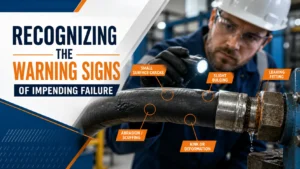
You can often catch a failing hose before it bursts. Implementing routine visual checks helps maintenance teams spot rubber hose damage causes early. Look for these critical physical symptoms:
- Hardened or stiffened sections: Rubber hose damage causes bending or feels like solid plastic, thermal degradation has occurred.
- Deep surface cracks: Visible splits on the outer cover that expose the layers beneath.
- Blisters and bubbles: Soft spots or raised bumps indicate fluid has leaked through the inner tube and is pooling under the outer cover.
- Exposed or frayed reinforcement: Any visible wire or fabric means the hose has lost its protective barrier.
- Weeping or dampness around fittings: Rubber hose damage causes unexplained moisture at the connection points signifies failing crimps or internal tube collapse.
- Flattened or crushed areas: Signs that heavy equipment ran over the hose, compromising its internal structure.
Master the STAMPED Method for Hose Selection

The best hose failure prevention strategy starts before you even purchase the hose. Selecting the wrong component guarantees premature failure. Engineers and buyers should universally apply the STAMPED method for accurate specification.
S – Size: Measure the required inside diameter (ID) and outside diameter (OD). The ID must match the system’s flow rate requirements. Too small an ID causes fluid velocity to increase, generating internal heat and friction.
T – Temperature: Identify the continuous and maximum temperatures of both the internal fluid and the external environment.
A – Application: Define exactly what the hose will do. Will it face severe vibration? Will it be submerged? Does it need to handle vacuum pressure as well as positive pressure?
M – Material: Select the exact rubber compound (e.g., Nitrile, EPDM, Neoprene) that offers complete chemical compatibility with the fluid being transferred.
P – Pressure: Determine the maximum system working pressure, including potential pressure surges and spikes.
E – Ends: Choose the correct fittings, couplings, and attachment methods (crimped vs. banded) that match the system interfaces perfectly.
D – Delivery: Specify testing requirements, packaging needs, and specific delivery timelines required for the project.
Also, Read: Complete Rubber Hose Maintenance Guide for Industrial Use
Industrial Hose Inspection Guidelines
Routine, documented inspections are the backbone of industrial hose safety. Do not wait for a leak to check your equipment. Establish a rigid industrial hose inspection framework.
Conduct visual inspections daily. Operators should walk the lines before starting up machinery, looking for obvious signs of abrasion, kinks, or moisture. This takes only minutes but prevents catastrophic accidents.
Perform comprehensive, documented inspections monthly or quarterly, depending on application severity. During these checks, technicians must power down the system, wipe the hoses clean, and physically feel the assemblies for hard spots, soft spots, or blistering.
Implement hydrostatic testing for critical applications. This involves taking the hose out of service, filling it with water, and pressurizing it to a specific test pressure (usually twice the working pressure) for a set time. If the hose holds pressure without leaking or ballooning, it remains fit for service.
Proven Hose Failure Prevention Methods
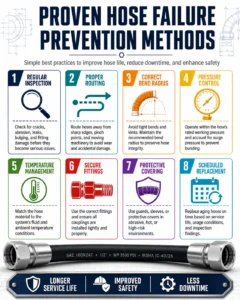
To maximize the lifecycle of your fluid conveyance systems, adopt proactive hose failure prevention methods.
Use correct routing techniques. Install elbows and specific adapters to prevent severe bends immediately behind the hose fittings. The straight length of the hose extending from a fitting should be at least twice the outside diameter of the hose before any bend begins.
Support heavy hose runs properly. Do not let hoses hang freely from their fittings, as the weight of the conveyed fluid will pull the hose out of the crimped end. Use nylon slings, hose bun saddles, or proper clamping systems to support the weight along the routing path.
Install external protection. If a hose must rub against a vibrating surface, slide an abrasion-resistant nylon sleeve or high-density polyethylene spiral wrap over it. For applications near furnaces or molten metal, utilize fire-resistant fiberglass sleeving to deflect extreme external heat.
Industrial Hose Safety Best Practices
When rubber hose failure causes a high-pressure blowout, the physical force is lethal. A ruptured hydraulic or pneumatic hose will whip violently, striking anything in its path.
Always install whip checks or hose restraint cables on high-pressure air and fluid lines. These steel cables bridge the hose and the solid connection point. If the fitting blows off, the cable catches the hose, preventing it from whipping across the factory floor.
Ensure personnel wear appropriate Personal Protective Equipment (PPE) when working near pressurized systems. Fluid injection injuries occur when a pinhole leak acts like a hypodermic needle, shooting toxic fluid directly through a worker’s skin.
Never use your bare hands to feel for leaks in a pressurized rubber hose. Use a piece of cardboard or wood to pass over the line to detect escaping fluid.
Always follow rigorous lockout/tagout (LOTO) procedures before replacing or inspecting a hose. Depressurize the system completely and drain residual fluids before loosening any fittings.
Common Mistakes to Avoid
Maintenance teams often fall into bad habits that compromise industrial hose safety. Avoid these widespread errors:
- Mixing manufacturers’ components: Never crimp Brand A’s fitting onto Brand B’s hose. The tolerances differ microscopically. Mixing components voids warranties and guarantees a weak connection.
- Ignoring shelf life: Rubber degrades in storage. Always practice first-in, first-out (FIFO) inventory management. Keep spare hoses in cool, dark, dry rooms away from electrical equipment that generates ozone.
- Reusing crimped fittings: Once a fitting is permanently crimped onto a hose, it deforms to grip the rubber. You cannot cut off the old hose and reuse that fitting safely.
- Painting rubber hoses: Painting lines to color-code them seems helpful, but the solvents in industrial paint break down the rubber cover and hide visible warning signs of cracking.
Conclusion
Mastering the root rubber hose failure causes protects your workforce, safeguards your budget, and ensures your plant hits its production targets. Most failures are entirely preventable through proper engineering, careful handling, and diligent maintenance.
By applying the STAMPED method during purchasing, respecting bend radiuses during installation, and committing to a strict industrial hose inspection schedule, you eliminate the guesswork from fluid conveyance.
Stop treating hoses as disposable commodities. Treat them as highly engineered assets, prioritize hose failure prevention, and build a safer, more reliable industrial environment.
Also, Read: Industrial Hose Quality Standards & Certifications Guide
Frequently Asked Questions (FAQ)
How often do I need to replace my industrial rubber hoses?
There is no universal expiration date. Replacement intervals depend entirely on the application, operating pressure, temperature extremes, and external environment. Regular industrial hose inspection determines the replacement cycle. Replace the hose immediately if any physical defects appear.
Can I repair a rubber hose that has a small leak?
No. You should never patch, tape, or splice a damaged industrial rubber hose. A leak indicates that the internal structural integrity has failed. The only safe solution is to depressurize the system and replace the entire hose assembly.
Why do my hoses keep cracking on the outside?
External rubber hose cracking is usually a symptom of environmental aging. High ambient heat, direct sunlight (UV exposure), dry air, and ozone from nearby electrical motors dry out the rubber plasticizers. Upgrading to a hose cover material specifically designed for UV and ozone resistance resolves this issue.
What does "minimum bend radius" actually mean?
The minimum bend radius is the tightest curve you can force a hose into without kinking it or damaging the internal reinforcement layers. If you bend a hose tighter than this manufacturer-specified measurement, you severely restrict flow and guarantee premature structural failure.