
In any industrial setting, from chemical plants to construction sites, hoses are the arteries that carry vital fluids. Whether it’s water, oil, fuel, or harsh chemicals, these flexible conduits are essential for daily operations. However, their reliability hinges on one critical factor: the industrial hose pressure rating. Choosing a hose with the wrong pressure rating is not just an operational mistake; it’s a significant safety hazard that can lead to catastrophic failures, costly downtime, and severe injuries.
The risks associated with hose failure are immense. A burst hose can release high-pressure fluids, causing direct harm to personnel, damaging expensive equipment, and creating environmental contamination. Unfortunately, misunderstandings about pressure ratings are common. Many users confuse working pressure with burst pressure or fail to consider how factors like temperature and chemical exposure can degrade a hose’s capacity over time.
This guide will demystify the complexities of industrial hose pressure rating. We will provide engineers, industrial buyers, and safety officers with the practical knowledge needed to select the right hose for the right application, ensuring both operational efficiency and workplace safety.
For clarity, let’s establish a core definition. The industrial hose pressure rating defines the maximum safe pressure a hose can handle during operation without failure. This rating is the cornerstone of safe hose selection and use.
What Is Industrial Hose Pressure Rating?
An industrial hose pressure rating is a value assigned by the manufacturer that specifies the maximum internal pressure the hose can safely withstand during continuous operation. This is often referred to as the Maximum Allowable Working Pressure (MAWP). It’s not just a number; it’s a promise of performance and safety under specific conditions.
In industrial applications, this rating is paramount. Systems often operate under dynamic pressures, with fluctuations, surges, and constant stress. The pressure rating ensures that the hose assembly can manage these forces without rupturing or leaking. It directly impacts the reliability of your machinery and the safety of your team.
It’s crucial to distinguish between the hose’s pressure rating and the system’s actual operating pressure. The operating pressure is the force exerted by the fluid within the system during normal use. For safe operation, the system’s maximum operating pressure, including any potential spikes, must always be lower than the hose’s designated industrial hose pressure rating.
Hose Pressure Rating Units – PSI vs Bar Explained
When reviewing industrial hose specifications, you will encounter two primary units of pressure: PSI and bar. Understanding both is essential for making accurate comparisons and selections.
What PSI Means
PSI stands for “Pounds per Square Inch.” It is an imperial unit of pressure, widely used in the United States and certain other regions. It measures the force in pounds applied to an area of one square inch. When you see a hose pressure rating PSI, it tells you how many pounds of pressure can be exerted on every square inch of the hose’s inner surface.
What Bar Means
The bar is a metric unit of pressure. One bar is approximately equal to the atmospheric pressure at sea level. It is the standard unit used in Europe and most parts of the world, including India, for industrial applications. A rating in bar indicates the pressure in multiples of atmospheric pressure.
Conversion Basics
The conversion between PSI and bar is straightforward and important to know:
- 1 bar = 14.5038 PSI
- 1 PSI = 0.0689 bar
For quick mental calculations, you can often approximate 1 bar to 14.5 PSI. Many manufacturers list both units on their products to cater to a global market. Knowing how to convert between a hose pressure rating PSI and a hose pressure rating bar ensures you are comparing products accurately.
Both units are prevalent in industrial hose specifications because manufacturers serve international markets. An OEM in India might design a system using bar, while a component sourced from the US might be rated in PSI. Being fluent in both is a necessity for modern engineers and buyers.
Working Pressure vs Burst Pressure – Key Differences
Confusing working pressure and burst pressure is one of the most dangerous mistakes in hose selection. These two values represent vastly different aspects of a hose’s capability.
Working Pressure
Working pressure, or MAWP, is the maximum pressure at which a hose is designed to operate continuously. It is the rating you must use when selecting a hose for your application. This value is determined with a safety factor built-in to account for minor pressure fluctuations and normal wear.
Burst Pressure
Burst pressure is the pressure at which a hose is expected to rupture or fail. This value is determined during destructive testing in a controlled laboratory environment. It is a theoretical limit and not an operational parameter. You should never operate a hose at or near its burst pressure.
Safety Factor
The safety factor is the ratio between the burst pressure and the working pressure.
- Safety Factor = Burst Pressure / Working Pressure
A common safety factor for industrial hoses is 4:1, meaning the burst pressure is four times the working pressure. For example, a hose with a working pressure of 500 PSI might have a burst pressure of 2000 PSI. Some applications, particularly those involving steam or highly hazardous materials, may require a higher safety factor, such as 10:1. The safety factor provides a crucial buffer for unexpected pressure surges and gradual degradation of the hose over its service life.
Let’s illustrate with an example:
- Hose A: Rated for 20 bar working pressure.
- Safety Factor: 4:1.
- Calculated Burst Pressure: 20 bar x 4 = 80 bar.
This means Hose A can safely handle 20 bar in daily use, but it will fail around 80 bar. Attempting to use it for an application requiring 60 bar, even though it’s below the burst pressure, is extremely dangerous and will lead to premature failure.
Rubber Hose Pressure Limits – What Affects Them?
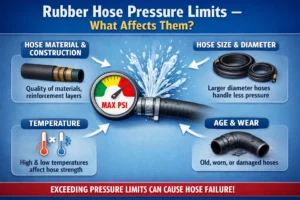
A hose’s pressure rating is not a static value. Several factors can influence its ability to contain pressure, and understanding these is key to maintaining rubber hose pressure limits and ensuring long-term safety.
- Hose Material: The type of rubber or polymer used for the inner tube and outer cover significantly impacts pressure capability. Materials like nitrile (NBR) or neoprene (CR) offer different resistances to pressure, temperature, and chemicals.
- Reinforcement Layers: This is the most critical component for pressure resistance. The number of reinforcement layers (e.g., textile braids, steel wire spirals) and the material used (e.g., polyester, high-tensile steel) directly determine the industrial hose pressure rating. More layers or stronger materials equal higher pressure capacity.
- Temperature: Both the ambient temperature and the temperature of the fluid being conveyed affect pressure rating. High temperatures can soften the rubber compound, reducing its strength and lowering its pressure capacity. Manufacturers often provide a temperature derating chart. For example, a hose rated for 1000 PSI at 20°C might only be rated for 500 PSI at 100°C.
- Ageing & Wear: Over time, rubber hoses degrade due to exposure to UV light, ozone, and simple mechanical stress. The material becomes less flexible and more brittle, compromising its ability to handle its original rated pressure. Regular inspection for cracks, softening, or hardening is essential.
- Chemical Compatibility: The fluid passing through the hose can react with the inner tube material. Aggressive chemicals can break down the polymer structure, weakening the hose and drastically reducing its pressure-holding capability. Always check a chemical compatibility chart before selecting a hose.
High Pressure Rubber Hose – When Is It Required?
A standard industrial hose may be suitable for water transfer or low-pressure air, but many applications demand a high pressure rubber hose. These hoses are engineered with enhanced reinforcement to handle extreme forces safely.
Applications requiring a high pressure rubber hose include:
- Hydraulic Systems: Powering machinery like excavators, presses, and injection molding machines.
- Pressure Washing: High-velocity water jetting for cleaning and surface preparation.
- Jackhammer and Pneumatic Tool Operation: Delivering compressed air at high pressures.
- Oil and Gas Exploration: Handling drilling muds, cement, and well control fluids.
- Water Blasting: Used for cutting concrete or cleaning industrial heat exchangers.
Common pressure ranges for these applications can vary widely, from 2000 PSI (approx. 138 bar) in some hydraulic systems to over 10,000 PSI (approx. 690 bar) for specialized water blasting equipment.
Using an under-rated hose in a high-pressure application is a recipe for disaster. The hose is likely to fail violently and immediately, creating a high-risk scenario. The force of a bursting high pressure rubber hose can turn it into a dangerous, whipping object, and the released fluid can cause severe injection injuries.
Industrial Hose Specifications Related to Pressure
When you examine an industrial hose, several specifications provide clues about its pressure capabilities. Learning to read them is a fundamental skill for any user.
- Inner Diameter (ID): The ID of a hose affects its pressure rating. For a hose of the same construction, a larger diameter will generally have a lower pressure rating. This is because the total force exerted on the hose wall (Pressure x Area) increases with a larger diameter, requiring a stronger construction to contain it.
- Reinforcement Type: This is a key indicator. Hoses may be reinforced with textile braids (for lower pressures), wire braids (for medium to high pressures), or spiral wire wraps (for very high pressures). The number of braids or spirals (e.g., two-wire braid vs. four-wire spiral) directly correlates with the industrial hose pressure rating.
- Hose Construction: The method of manufacturing—mandrel-built versus long-length extrusion—can also influence performance. Mandrel-built hoses often offer tighter tolerances and superior integrity for demanding applications.
- Markings on Hose (Layline): The hose itself is your best source of information. Manufacturers are required to print a continuous “layline” along the length of the hose. This text typically includes the manufacturer’s name, the hose type, its inner diameter, applicable standards, and, most importantly, the Maximum Allowable Working Pressure.
Pressure Rating Chart for Industrial Hoses
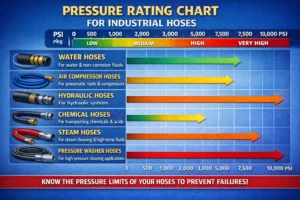
A pressure rating chart hose is an essential tool provided by manufacturers to help users select the correct product. While the format can vary, these charts generally organize information to make selection straightforward.
To read a pressure rating chart, you typically start by finding the hose type you need based on the application (e.g., oil suction, chemical transfer, air). The chart will then list various models or series. Within each series, you will find data organized by the hose’s inner diameter (ID). For each ID, the chart will specify the corresponding working pressure, burst pressure, and often other parameters like bend radius and weight.
For example, a chart for a generic hydraulic hose might look like this (in text):
Series X1 – One-Wire Braid Hydraulic Hose
| Part Number | ID (inch) | ID (mm) | Working Pressure (PSI) | Working Pressure (bar) | Burst Pressure (PSI) |
| X1-04 | 1/4 | 6.4 | 3250 | 225 | 13000 |
| X1-06 | 3/8 | 9.5 | 2750 | 190 | 11000 |
| X1-08 | 1/2 | 12.7 | 2500 | 172 | 10000 |
As you can see, as the inner diameter increases, the working pressure decreases. It is critical to remember that charts are manufacturer-specific. A 1/2″ one-wire braid hose from one brand may have a different pressure rating than a similar-looking hose from another. Always refer to the official pressure rating chart hose from the manufacturer of the exact product you are using.
Hose Safety Pressure – Best Practices in Industry
Ensuring hose safety pressure goes beyond just selecting the right rating. It involves a holistic approach to installation, operation, and maintenance.
- Maintain Pressure Margins: Never design a system where the operating pressure is exactly at the hose’s working pressure limit. A good rule of thumb is to select a hose with a pressure rating at least 25% higher than the system’s maximum operating pressure.
- Avoid Pressure Spikes (Surges): Rapidly opening or closing valves can create pressure surges (or “water hammer”) that far exceed the normal operating pressure. Where possible, install surge protectors or use slow-closing valves to protect the hose.
- Regular Inspection: Implement a routine inspection program. Look for leaks, kinks, blisters, abrasion on the cover, and signs of crushing. Any damaged hose should be immediately removed from service. Pay close attention to the coupling area, as this is a common point of failure.
- Proper Installation: Ensure the hose is not bent tighter than its minimum bend radius. Avoid twisting or kinking the hose during installation. Use proper hose supports and clamps to prevent abrasion and excessive strain on the fittings.
Industrial Hose Standards Governing Pressure Ratings
Industrial hose standards provide a framework for manufacturers to design, produce, and test hoses, ensuring a baseline level of quality and safety. Compliance with these standards is a mark of a reliable product.
Q: Which global standards are important for industrial hose pressure rating?
A: Key international standards include those from SAE (Society of Automotive Engineers), primarily for hydraulic hoses (e.g., SAE 100R series), ISO (International Organization for Standardization), and EN (European Norms). These documents specify dimensions, performance requirements, and testing procedures, including pressure ratings.
Q: How do ISO standards define hose pressure requirements?
A: ISO standards, such as the ISO 1436 for wire-braid hydraulic hoses, provide detailed requirements for construction, dimensions, and minimum performance levels under pressure. They define tests for proof pressure and burst pressure, ensuring hoses meet global safety benchmarks.
Q: Are there specific Indian manufacturing practices for hose pressure?
A: While global standards like EN and ISO are widely followed in India, the Bureau of Indian Standards (BIS) also provides relevant specifications (e.g., IS 444 for wire-braided hydraulic hoses). Reputable Indian manufacturers often align their products with both BIS and international standards to ensure competitiveness and safety.
Industrial Hose Testing Methods for Pressure Rating
A hose’s pressure rating is not just a theoretical number; it is verified through rigorous industrial hose testing procedures. These tests are performed by the manufacturer to validate the design and ensure consistent quality.
- Hydrostatic Pressure Testing: This is a non-destructive test where a hose assembly is filled with water or another liquid and pressurized to a certain level, known as the proof pressure. The hose is held at this pressure for a specified time to check for leaks or weaknesses.
- Burst Testing: This is a destructive test performed on a sample batch of hoses. The pressure inside the hose is steadily increased until it fails. This test determines the ultimate burst pressure and validates the design’s safety factor.
- Proof Pressure Testing: Typically conducted at twice the working pressure, this test is performed on many hose assemblies before they leave the factory. It serves as a final quality control check to ensure the integrity of the hose and the coupling installation.
- Factory Quality Control: Manufacturers implement ongoing quality control, testing random samples from production runs to ensure that every hose meets the specified industrial hose pressure rating. This commitment to testing is a key differentiator for high-quality suppliers.
Common Mistakes Related to Hose Pressure Rating
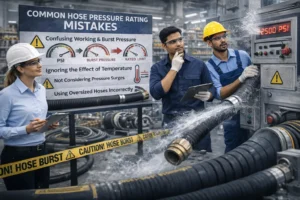
Even with the right information, mistakes can happen. Being aware of these common pitfalls can help prevent accidents.
- Confusing Working & Burst Pressure: As discussed, this is the most critical error. Always base your selection on the working pressure, not the burst pressure.
- Ignoring the Effect of Temperature: Using a hose at a temperature above its rated limit will derate its pressure capacity. Always check the manufacturer’s specifications for temperature derating factors.
- Not Considering Pressure Surges: Failing to account for system pressure spikes can cause a hose rated for the “average” pressure to fail prematurely.
- Using Oversized Hoses Incorrectly: Sometimes, an oversized hose is used to reduce flow velocity. However, remember that a larger ID typically means a lower pressure rating. You must ensure the larger hose still meets the system’s pressure requirements.
Final Checklist – Pressure Rating Safety Before Buying Hoses
Before you finalize any purchase or install a new hose, run through this simple safety checklist:
- ✔ Working Pressure Check: Is the hose’s working pressure greater than the system’s maximum operating pressure, including potential surges?
- ✔ Adequate Safety Factor: Does the hose offer a sufficient safety factor (e.g., 4:1) for the application?
- ✔ System Compatibility: Is the hose material compatible with the fluid’s chemical properties and operating temperature range?
- ✔ Certified Product: Is the hose manufactured and tested according to recognized industrial hose standards (e.g., ISO, SAE, EN)?
- ✔ Reliable Manufacturer: Are you sourcing the hose from a reputable manufacturer with a proven track record of quality and support?
Conclusion
The industrial hose pressure rating is more than just a technical specification; it is the foundation of a safe and reliable fluid power system. A thorough understanding of working pressure, safety factors, and the variables that affect a hose’s performance is non-negotiable for engineers, buyers, and plant managers. By prioritizing correct hose selection and implementing rigorous safety practices, you protect your people, your equipment, and your bottom line.
Ultimately, investing time in understanding and verifying the industrial hose pressure rating reduces long-term operational costs and mitigates catastrophic risks. Never compromise on pressure safety; your facility’s integrity depends on it.
Also, Read: Rubber Hose for Cement Industry: Complete Guide to Heavy-Duty Material Handling
FAQs – Industrial Hose Pressure Rating
Is a higher pressure hose always safer?
Not necessarily. While a higher pressure rating provides a greater safety margin, these hoses are often heavier, less flexible, and more expensive. The safest hose is the one that is correctly matched to the application's pressure, temperature, and media requirements. Over-specifying can be wasteful and impractical.
How often should pressure-tested hoses be replaced?
There is no fixed schedule. Replacement frequency depends on the application, usage hours, operating conditions (pressure cycles, temperature), and inspection results. Hoses in critical or high-stress applications should be replaced proactively based on manufacturer recommendations and inspection findings.
Can old hoses handle their original pressure rating?
No, it is unsafe to assume an old hose can still perform to its original rating. Material degradation from age, UV exposure, and wear reduces its strength. An old hose, even if it looks fine, has a lower effective pressure capacity and should be used with caution or replaced.
Are PSI and bar ratings interchangeable?
No, they are not interchangeable without conversion. 1 bar is approximately 14.5 PSI. Using the values interchangeably (e.g., treating 100 bar as 100 PSI) is a dangerous error that will result in selecting a grossly under-rated hose for the application.
How does bend radius affect pressure?
Bending a hose tighter than its specified minimum bend radius can cause kinking, which physically damages the reinforcement layers. This damage creates a weak point in the hose, severely compromising its ability to handle its rated pressure and leading to premature failure.
Does the coupling affect the assembly's pressure rating?
Yes, absolutely. A hose assembly is only as strong as its weakest link. The pressure rating of the final assembly is determined by the lower of the hose's rating or the coupling's rating. Using an improperly rated or incorrectly installed coupling can cause failure even if the hose itself is correct.
Why is the 4:1 safety factor common?
The 4:1 safety factor provides a robust buffer to account for variables that are difficult to control in the real world. This includes minor, unforeseen pressure surges, slight degradation of the hose material over time, and small imperfections that might occur during manufacturing.