
In any industrial environment—whether it is a heavy manufacturing unit in India, a construction site in the Middle East, or a chemical processing plant in Europe—industrial hoses play a critical yet often overlooked role. They act as the backbone of material transfer systems, safely carrying water, air, chemicals, oils, fuels, and abrasive materials from one point to another. Choosing the right hose material is not just a purchasing decision; it is an engineering, safety, and cost-efficiency decision. Among all available materials, the most common and important debate in industrial procurement is rubber hose vs PVC hose.
Both rubber and PVC hoses are widely used, but their performance characteristics, durability, pressure-handling capability, and suitability for industrial environments are very different. Selecting the wrong hose can result in frequent failures, downtime, leakage, safety risks, and increased operational costs.
This comprehensive guide provides a detailed industrial hose comparison to help engineers, plant managers, maintenance teams, and procurement professionals determine the best hose for industrial use based on real-world operating conditions.
Why the Rubber Hose vs PVC Hose Comparison Is Important
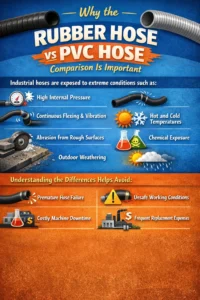
Industrial hoses are exposed to extreme conditions such as:
- High internal pressure
- Continuous flexing and vibration
- Hot and cold temperatures
- Abrasion from rough surfaces
- Chemical exposure
- Outdoor weathering
The rubber hose vs PVC hose debate exists because both materials serve different industrial purposes. Understanding their strengths and limitations helps avoid:
- Premature hose failure
- Unsafe working conditions
- Costly machine downtime
- Frequent replacement expenses
Material Fundamentals: Rubber Hose vs PVC Hose
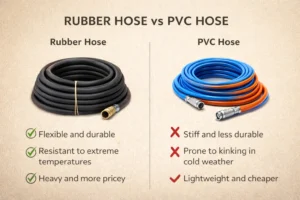
What Is a Rubber Hose?
Rubber hoses are manufactured using natural or synthetic rubber compounds, depending on the application. Common types include:
- EPDM Rubber – Excellent for hot water, steam, acids, alkalis, and outdoor exposure
- Nitrile Rubber (NBR) – Best for oil, fuel, grease, and petroleum-based fluids
- SBR Rubber – Used for general-purpose industrial applications
Rubber is a thermoset material, meaning once it is vulcanized, it cannot be reshaped. This process creates strong molecular bonds that give rubber hoses their:
- High elasticity
- Excellent pressure resistance
- Long service life
These properties are the foundation of rubber hose durability, making them ideal for demanding industrial environments.
What Is a PVC Hose?
PVC (Polyvinyl Chloride) is a thermoplastic polymer. PVC hoses are produced by extrusion and are often combined with:
- Plasticizers for flexibility
- Polyester or nylon reinforcement for pressure strength
- PVC or steel helix for suction applications
PVC hoses are:
- Lightweight
- Easy to handle
- Cost-effective
This makes PVC hose industrial use suitable for light to medium-duty applications where extreme performance is not required.
In-Depth Industrial Hose Comparison: Rubber Hose vs PVC Hose
1. Temperature Resistance
Winner: Rubber Hose
Temperature tolerance is one of the most important factors in the rubber hose vs PVC hose comparison.
Rubber Hose Advantages
- Operating range: -40°C to 120°C or higher
- Maintains flexibility in cold environments
- Suitable for hot water and steam applications
PVC Hose Disadvantages
- Operating range: -10°C to 60°C
- Becomes brittle in cold temperatures
- Softens and weakens at high temperatures
For temperature-sensitive industrial environments, rubber is the clear winner.
Also, Read: Industrial Rubber Hose Selection: How to Choose the Right Rubber Hose for Your Industry
2. Pressure Handling Capability
Winner: Rubber Hose
When it comes to pressure, there is no real competition.
Rubber Hose for High Pressure
- Designed with multi-layer textile or steel wire reinforcement
- Capable of handling very high PSI
- Used extensively in hydraulic and pneumatic systems
PVC Hose Industrial Use
- Limited to low or medium pressure
- Reinforced PVC improves strength but has limitations
- Not suitable for hydraulic applications
If pressure is critical, rubber hoses are the best hose for industrial use.
3. Flexibility and Kink Resistance
Winner: Rubber Hose
Flexible Industrial Hoses are essential in dynamic environments where hoses bend, move, and vibrate continuously.
Rubber Hoses
- Highly flexible
- Excellent bend radius
- Minimal risk of kinking
- No coil memory
PVC Hoses
- Stiffer construction
- Prone to kinks
- Retains coiled shape (memory effect)
This flexibility advantage further strengthens rubber hose advantages in industrial settings.
4. Abrasion and Wear Resistance
Winner: Rubber Hose
Industrial hoses often face rough handling, dragging, and contact with abrasive surfaces.
Rubber Hose Durability
- Excellent resistance to abrasion
- Tough outer cover
- Long service life in harsh environments
PVC Hose Disadvantages
- Surface wears out faster
- More vulnerable to cuts and punctures
- Shorter lifespan in heavy-duty use
Chemical Compatibility
Winner: Application-Specific
This is one area where industrial hose comparison must be done carefully.
Rubber Hoses
- NBR → oils, fuels, lubricants
- EPDM → acids, alkalis, steam
- Incorrect selection can cause swelling or degradation
PVC Hoses
- Good resistance to some acids and salts
- Poor resistance to oils, fuels, and solvents
- Plasticizers may leach out over time
Always verify chemical compatibility before selection.
6. Weight and Ease of Handling
Winner: PVC Hose
PVC hose industrial use has a clear advantage when portability matters.
Rubber Hoses
- Heavy and bulky
- Can cause operator fatigue
PVC Hoses
- Lightweight
- Easy to move and install
- Ideal for portable and temporary applications
7. Cost vs Long-Term Value (Add-On Insight)
Initial Cost
- PVC hoses are more affordable
- Rubber hoses cost more upfront
Lifetime Cost
- Rubber hoses last longer
- Lower replacement frequency
- Reduced downtime
In long-term industrial operations, rubber hoses often provide better overall value.
Rubber Hose vs PVC Hose Comparison Table
| Feature | Rubber Hose | PVC Hose |
|---|---|---|
| Temperature Resistance | Excellent | Limited |
| Pressure Capacity | Very High | Low–Medium |
| Flexibility | High | Moderate |
| Abrasion Resistance | Excellent | Low |
| Chemical Resistance | Compound-based | Limited |
| Weight | Heavy | Lightweight |
| Initial Cost | Higher | Lower |
| Lifespan | Long | Short–Medium |
Also, Read: The Ultimate Guide to Rubber Hose Pipe: Types, Uses, and Benefits
Industrial Applications: Choosing the Right Hose
When to Choose a Rubber Hose
Rubber hoses are the preferred choice for:
- Hydraulic systems
- Pneumatic tools
- Oil and fuel transfer
- Hot water and steam lines
- Abrasive material transfer
- Heavy manufacturing plants
- Mining and construction industries
These applications demand rubber hose durability and pressure strength.
When to Choose a PVC Hose
PVC hoses are suitable for:
- Low-pressure water transfer
- Agriculture irrigation
- Light chemical transfer
- Ducting and ventilation
- Food-grade liquid transfer
- Temporary installations
This is where PVC hose industrial use makes economic sense.
Common Industrial Hose Types
Understanding industrial hose types helps in better selection:
- Reinforced Hoses – For pressure handling
- Suction & Discharge Hoses – With rigid helix to prevent collapse
- Lay-Flat Hoses – Easy storage, mostly PVC
- Braided Hoses – Balance of flexibility and strength
Both rubber and PVC hoses are available in these configurations.
Safety & Compliance Considerations
- Always check working pressure and burst pressure
- Match hose material with fluid type
- Inspect hoses regularly for cracks or bulges
- Follow ISO, IS, FDA, or industry-specific standards
Incorrect hose selection can lead to serious safety hazards.
How to Choose the Best Hose for Industrial Use (Buyer Checklist)
Ask these questions before finalizing:
- What fluid will flow through the hose?
- Operating pressure range?
- Temperature conditions?
- Indoor or outdoor use?
- Continuous or intermittent operation?
- Budget vs durability expectations?
This checklist simplifies the rubber hose vs PVC hose decision.
Final Verdict: Rubber Hose vs PVC Hose
There is no universal winner in the PVC hose vs rubber hose debate.
- Choose Rubber Hose when pressure, temperature, durability, and safety are priorities.
- Choose PVC Hose when the application is light-duty, low-pressure, and cost-sensitive.
The right choice ensures:
- Safer operations
- Longer service life
- Lower maintenance costs
- Higher operational efficiency
Also, Read: 4 Types of PVC Hose Pipe That Makes Work Easier and Faster
FAQs: Rubber Hose vs PVC Hose
Which is better for industrial use: rubber hose or PVC hose?
For heavy-duty industrial use, a rubber hose is better due to its high pressure capacity, superior durability, and resistance to heat and abrasion. PVC hose industrial use is limited to low-pressure and less demanding environments.
What are the key advantages of rubber hoses?
Rubber hose advantages include high pressure resistance, excellent flexibility, strong abrasion resistance, long service life, and reliable performance in extreme temperatures, making them ideal for industrial applications.
What are the disadvantages of PVC hoses in industrial applications?
PVC hose disadvantages include limited pressure handling, poor performance at high temperatures, brittleness in cold conditions, and shorter lifespan when used in harsh or heavy-duty industrial environments.
Are rubber hoses suitable for high-pressure applications?
Yes, rubber hose for high pressure applications is the industry standard. Reinforced rubber hoses are widely used in hydraulic and pneumatic systems because they can safely handle very high operating pressures.
Where is PVC hose commonly used in industrial settings?
PVC hose industrial use is common in low-pressure water transfer, irrigation systems, ventilation, light chemical transfer, and temporary installations where flexibility and low weight are more important than durability.
Which hose lasts longer: rubber or PVC?
Rubber hoses generally last longer than PVC hoses because of better abrasion resistance, flexibility, and resistance to environmental stress, resulting in higher rubber hose durability.
Which hose is better for chemical transfer, rubber or PVC?
The best hose for chemical transfer depends on the chemical. Nitrile rubber hoses are ideal for oils and fuels, while PVC hoses may be suitable for certain acids and salts at low pressure. Chemical compatibility must always be checked.
Which material is best for flexible industrial hoses?
Rubber is the preferred material for flexible industrial hoses because it resists kinking, maintains flexibility under movement, and performs well in dynamic industrial environments.
How do I choose the best hose for industrial use?
To choose the best hose for industrial use, evaluate the fluid type, operating pressure, temperature range, environment, and durability requirements. Rubber hoses are best for demanding applications, while PVC hoses are suitable for light-duty, cost-sensitive use.